Lauda
The InvincibleLauda, the Invincible’s Chief Paleobiologist, is the expedition’s most consequential interpreter of Regis III. He does more than classify the planet’s fossils or dispute an implausible biological theory: he reconstructs a six-billion-year planetary history in which life on land disappears, self-organizing machines inherit the continental environment, and mechanical adaptation becomes an evolutionary process independent of its creators. Lauda’s Hypothesis gives the expedition a coherent account of the black mechanical cloud, the metallic formations mistaken for cities, the planet’s deserts, and the limits of human intelligence when confronted with a system that is not a mind yet can still destroy minds and living bodies.
Identity and Scientific Position
Lauda is introduced as the ship’s Chief Paleobiologist, a senior specialist whose authority rests on evolutionary reasoning rather than on military command. When the crew debates the alleged “flies,” he rejects the idea that insects could exist without the ecological community that would have produced them: ground plants, other invertebrates, and the rest of a functioning biotope. Regis III has none of the associated arthropod life that such a hypothesis requires. His certainty is severe enough to provoke Ballmin, whose challenge Lauda answers with the dry confidence of a professor judging a failed examination.
That exchange establishes Lauda’s method. He does not treat an isolated appearance as proof of a familiar category; he tests the category against the entire habitat. His biology is therefore ecological and historical at once. The absence of land life, the oxygen in the atmosphere, the ancient fossils, and the metallic residues must be explained together, not as disconnected curiosities. The same insistence on total environmental context later enables him to recognize that the apparent “insects” are not animals at all.
Lauda’s physical presence reinforces the impression of an experienced field investigator rather than a remote academic. He is no younger than Horpach, has been unusually permitted to fly despite his age, and looks more like a seasoned mechanic than a scientist. The detail links his scientific imagination to practical knowledge of machines: he can think about automatons as systems with energy requirements, replacement parts, reproduction, and adaptive failure, rather than merely as manufactured tools.
Formation of Lauda’s Hypothesis
Lauda’s argument begins with the geological record. Regis III contains sedimentary layers interspersed with ruddy-black material of non-geological origin, apparently formed from metallic fragments deposited millions of years ago and altered through oxidation and chemical reaction. Drilling reveals organic carbon, fossils of dry-land plants, and evidence that primitive reptiles once inhabited the planet. Land evolution occurred more than once, but its traces diminish in later strata while metallic deposits increase. The disappearance of continental life coincides with the emergence of metal layers, yet the measured radiation—equivalent to only twenty or thirty megatonnes spread across hundreds of millennia—was insufficient to exterminate biological evolution.
For Lauda, this coincidence points away from a simple nuclear catastrophe. He proposes that, before the explosion of Zeta Lyrae, an inhabited sixth planet of that system sent a technologically advanced scout ship to Regis III. The vessel may have crashed or suffered a reactor accident, killing its crew while leaving its automatons intact. Those machines were not humanoid and may not have resembled the Lyrans themselves. Once deprived of supervision, they continued to perform inherited functions, including repair, even when repair no longer served any living master.
The descendants of these systems then entered a form of selection. Local predators may have attacked them, forcing adaptation; the automatons could manufacture new automatons according to changing needs, so mechanisms suited to flight, defense, mining, or other tasks could proliferate. Over hundreds of generations they ceased to resemble the original Lyran devices. Lauda identifies this transformation as inanimate evolution: mechanical systems altered by survival pressures until the products of an intelligent civilization became something effectively belonging to the natural history of Regis III.
Energy scarcity supplies the decisive pressure in his reconstruction. The most advanced machines may initially have depended on radioactive reserves, but Regis III contains no usable radioactive elements. Simpler repair devices, perhaps powered by solar batteries, could therefore gain an advantage over larger and more sophisticated systems. The result would not be a victory for intelligence in the human sense. Smaller, more economical, and better adapted mechanisms could outlast more powerful but energy-hungry competitors. Lauda’s model thus separates intelligence from evolutionary success: a system can be clever yet poorly fitted to its environment, while a simpler one can prevail through efficiency.
The Cloud and the Metallic Vegetation
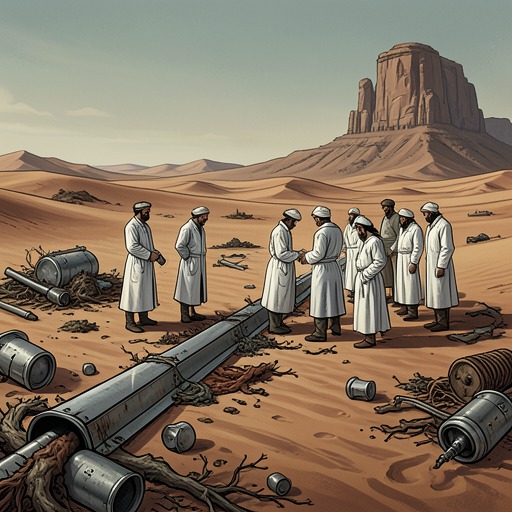
Lauda interprets the black clouds as the mobile branch of this mechanical evolution. He imagines their smallest units as tiny pseudo-insects capable of joining together into larger superordinate systems for mutual advantage. The sedentary branch produced the metallic vegetation found among the ruins that the expedition has called cities. In his account, those ruins are not cities in the human sense but immense agglomerations of stationary mechanisms that reproduce and absorb solar energy through specialized organs, perhaps represented by the small triangular plates discovered by the scientists.
Later examination of a captured black crystal gives his hypothesis a striking mechanical basis. Each crystal contains a microcrystalline structure that can generate electrical and magnetic fields, heat part of the mechanism, and produce directed recoil sufficient to raise and move the individual unit. A solitary crystal cannot control its flight precisely, but an aggregate becomes increasingly capable as more crystals connect. Each unit can link with three others, attach an arm to another unit’s central node, or remain magnetically coupled without direct contact.
Collective organization changes the nature of the object. Once enough crystals assemble, the formation can alter its direction, shape, structure, and internal impulse patterns in response to external stimuli. When the polarity changes, the aggregate separates into individual crystals and scatters. A second network within each crystal appears to be only a fragment of a larger system, while the enormous whole formed by many units acts as the cloud’s actual motor. The scientists cannot determine whether this higher-level structure possesses intelligence, but its potentially expandable organization resembles a brain whose size increases with the magnitude of the problem it confronts. The cloud is therefore neither a single organism nor a conventional machine; it is a scalable, detachable collective whose behavior emerges from connection and dispersal.
This structure explains why conventional military success remains elusive. The cloud can scatter when struck, regenerate from surviving portions, multiply, and move between continents. It is not protected by a single command center or dependent on a vulnerable body. Its apparent strategic behavior may be the accumulated result of inherited adaptation rather than deliberate planning. Lauda therefore treats its ability to block communications, isolate Regnar’s expedition, and attack reconnaissance planes as a recurrent mechanical function: the higher automatons of its evolutionary past may have communicated by radio, and disrupting such communication would have become one of the cloud’s oldest adaptive operations.
Conflict with Human Strategy
Lauda’s scientific account immediately becomes a strategic argument. The mechanisms are inferior to humans in abstract intelligence, he maintains, but nearly perfect in their fitness for Regis III’s conditions and in their ability to destroy anything intelligent or alive. What is harmless to an inanimate system can be lethal to biological beings. The expedition, by contrast, must remain under a force field, depends on machines for movement and survival, and cannot protect every resource at once. The cloud has freedom of maneuver, apparently inexhaustible material resources, and the capacity to disperse whenever concentrated force threatens it.
For that reason Lauda rejects the idea of total annihilation. Even an antimatter strike cannot eliminate a distributed planetary system, and destroying one continent would merely drive the remaining formations elsewhere. More importantly, he argues that the expedition has no moral basis for revenge. If the cloud is the product of inanimate, unthinking evolution, punishing it for the destruction of the Condor would be like attacking the ocean for sinking a ship. The comparison displaces the language of enemy, crime, and retribution with the language of natural process and ecological hazard.
Lauda’s recommendation is consequently withdrawal. The Invincible should leave Regis III rather than continue escalating a war against a force that cannot be persuaded, intimidated, or morally condemned. Horpach accepts the possibility of the hypothesis but refuses to return with conjecture alone. He wants certainty and a sample of the flying mechanical fauna before abandoning the investigation. The disagreement exposes the practical cost of Lauda’s insight: recognizing a nonhuman system as a force of nature does not automatically release a military expedition from its demand for proof.
Intellectual and Thematic Significance
Lauda’s theory overturns the expedition’s first assumptions. Rohan briefly suggests that intelligent aquatic beings may have built an underwater civilization, but Lauda’s model explains both the survival of oceanic life and the absence of life on land without inventing a hidden civilization. Oceanic algae can account for the planet’s oxygen, while mechanical evolution remains confined to the continents and prevents biological forms from returning to them. Regis III is not an empty world awaiting human occupation; it is a divided planetary system with its own long equilibrium.
His interpretation also attacks galactocentrism, the habit of judging existence by its resemblance to humanity. Rohan later reaches a parallel conclusion, understanding that human beings have no right to interfere merely because they encounter something alien and powerful. Lauda supplies the conceptual groundwork for that realization: the machines are not lesser animals waiting to be classified as enemies, nor rational opponents whose motives can be decoded, but a nonproteinaceous survival system that has occupied its environment for millions of years.
Lauda’s importance lies in the tension within his own position. He is the character most willing to deny human centrality, yet his explanation is produced through the expedition’s most advanced scientific practices: mapping, drilling, fossil analysis, paleobiology, cybernetics, and the laboratory study of captured crystals. Human knowledge makes the planetary other intelligible, but that intelligibility does not grant permission to dominate it. Lauda’s Hypothesis therefore turns science from a weapon of possession into an argument for restraint, while leaving the expedition confronted by the unsettling fact that adaptation, organization, and lethal effectiveness do not require consciousness.