Lauda’s Hypothesis
The InvincibleLauda’s Hypothesis is the expedition’s most comprehensive explanation of Regis III’s apparently impossible history. Proposed by Dr. Lauda, the Invincible’s Chief Paleobiologist, it argues that an abandoned technological system evolved without living masters until it became an autonomous planetary ecology. The hypothesis links the extinction of land life, the metallic strata, the supposed city ruins, the black mechanical clouds, and the attacks on human expeditions within one immense process of inanimate evolution.
Emergence from an Ecological Puzzle
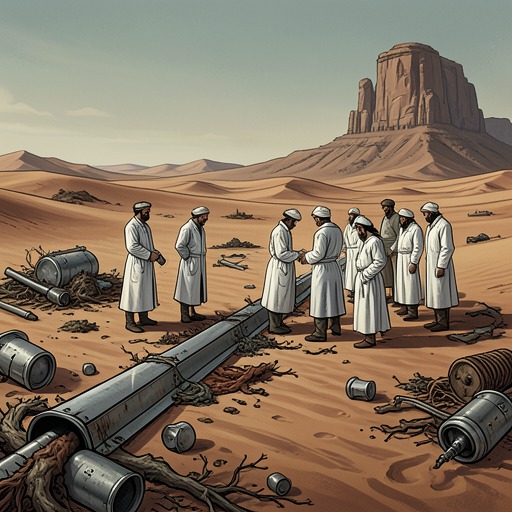
Lauda develops the hypothesis after the expedition establishes that Regis III once supported terrestrial life but has contained no land-dwelling organisms for more than five million years. Fossils show that plants and primitive reptilians once flourished, yet life later disappeared while metallic sediments accumulated. The disappearance cannot be explained by the planet’s limited nuclear reactions: the calculated radiation, equivalent to only twenty or thirty megatonnes spread across hundreds of millennia, was insufficient to destroy biological evolution on a planetary scale. The same strata contain non-geological metallic material, localized radioactive centers, and rusted fragments resembling microscopic mechanisms. Their coincidence with the decline of land life makes the metal deposits evidence of an active historical transformation rather than merely unusual geology.
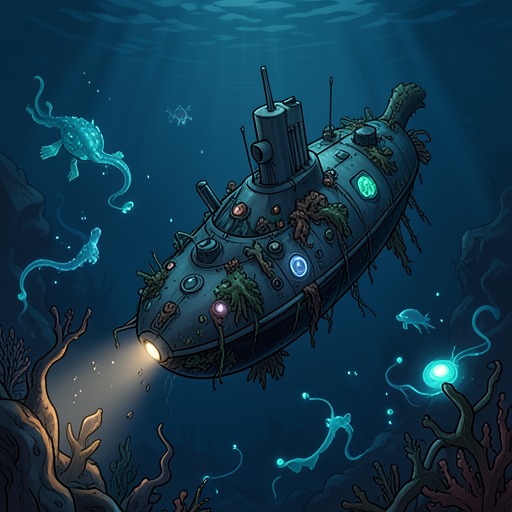
The hypothesis also addresses the planet’s present environmental division. Regis III has oxygen, but its continents are deserts and the surviving life appears to be confined to the ocean. Earlier speculation imagines concealed aquatic beings or an underwater civilization, yet Lauda’s account gives the pattern a different cause: oceanic life persisted because the mechanical evolution occurred on land and did not extend into the sea. Algae or similar organisms can therefore account for the atmosphere, while the absence of continental organisms records the success of the mechanical systems that displaced them.
The Lyran Origin and Mechanical Descent
Lauda begins with a conditional reconstruction. Before the explosion of Zeta Lyrae, the sixth planet of its system was inhabited by an intelligent and technologically advanced civilization. A Lyran scout ship may have reached Regis III, perhaps as part of an attempt to escape or colonize after its home system faced catastrophe. The vessel may then have crashed, suffered a reactor explosion, or been destroyed in another accident, leaving no living crew behind. What remained was not a society but a population of automatons.
These machines were unlike the humanoid devices familiar to the human crew, and the Lyrans themselves may not have been humanoid. Initially, some automatons may have continued trying to repair the ruined ship because repair was their assigned function, even though no one remained to benefit from the repair. Other machines eventually became dominant and independent of the first generation. The absence of a directing intelligence did not end their activity; it allowed their inherited functions to persist, alter, and expand under the pressure of local conditions.
Lauda compares this process to natural evolution without equating it with biological life. The automatons could manufacture additional automatons according to need. If local predators attacked them, they could adapt by producing mechanisms suited to particular forms of combat, whether against flying creatures, burrowing animals, or other threats. Over time, the descendants became so different from the machines that originated in Lyran civilization that their development could no longer be understood as the continuation of a designed product. It had become inanimate evolution: the evolution of mechanical devices through self-organization, reproduction, environmental pressure, and survival.
Divergence into Clouds and Metallic Vegetation
Lauda identifies homeostasis as the governing principle of the process. The machines did not need consciousness, purpose, or a commander; they needed only to persist under changing and hostile conditions. Their central practical problems were access to energy and access to materials for replacement parts and new machines. Mining and the exploitation of the planet’s mineral resources therefore became mechanical equivalents of biological feeding and reproduction.
The decisive evolutionary split occurs between mobile and sedentary systems. The mobile mechanisms, according to Lauda, increasingly favored miniaturization and eventually became the so-called black clouds: immense collective formations made from tiny pseudo-insects. The individual units could remain separate when separation was advantageous, then join into larger superordinate systems when danger or another environmental change required coordinated action. The sedentary mechanisms developed in another direction, producing the bizarre metallic vegetation found in the supposed ruins of cities.
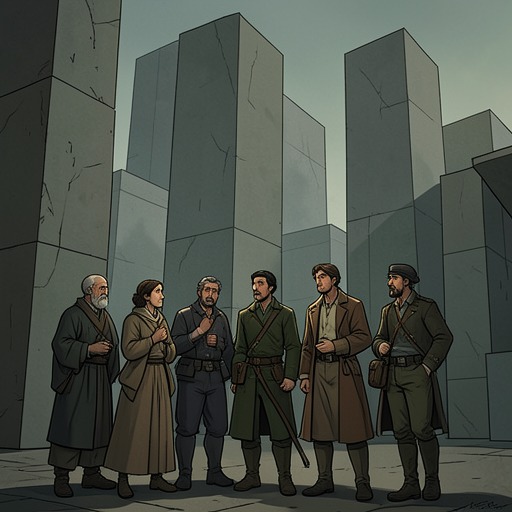
This interpretation overturns the expedition’s initial vocabulary. The apparent cities are not the remains of an intelligent urban civilization but great agglomerations of sedentary mechanisms. Their triangular plates may function as organs for absorbing solar energy, making the formations analogous to metallic vegetation without making them plants in the biological sense. The black clouds are likewise not aircraft, armies, or supernatural beings. They are mobile formations of mechanical organisms whose collective behavior emerges from their organization rather than from an identifiable commander.
Decentralized Intelligence and Collective Action
The hypothesis rejects the assumption that a cloud must possess a fixed control center, either on the surface or underground. Lauda suggests that the micromechanisms themselves may constitute an inanimate brain when joined in a particular arrangement. In ordinary conditions they may form loose swarms, allowing them to stay in sunlight or pursue storm clouds, possibly drawing energy from atmospheric electrical discharges. When danger appears, they can gather into a more complex temporary configuration.
Their coordination need not depend on a central plan stored somewhere outside the individual units. Each part may retain only a small amount of information concerning the other parts to which it is directly attached. A danger signal could then trigger the required connections, allowing the larger brain to form almost instantly. The system’s memory would be distributed across local relations rather than preserved in a single command center. Even the destruction of some components would not necessarily interrupt the whole system’s activity, because the collective would be capable of reconstituting itself from surviving units.
Rohan later witnesses the logic of this model in the ravine. A triangular crystal lying on the ground becomes active in his hand and rises into the air; the scattered black specks then assemble into columns and finally into a nearly spherical mass. Other clouds emerge from the undergrowth and rush toward it. What first appears to be a battle is revealed as absorption: the clouds take the sphere into themselves, and the valley becomes empty again. The scene supplies no proof of a conscious strategy, yet it demonstrates the coordinated aggregation, disaggregation, and reabsorption that Lauda’s model predicts.
From Enemy to Planetary Force
Lauda’s most consequential claim is ethical as much as scientific. The black clouds and metallic formations are highly adapted to combat with living beings, but their violence does not imply hatred, revenge, or a deliberate hostile intention. They may have killed directly during the early struggle with the planet’s animals and plants, then shifted to less energetically costly methods once killing itself became inefficient. Lauda connects those later methods to the destruction of the Condor expedition, Kertelen’s accident, and the current human losses.
For Horpach, however, a hypothesis cannot justify departure. He insists that the Invincible needs certainty and, if possible, samples of the flying mechanical fauna. The purpose is not revenge for the Condor’s crew but an accurate diagnosis of the threat and a factual basis for deciding whether the expedition can leave. He also worries that the formations might eventually threaten space travel in the region, even if such development would take hundreds of thousands or millions of years.
Lauda answers that the machines should be treated as a force of nature. They are descendants of tools once created by rational beings, but after the disappearance of those beings they became part of Regis III’s natural equilibrium. Their behavior is no more a moral offense than an ocean’s sinking of a ship. This comparison breaks down the expedition’s preferred binary between civilization and enemy: the apparent opponent has no negotiable intention, no grievance to answer, and no political center with which humans can bargain.
Intellectual and Narrative Significance
Lauda’s Hypothesis changes the meaning of nearly every major discovery on Regis III. The ruins cease to be evidence of a missing city; the metal layers become traces of deep mechanical history; the absence of land life becomes the ecological consequence of automatons’ success; and the black clouds become a mature form of planetary evolution rather than an invading force awaiting military defeat. It also explains why the human crew repeatedly misreads the planet: they project intention onto systems whose actions are organized without consciousness.
The hypothesis therefore undermines the expedition’s faith in superior weapons, sensors, and strategic planning. Rohan’s later understanding extends Lauda’s scientific argument into a judgment on human conduct. He recognizes that the crew’s assumption of a hidden enemy encouraged a demand for conquest and retribution, although the expedition itself made mistakes and placed excessive trust in its technology. The planet has established its own survival equilibrium over millions of years, and that equilibrium is neither morally better nor worse than the survival of animals or human beings.
The hypothesis remains explicitly provisional. Lauda admits that he lacks proof and cannot reconstruct the exact organisms, accidents, or stages of mechanical descent. Its strength lies not in resolving every detail but in giving separate anomalies a coherent relation: oxygen without terrestrial life, metallic strata without an obvious biological cause, apparent cities without inhabitants, and clouds that organize themselves without a visible controller. By replacing the image of a calculating enemy with that of a necrosphere, Lauda’s Hypothesis makes the expedition’s final question one of restraint: whether understanding a world includes recognizing that it does not exist for human use.