Lyran beings
The InvincibleLyran beings are the extinct intelligent inhabitants associated with the Zeta Lyrae system, whose possible arrival on Regis III becomes one of the expedition’s most consequential hypotheses. They are not encountered directly; instead, they survive in scientific monographs, half-remembered stories, geological traces, and competing explanations of the planet’s ruins and mechanical life. Their absence is therefore central to their narrative function: the vanished civilization provides the missing historical scale through which the crew tries to understand a world whose most dangerous inhabitants may no longer serve any living creator.
Identity and Historical Record
Lyran beings are presented as a real, technologically advanced civilization rather than a purely legendary people. Gralev introduces the subject cautiously as something he has heard in a story resembling a fable, but Rohan immediately rejects the idea that the Lyrans were fictional and refers to Akhramian’s monograph about them. Ballmin adds that Payne believed some Lyran beings might have survived, although he considers that unlikely because the entire civilization apparently perished during the nova that destroyed its home system.
The available record is radically incomplete. Akhramian reportedly thought the Lyran beings were humanoid, but this remains only a hypothesis, and Ballmin emphasizes that even less physical evidence survived of them than of Australopithecus. The destruction of their home world explains this extreme uncertainty: their planet was immersed in the chromosphere of a nova for thousands of years, its surface temperature sometimes exceeding ten thousand degrees. The oceans disappeared, the globe burned, and even the planet’s bedrock underwent complete metamorphosis. Any attempt to reconstruct Lyran bodies, culture, or motives must therefore proceed through inference rather than recovered testimony.
The Nova and the Flight from Extinction
Before the explosion of Zeta Lyrae, the Lyran beings possessed a highly developed technological civilization. According to the account repeated by Gralev, they recognized the danger facing their system and sent spacecraft toward the planets of neighboring stars in an effort to save themselves. They were already capable of sublight travel, making a journey of sixteen light-years—the approximate distance between their system and Regis III—conceivable within the story’s scientific framework.
This possibility transforms Regis III from an isolated alien planet into a potential refuge or failed colony. The crew asks whether one of the Lyran ships could have landed there and whether descendants of its passengers might still exist. Yet the questions immediately encounter the evidence of absence. No surviving Lyran society is found, and the ruins do not yield a clear population, language, or humanoid remains. The hypothesis remains suspended between rescue attempt and final extinction: the Lyran beings may have reached Regis III, but nothing proves that living Lyran beings ever established themselves there.
The Proposed Origin of the Automatons
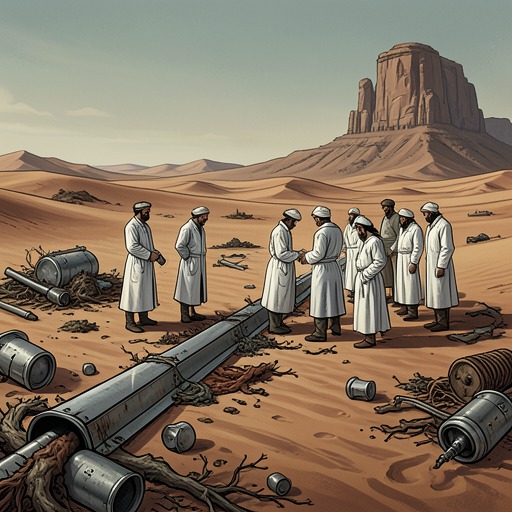
The most developed explanation of the Lyran connection comes from the biologist. He begins with the contrast between Regis III’s environments: life exists in the ocean, while life on land disappeared more than five million years ago. He proposes that a Lyran scout ship may have landed on Regis III after a crash or another accident, perhaps involving a reactor explosion or chain reaction. The crew would have died, leaving only the ship’s automatons active on the planet.
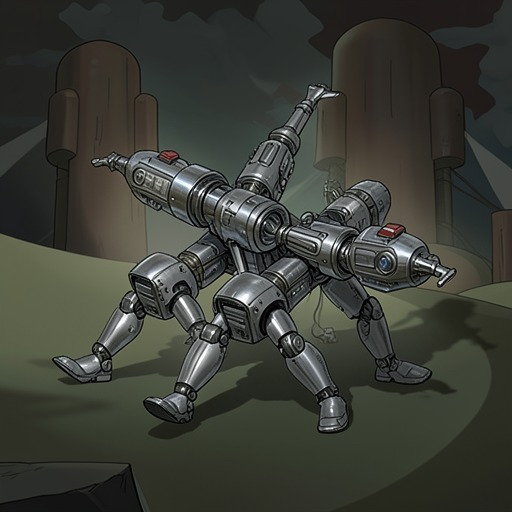
These machines would not have resembled the expedition’s humanoid automatons, and the Lyran beings themselves may not have been humanoid either. The surviving mechanisms are described as highly specialized homeostatic systems able to endure the planet’s harsh conditions. At first, some of the more intelligent machines may have attempted to repair their abandoned ship, continuing their assigned function even after that function had ceased to serve any living master. Later generations or varieties of automatons became independent of the original ones and adapted to the local environment.
The decisive feature of this proposed machine ecology is reproduction through manufacture. The automatons could construct other automatons suited to particular problems. If they needed flying mechanisms to fight aerial reptiles, they could produce them; if they faced burrowing predators, they could develop forms adapted to subterranean conflict. Over millions of years, the mechanisms on land would have become increasingly fitted to Regis III, eventually defeating every form of animal life and then plant life as well. The Lyran beings would thus be the remote originators of a process whose later stages no longer express Lyran intention, culture, or command.
Regis III as a Deep-Time Trace
Several discoveries make the Lyran hypothesis more than a free-floating tale, although none proves it. Geological investigations reveal ruddy-black metallic layers of non-geological origin, apparently formed from vast quantities of metal fragments deposited millions of years ago. The fragments may have come from a gigantic nickel-iron meteor that exploded in Regis III’s atmosphere, but other explanations connect the metallic strata with the catastrophe in the Lyran system and with attempts to colonize Regis III.
The planet’s strata also record repeated disruptions of life. Land life appears to have flourished, vanished abruptly around a hundred million years ago, and later returned in new forms. Much more recently, between eight and six million years ago, shallow metallic layers contain localized centers of radioactivity and unusual concentrations of antimonite, molybdenum oxide, ferrous oxides, and salts of nickel, cobalt, and titanium. The disappearance of land organisms coincides with the appearance of these metal strata, although the measured radiation—equivalent to only twenty or thirty megatonnes of nuclear detonations spread over hundreds of thousands of years—could not itself have destroyed biological evolution on the required scale.
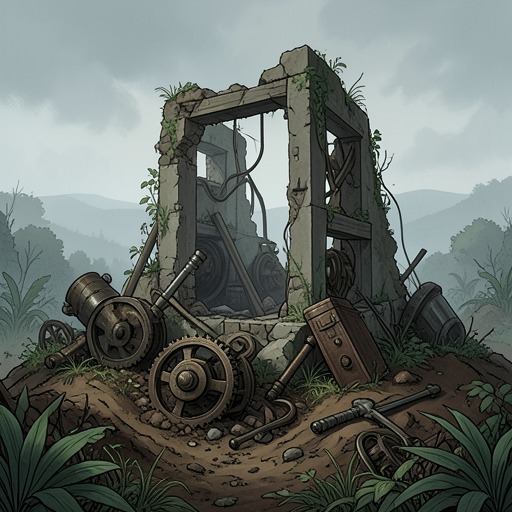
The same metallic material appears in remote regions, weakening the explanation that a single impact produced all of it. Test drilling eventually finds rusted, strangely shaped remains resembling broken microscopic mechanisms in an iron-oxide seam about seventy feet below the surface. The discovery does not identify the Lyran beings, but it offers a material link between the planet’s geological history and the possibility of ancient machinery. The ruins, the metallic deposits, and the extermination of continental life begin to look like successive layers of one planetary history rather than unrelated anomalies.
From Civilization to Natural Force
The Lyran hypothesis ultimately changes the moral vocabulary of the expedition. The surviving automatons may have begun as tools of rational beings, but after the Lyran beings disappeared they became autonomous and, over millions of years, effectively part of the natural forces of Regis III. The ocean retains organic life because mechanical evolution does not extend there, while the continents have become deserts because the land mechanisms destroy living organisms and create no civilization of their own.
This interpretation also explains why the mechanical cloud behaves without an apparent strategic intelligence. It attacks opportunities as they arise, disrupts communication, and scatters when struck rather than pursuing a unified plan. Its ability to regenerate and multiply makes it vastly difficult to eradicate, but its actions need not be understood as revenge, conquest, or deliberate hostility. The machines may simply be enduring according to an inherited and endlessly adapted process.
Rohan’s later reflections give the Lyran beings a final, speculative significance. If they sent ships to Regis III as their last hope after their astrophysicists foresaw the nova, then the planet may preserve the aftermath of a desperate migration that failed in its original purpose but succeeded in leaving behind an autonomous mechanical ecology. The humans’ attempt to classify and destroy that ecology repeats, in a transformed form, the old assumption that whatever is intelligent must be an enemy or whatever is unfamiliar must be brought under control. The Lyran beings therefore stand at the boundary between culture and nature: their civilization is gone, but its technology may have entered a form of inanimate evolution that no longer recognizes its makers.
In this sense, the Lyran beings are less a recovered species than a vanished point of origin. They explain how a designed instrument could become an ecosystem, while also exposing the limits of human certainty. The expedition cannot establish whether Lyran descendants reached Regis III, whether the ruins belonged to them, or whether the metallic strata came from their ships. Yet the possibility forces the humans to confront a planet whose history is measured in millions of years and whose active inhabitants may be neither living organisms nor conscious enemies. The Lyran disappearance thus enlarges the story’s central question: when a civilization’s tools survive its civilization, who—or what—has inherited the world?