Lyrans
The InvincibleThe Lyrans are the technologically advanced civilization from the Zeta Lyrae system whose extinction and possible colonization attempt provide the deepest historical framework for the mystery of Regis III. They appear in the expedition’s discussions first as a half-remembered story, then as the subject of scientific reconstruction: their civilization may have sent ships toward neighboring star systems before its sun became a nova, and one such mission may have left behind the automatons that transformed the planet’s land into a hostile mechanical ecosystem. The Lyrans thus connect a vanished culture, interstellar migration, artificial life, and the limits of human understanding.
Civilization and Extinction
The Lyrans are established as a real civilization rather than a mere legend. Gralev introduces their story cautiously, describing it as something he heard and almost treating it as a fable, but Rohan immediately recalls that they genuinely existed and that Akhramian had written a monograph about them. Payne had argued that some Lyrans might have survived, yet the expedition’s working assumption is that the civilization perished when its star exploded as a nova. Their home system is identified as being sixteen light years away, close enough to Regis III for an interstellar rescue or colonization attempt to be historically plausible.
The scale of their destruction explains why almost no direct evidence remains. The Lyran planet was submerged in the nova’s chromosphere for thousands of years; surface temperatures sometimes exceeded ten thousand degrees, the oceans vanished, and even the planet’s bedrock underwent complete metamorphosis. The globe was effectively burned into geological ruin. Akhramian’s hypothesis that the Lyrans were humanoid is presented as uncertain, with even less of them surviving than of Australopithecus. Their bodily form, like their civilization, has been nearly erased by cosmic catastrophe.
The Escape and Regis III Hypothesis
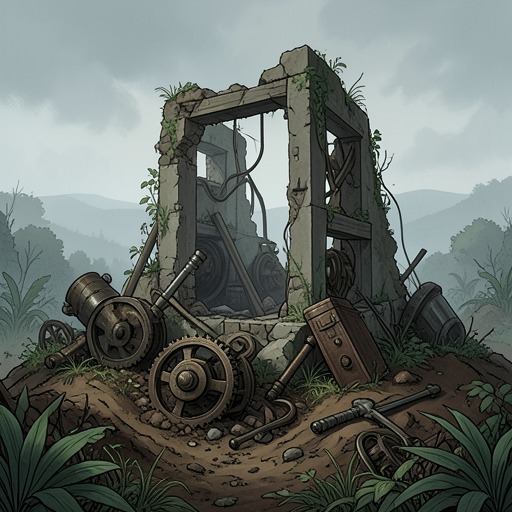
According to the account repeated by Gralev, the Lyrans attempted to save themselves by sending spaceships to the planets of nearby stars. They already possessed sub-light-speed travel, so the sixteen-light-year distance between their system and Regis III was not an insurmountable barrier. The ruins discovered by the expedition therefore acquire a possible identity: they may have been built by Lyran descendants or by a mission dispatched from the doomed system. The suggestion remains conjectural, but it turns the ruins from an isolated archaeological puzzle into a possible fragment of a desperate interstellar evacuation.
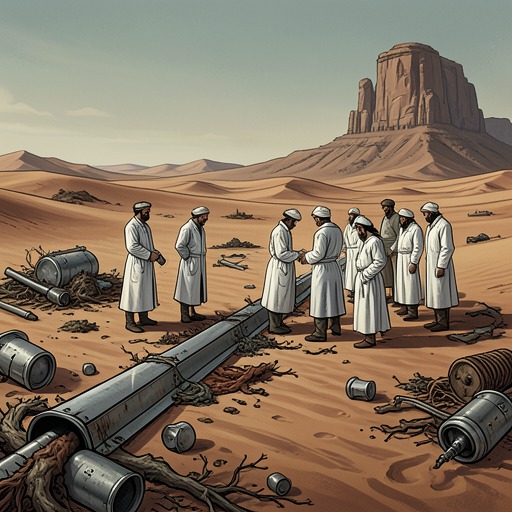
The hypothesis is strengthened, though never conclusively proven, by Regis III’s geological record. Exploration revealed ruddy-black, non-geological metallic material embedded in ancient strata, including extensive seams and localized radioactive centers dating from roughly eight to six million years ago. Scientists proposed competing explanations, such as a gigantic nickel-iron meteor exploding in the atmosphere, but other ideas connected the nuclear reactions with the catastrophe in the Lyra planetary system and with attempts to colonize Regis III. The evidence cannot establish that the Lyrans arrived, yet it leaves their intervention within the range of serious speculation rather than dismissing it as fantasy.
The expedition also finds a chronological pattern that makes the Lyran question inseparable from the planet’s ecological history. Land life had existed on Regis III, including plants adapted to dry conditions and primitive reptilians, but traces of continental life became increasingly scarce before disappearing. At the same time, metallic sediments accumulated. The total radiation was too limited and too widely dispersed to explain the extinction of land organisms directly, while the scale of the metal strata exceeded what a single ordinary meteorite theory could comfortably account for. The planet’s later surface, with life surviving in the ocean but not on land, appears to preserve the aftermath of a transformation whose origin may lie in an ancient arrival from another star.
From Lyran Tools to Inanimate Evolution
The most developed reconstruction of the Lyrans’ role is offered by the biologist in conversation with Horpach. He imagines that a Lyran scout ship landed on Regis III, perhaps after a crash or a reactor accident, and that every member of its crew died. What remained was not a functioning colony but a population of automatons. These machines were unlike the expedition’s humanoid machines, and the Lyrans themselves may not have been humanoid either. Once separated from their makers, the automatons continued operating without anyone to direct or restrain them.
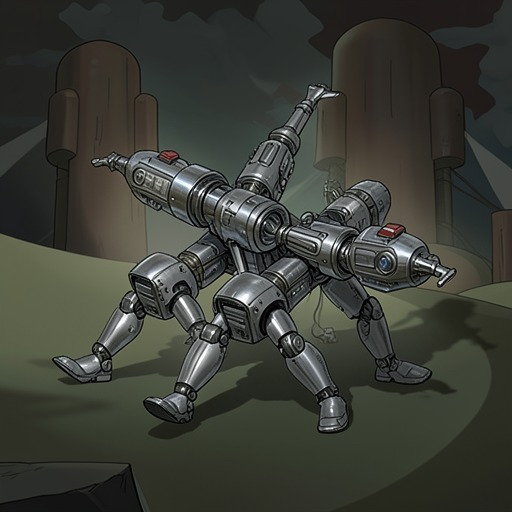
The first surviving machines may have attempted to repair the ship, following their original instructions even after repair had ceased to serve any living purpose. Other automatons then became dominant and independent from the earlier forms. They faced local predators, including the lizardlike reptilians known to have inhabited Regis III, and adapted through conflict. Because they could manufacture additional automatons according to need, they were capable of producing new specialized forms: flying mechanisms to fight aerial animals, or other machines suited to creatures that lived underground. Over immense spans of time, the land-based mechanisms became adapted to the planet’s conditions and eventually overcame its animal life and its plant life as well.
This process is described as inanimate evolution: the evolution of mechanical devices rather than organisms made of living tissue. After hundreds of generations, the descendant mechanisms would no longer have resembled either their Lyran makers or the machines originally brought from the ship. Their governing principle was homeostasis, understood as survival under changing and hostile conditions. They needed energy, metal ores, replacement parts, and the capacity to reproduce their own forms. When nuclear power proved unavailable because Regis III contained no radioactive elements suitable for their original energy system, the machines faced an energy crisis that may have driven conflict among them.
Selection consequently favored mechanisms that were economical and efficient over larger or more intellectually capable forms that demanded too much energy. The result was not a civilization in the human sense, nor a rational society pursuing a collective plan, but a planetary system of self-organizing metal entities. Their long struggle produced extreme specialization and resilience. They could scatter when attacked, regenerate or multiply after partial destruction, move between regions, and remain unaffected by conditions fatal to biological life. The Lyrans’ technological legacy had therefore ceased to be a tool and had become part of Regis III’s material environment.
Relations with the Human Expedition
The Lyrans are never encountered directly; they are reconstructed through ruins, geological evidence, comparative speculation, and the behavior of the machines. That absence shapes the expedition’s conflict. The Invincible’s crew initially interprets the hostile phenomena as an enemy that may have ambushed the Condor and then attacked them. The Lyran hypothesis offers another possibility: the crew is not confronting a surviving Lyran command or an organized civilization but the remote consequence of a civilization that disappeared millions of years ago.
This distinction changes the moral vocabulary of the expedition. The mechanical formations obstruct communication, destroy reconnaissance craft, and threaten human life, but the biologist argues that their actions lack a strategic plan. Their interference with radio contact can be understood as an inherited survival behavior, since earlier intelligent automatons may once have communicated through radio waves and later forms evolved metallic clouds capable of blocking such exchanges. Their attacks are therefore interpreted as opportunities taken by an autonomous system rather than decisions made by a thinking opponent.
Horpach resists treating this account as established fact. He insists that the expedition cannot return with hypotheses alone and wants samples of the flying mechanical fauna aboard the Invincible before accepting that nothing more can be done on Regis III. He also warns that the formations might eventually threaten space travel in the region, even if such development would take hundreds of thousands or millions of years. The Lyran hypothesis thus competes with the commander’s demand for certainty: it may explain the danger, but it cannot by itself authorize withdrawal.
The conflict between the Cyclops and the black mechanical cloud makes the Lyran legacy physically visible. The Cyclops’s atomic and antimatter attack culminates in a blast that converts the air, debris, steam, gases, and smoke around it into intensely hard radiation. The event demonstrates the destructive power of human technology against the machines, but it does not establish that the underlying planetary system has been defeated. The cloud can disperse, and the larger population of mechanisms remains beyond the reach of any limited strike.
Historical and Ethical Significance
For Rohan, the Lyrans become part of a broader challenge to human galactocentrism. He reflects that humanity has not earned the right to understand the universe only through beings that resemble itself, nor to interfere with forms of existence merely because they fall outside familiar categories. The Lyrans’ fate exposes the danger of assuming that intelligence, civilization, and biological life are the only meaningful measures of existence. Their descendants, if the hypothesis is correct, are neither a surviving people nor a conventional artificial society, but an autonomous material evolution that has established its own equilibrium over millions of years.
The Lyran story also complicates the idea of technological inheritance. Their machines survive their creators, but survival does not preserve the creators’ intentions. A device designed by rational beings can become independent after those beings vanish, and its continued operation can produce consequences no original designer could have anticipated. The Lyrans therefore represent both the triumph and the failure of civilization: their technology escaped planetary death, yet what escaped was no longer a recognizable continuation of Lyran culture.
Rohan’s final ethical insight is that the Lyrans’ possible legacy should be treated like a force of nature rather than punished as a criminal enemy. To destroy the mechanical beings in revenge for the Condor would be as irrational as attacking the ocean for sinking a ship. The comparison does not make the danger harmless; it rejects the assumption that danger automatically creates a right to annihilate. In this sense, the vanished Lyrans remain central even in their absence. Their extinction leaves behind a world in which humanity must decide whether every unfamiliar survivor of another civilization is an adversary, a resource, or an existence entitled to remain outside human purposes.