McMinn
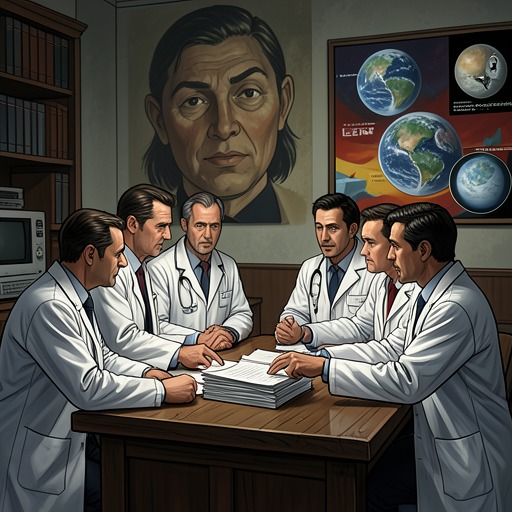
The InvincibleMcMinn is the biochemist aboard the Invincible whose laboratory examination supplies one of the expedition’s clearest negative findings. Called into a tense meeting while still wearing his long laboratory apron, he studies the body recovered from the hibernation chamber and rules out poisoning, pathological disease, and any toxic substance in the man’s food. His conclusion—that the man froze to death—narrows the mystery surrounding the Condor and the ruins of Regis III without pretending to solve the larger catastrophe.
Identity and Introduction
McMinn enters the narrative as Dr. McMinn, a specialist whose authority rests on analysis rather than conjecture. Nygren introduces him to the assembled officers and scientists as the man who has been examining the body found in the hibernation chamber. McMinn comes through the doorway still dressed for laboratory work, and all heads turn toward him before he passes between the chairs to stand beside Nygren. The detail of the apron gives his arrival a practical, almost unfinished quality: he has been summoned directly from the investigation, carrying the material seriousness of the laboratory into the command discussion.
His appearance is described with unusual precision. His hair is so light that it is difficult to tell whether it is merely gray, his eyes are the same color, and large freckles cover even his eyelids. His long, horselike face, which might ordinarily have seemed amusing, attracts no amusement in the meeting. The description places an ordinary, recognizable human body against the expedition’s increasingly incomprehensible circumstances; McMinn is introduced not as a heroic adventurer but as a working scientist confronted with evidence of death.
The Hibernation-Chamber Examination
McMinn’s investigation is important because it tests the most immediate explanations for the dead man’s condition. The physician has already outlined the possible routes by which poisoning could occur on a planet: through the lungs, the alimentary tract, or the skin. The body’s breathing equipment still contains enough oxygen for ten or fifteen hours, making the discovery of a poisoned or dead explorer especially difficult to interpret. Rohan remembers the preserved corpse’s shrunken skin, discolored marks on the cheeks, and eye sockets from which sand was spilling, details that make the body appear to bear the signs of some hostile planetary process.
McMinn’s report strips those impressions of explanatory force. He finds no organic or non-organic poisoning, no pathology in the enzymatic compounds of the tissues, and normal blood. The stomach contains only the remains of digested hard tack and concentrate. This is not merely a list of laboratory results: each finding closes a route by which the expedition might have converted the corpse into evidence of an attack. There is no poison in the body, no diseased biochemical process, and no suspicious meal to account for the death.
When Horpach asks how the man died, McMinn gives the plain answer that the man simply froze to death. The statement produces a value shift in the investigation. The crew has been searching for an active cause—an enemy, a toxin, or an unknown weapon—but McMinn’s evidence points instead to exposure and physical vulnerability. The answer does not make the death less tragic, yet it removes the reassurance that a deliberate killer must be responsible.
Scientific Function in the Expedition’s Reasoning
McMinn’s findings become part of a wider effort to reconstruct what happened to the Condor’s people. The expedition learns that there is no food on the land and that the disaster occurred soon after the explorers landed; the crew sent only a single patrol into the heart of the ruins. In that context, the absence of poison matters because it suggests that the dead were not overcome by something they ate or by an obvious biochemical contamination. McMinn cannot identify the final cause of the expedition’s disappearance, but he establishes a firm limit around the possible explanations.
That limit contrasts with the speculative hypotheses developing elsewhere. Rohan considers concealed aquatic beings and a civilization beneath the ocean, while the biologist proposes that a rocket from another system may once have landed on Regis III. Geological research reveals ruddy-black metallic seams of non-geological origin, possible fragments fused into ancient rock, and later strata containing unusual metallic deposits and localized radioactivity. The disappearance of land life coincides with the appearance of these metal layers, although the calculated radiation is too limited to explain the destruction of biological forms. McMinn’s contribution operates on a smaller scale than these planetary theories, but its method is complementary: before the expedition attributes a death to an alien civilization or a necrosphere, it must determine what the body itself can and cannot show.
Limits, Consequences, and Narrative Significance
McMinn is not presented as the architect of a grand theory, and the supplied scenes give him no extended personal history or later independent action. His narrative role is therefore concentrated and forensic. He appears at the moment when the expedition needs a trustworthy reading of physical evidence, and his report prevents fear from becoming proof. The corpse may look like the aftermath of an attack, but the tissues, blood, stomach contents, and breathing equipment do not support that interpretation.
The significance of McMinn’s conclusion becomes clearer as the expedition debates whether the adversary is an intelligent opponent or the product of inanimate evolution. Horpach insists that the crew needs certainty rather than revenge and wants samples of the flying mechanical fauna before deciding what should be done. Rohan later recognizes the danger of treating every incomprehensible phenomenon as an enemy and condemns the expedition’s impulse toward conquest and retribution. McMinn’s examination anticipates that ethical movement in miniature: it replaces an emotionally satisfying accusation with a materially supported, less anthropomorphic explanation.
Thus McMinn’s importance lies in disciplined refusal. He does not explain the origin of the metallic strata, the extinction of land life, or the possible mechanical beings of Regis III. He does something narrower and indispensable: he demonstrates that the body from the hibernation chamber contains no poison or disease and that its death is consistent with freezing. In a story increasingly concerned with the human tendency to project intention onto alien processes, his evidence becomes one of the first steps away from the fantasy of a conventional murderer and toward the harder recognition of a world whose forces may have no conscious hostility at all.