Mechanical Forest
The InvincibleThe Mechanical Forest is the decisive reclassification of the ruins on Regis III. What first appears to be a city turns out to be a nonhuman ecological formation: a monumental aggregation of sedentary mechanisms whose regular, branching, metallic structures have been shaped by replication, energy use, deterioration, and competition rather than by architecture in the human sense. Its discovery breaks the expedition’s habit of interpreting every organized form as evidence of a civilization and becomes central to the explanation of Regis III’s deserts, its surviving mobile mechanical fauna, and the limits of human judgment.
Appearance and Misidentification
The Invincible lands almost three and a half miles north of the outer limits of the supposed city, close enough for its angular black structures to be clearly visible from the bridge. They vary in height, are generally broader at the base, and in places gleam like metal; many appear riddled with holes. From a distance, their scale and repeated forms encourage the crew to imagine buildings, but the closer expedition makes that comparison increasingly untenable.
Rohan leads a column of five rovers, accompanied by a larger mobile antimatter cannon, through sand and low hills toward the ruins. Within a local force field, the vehicles pass over buried metal cables and shifting dunes, while unmanned craft mark and protect the route. The approach itself places the formations within a military and cartographic order: they are photographed, surveyed, reached by convoy, and considered as possible sites of danger before their nature is understood.
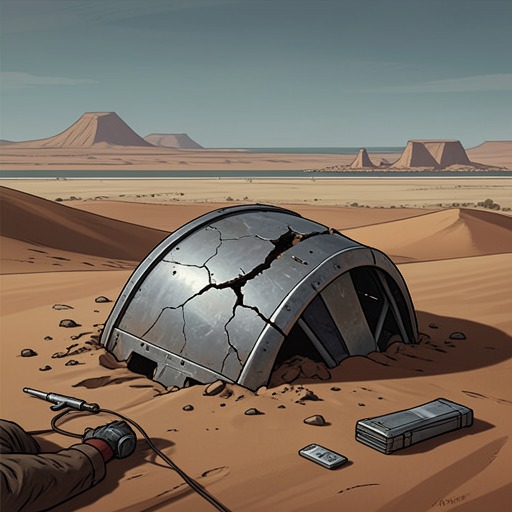
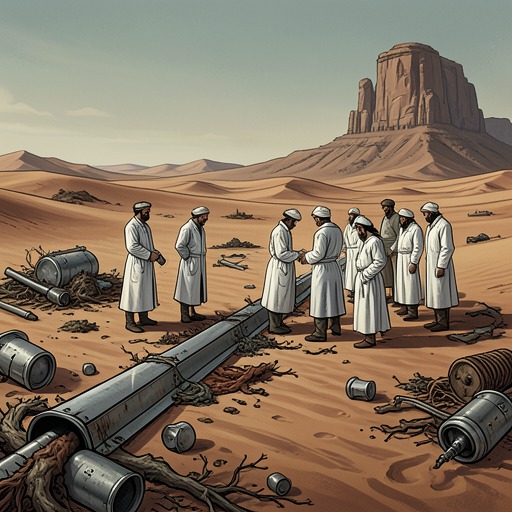
At close range, the structures have no windows, doors, or recognizable walls. Some resemble densely tangled nets folded and crossed in every direction; others suggest interpenetrating honeycombs or sieves pierced by three- or five-sided openings. Their visible planes display unmistakable regularity, but it is not the homogeneous regularity of a crystal. It repeats in rhythms while also being broken by extensive disintegration. Angular branches twist together into archlike forms or opposed spirals, and other elements project from the sand at slanting angles like drawbridges.
Wind has buried horizontal surfaces and short overhangs beneath fine sand, making distant sections look like truncated pyramids. Up close, those apparently smooth surfaces resolve into shaggy rods and slats so densely interwoven that they retain sand between them. Rohan first compares the forms to geometric rock remains overgrown by dead vegetation, but this impression also fails: the structures are neither solid nor hollow. Gaps reveal the interior, yet the interior is filled throughout by the same metallic tangle. The resulting impression is not of an abandoned building but of an immense formation whose life, if it ever possessed anything comparable to life, has vanished.
Evidence Beneath the Ruins
The expedition’s geological work gives the Mechanical Forest a history extending far beyond the present ruins. Sedimentary strata across Regis III contain ruddy-black material of non-geological, non-planetary origin, apparently formed from enormous quantities of metallic fragments deposited on an ancient basalt shield. The fragments may have been produced by a catastrophic meteor event, though the evidence also prompts speculation about events connected with the Lyran System and the destruction of its civilization.
The broader geological record shows that land life disappeared over a period of millions of years as metallic strata began to appear. The evidence does not support the simple explanation that radiation sterilized the continents: the calculated total, roughly twenty to thirty megatonnes distributed across hundreds of thousands of years, would not have posed a sufficient threat to biological evolution. The coincidence between the disappearance of plants and animals and the emergence of metallic layers therefore remains puzzling but substantial, linking the planet’s ecological transformation to some process involving metal rather than merely to a single radioactive catastrophe.
Further drilling becomes difficult because open excavation would require removing immense quantities of earth, while underground workers would no longer be protected by a force field. The decision to continue is strengthened by the discovery, about seventy feet down in an iron-oxide-rich seam, of rusted, strangely shaped remains resembling broken microscopic mechanisms. These fragments provide material support for the idea that the visible ruins are not conventional architecture. They suggest a buried technological history whose remains have entered the geology of the planet itself.
The apparent city also forms part of the expedition’s contrast between land and ocean. The planet is old, its sun is far past its prime, and life survives in the ocean even though land life has vanished. Rohan considers hidden underwater beings and a submerged civilization, but the possibility is rejected as inconsistent with the fate of earlier explorers and with the expectation that intelligent aquatic beings would have attempted to occupy the land. The Mechanical Forest ultimately offers a different explanation: organized land forms remain, but they are not living beings in the familiar biological sense and have no humanlike civilization behind them.
Lauda’s Evolutionary Hypothesis
Dr. Lauda interprets the ruins as the product of what he calls a highly particular form of inanimate evolution. According to this hypothesis, mechanisms brought to Regis III by an earlier technological civilization became subject to selection-like processes after their makers disappeared. The result was not a machine society governed by conscious plans, but an autonomous mechanical ecology developing over millions of years.
Lauda identifies two winning tendencies in that evolution. Systems that miniaturized themselves most effectively gave rise to the mobile beings later described as black clouds, while sedentary systems developed into the metallic vegetation of the ruins. The distinction is ecological as much as morphological: one lineage became mobile and adaptive across the land, while the other established large, stationary aggregations capable of absorbing solar energy through their own specialized organs. Lauda suspects that the small triangular plates found among the remains served that energy-absorbing function.
The Mechanical Forest is therefore not a city, even though its scale and regularity invite that name. It is an aggregation of mechanisms able to multiply and persist, a machine formation whose apparent architecture is the visible consequence of collective organization rather than a plan intended for inhabitants. Its structures occupy the land as a forest might, but their branching, netlike, and honeycomb-like forms are mechanical rather than organic. The analogy to vegetation remains useful only after it has been stripped of ordinary assumptions about metabolism, growth, and consciousness.
Lauda believes that the forest eventually lost its struggle for existence and survives only as rusting remains. The mobile mechanisms alone endured and came to dominate the continents. He offers the cooling of the Regis III sun as one possible reason: over the last three million years, the large sedentary organisms may have been unable to obtain enough energy. The explanation is expressly tentative, but it connects the ruins’ decay to planetary climate and stellar history rather than to a human attack or a single moment of destruction.
Relation to the Mobile Mechanical Fauna
The Mechanical Forest and the black mechanical clouds represent competing branches of the same post-civilizational mechanical evolution. The forest is sedentary, large, and dependent on access to solar energy; the cloud is mobile, miniaturized, and capable of assembling countless small units into larger, temporary systems. Lauda’s model makes the apparent opposition between ruins and clouds intelligible as an ecological succession: the surviving mobile forms have taken over the land after the sedentary formations declined.
This relationship changes the expedition’s understanding of the threat. Horpach wants certainty and asks for samples of the flying mechanical fauna, both to establish the facts and to determine whether the formations might eventually threaten space travel in that region of the Galaxy. Lauda replies that such a development would take hundreds of thousands, more likely millions, of years, and argues that the beings should be treated as a force of nature rather than as a thinking enemy.
The same reasoning applies to the Mechanical Forest. It has no demonstrated hostile intention, no political program, and no surviving center of command. Its formations persist because they are capable of persisting, not because they are pursuing revenge or conquest. The ruins thus become evidence for a planet-wide system in which survival is active but not necessarily conscious. Oceanic life remains because mechanical evolution does not extend into the sea, while the mechanical occupants of the land prevent those life forms from gaining access to the continents. This division also helps explain the planet’s moderate oxygen level, attributed to oceanic algae, and the deserts covering its landmasses.
Human Interpretation and Significance
The Mechanical Forest exposes the danger of treating unfamiliar order as a distorted version of human order. The crew’s first word, “city,” imports inhabitants, purposes, interiors, and history into formations that possess none of those features in recognizable form. When Rohan finally concludes that the place was not a city, the statement is not merely terminological. It marks the collapse of an anthropocentric framework that had made the ruins legible only by comparing them with settlements on Earth.
The expedition’s procedures reinforce that tension. From orbit, Rohan recognizes that visual observation has limited value and considers spending almost a month collecting a complete set of photographs. On the ground, the team advances behind force fields, scout robots, infobots, rovers, and the antimatter cannon, converting the unknown landscape into a sequence of routes, protected zones, images, and samples. The Mechanical Forest is encountered simultaneously as a material reality and as an object produced by scientific and military description.
The commander’s rule on Regis III requires every researcher outside a force field to remain within the view of someone protected inside it. That rule expresses the expedition’s attempt to preserve freedom of movement without abandoning surveillance and support. Yet the ruins resist the expedition’s practical categories: the sensors register no living activity, there is no interior for the antimatter cannon to penetrate, and the wind continually alters the visible relation between metal and sand. The forest is present as structure, absence, and process rather than as a site that yields a stable human answer.
For Rohan, this recognition becomes part of a larger ethical reversal. He comes to see that the expedition’s wish to avenge the Condor and secure human mastery has mistaken an autonomous planetary process for an enemy. Humanity’s technological power, cannons, sensors, and confidence in a supposedly universal human standpoint have not granted the right to destroy every form that does not resemble humanity. The Mechanical Forest therefore functions as both ruin and warning: it records the disappearance of its makers, while challenging the visitors to understand that intelligence, value, and civilization are not the only forms of order that can endure.