Metal Forest
The InvincibleThe Metal Forest is the name eventually given to the supposed city discovered on Regis III, though the name is deliberately corrective: the site is not a settlement built for inhabitants but the rusting remnant of a self-organizing population of sedentary machines. It is decisive to the expedition’s understanding of the planet because it turns an apparently archaeological mystery into evidence of inanimate evolution, while also challenging the human assumption that intelligence, civilization, and hostile intention must lie behind every ordered structure.
Discovery and Setting
The first indication of the Metal Forest came from orbital photography. On a bare plateau beside a sharply straight coast, with the rest of the image occupied by the black ocean, the expedition saw a mosaic of indistinct forms that could not plausibly be geological. Rohan immediately recognized the blurred formation as a city, although the image was poor, monochrome, and partly obscured by clouds and their shadows. The discovery complicated the initial picture of Regis III as an ancient, largely lifeless world whose land was barren while life might persist beneath the sea.
The Invincible landed nearly three and a half miles north of the apparent city. From the bridge, the structures looked artificial: angular black forms, generally wider at their bases than at their tops, rising to different heights and extending for several miles. Some surfaces gleamed like metal, while powerful telescopes still failed to resolve their details; most of the structures appeared riddled with holes. The landing site therefore became a planned zone of observation and military protection, with rovers, a mobile antimatter cannon, scout robots, infobots, and local force fields moving toward the ruins under Rohan’s command.
Physical Appearance
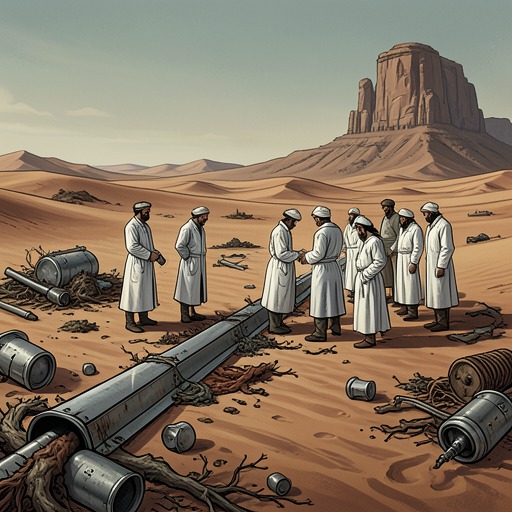
At ground level, the apparent city became stranger rather than clearer. Dark edifices lay partly submerged in shifting dunes and rose several stories above the sand, but they possessed none of the familiar elements of terrestrial architecture. They had no windows, doors, or recognizable walls. Some resembled dense nets folded over themselves and crossing in every direction, with thicker points at their intersections. Others suggested spatial arabesques made from interpenetrating honeycombs or sieves perforated by three- or five-sided openings.
Their forms were not chaotic in the ordinary sense. Every larger element and visible plane exhibited a recurring regularity, less uniform than a crystal but unmistakably rhythmic. Broken angular branches twisted together into arches or into paired spirals turning in opposite directions. Some structures projected vertically from the dunes; others leaned like drawbridge arms. Wind from the north buried horizontal surfaces and short overhangs beneath fine sand, making distant ruins resemble truncated pyramids. Close examination revealed that the apparent smoothness was only a crust over shaggy rods and slats, tangled so densely that they retained sand between them.
The ruins also resisted the basic categories of solid and empty. They were not solid, because gaps in the metallic snarl allowed the observers to see inward; yet they were not hollow, because the tangle filled them throughout. Their regular black openings were gradually clogged by blowing sand, which accumulated in steep cones at their bases. Rohan initially compared them to rocks overgrown by dead vegetation, but that resemblance dissolved as the foreign regularity of the structures asserted itself. The entire site conveyed an emptiness without life, and the antimatter cannon offered no useful solution: there was no conventional interior into which force could open a passage.
From City to Machine Ecology
The expedition’s scientists soon questioned the urban interpretation. One scientist told Rohan that the ruins did not resemble living quarters and, if they could be compared with anything, resembled machinery. Rohan’s later conclusion was abrupt but exact: this had not been a city. The proposed replacement term, Metal Forest, identified the structures as large agglomerations of sedentary mechanisms rather than buildings designed for occupation.
Lauda’s hypothesis supplied the conceptual framework. Regis III had once supported biological life on land, but the geological record indicated that such life disappeared over a period of millions of years as metallic strata began to appear. The strata were non-geological in origin, containing what seemed to be fused metallic fragments, oxidation products, and localized radioactive centers. Drilling also uncovered rusted remains resembling broken microscopic mechanisms. Yet the total radiation was too limited and too dispersed to explain the extinction of terrestrial life directly. The coincidence between the disappearance of land organisms, the rise of metallic deposits, and the ruins therefore remained puzzling but difficult to dismiss.
According to Lauda, mechanisms brought to Regis III from another star system entered an evolutionary process independent of biological heredity. The most highly developed mechanisms drew energy from radioactive reserves, while simpler repair systems might have used solar batteries. Under these conditions, selection favored two broad tendencies: mechanisms that miniaturized themselves most effectively and mechanisms that remained sedentary. The first tendency produced the black mechanical clouds, mobile formations made from tiny pseudo-insects capable of joining into larger, mutually coordinated systems. The second produced the Metal Forest, a metallic vegetation of stationary mechanisms that could multiply and absorb solar energy through specialized organs, possibly including the small triangular plates observed by the expedition.
Decline and Relation to the Black Mechanical Cloud
The Metal Forest was not presented as a surviving city. Lauda believed that it had lost its struggle for existence and had become no more than rusting remains. Only the mobile mechanisms had endured, spreading across the land of Regis III. The contrast is central: the Metal Forest represents the defeated sedentary branch of machine evolution, while the black mechanical cloud represents the successful mobile branch.
This interpretation also explains why Regis III’s land is a desert even though the ocean contains life. Oceanic algae can account for the planet’s moderate oxygen supply, but the mechanical organisms that control the continents do not build a civilization or create anything that humans would classify as valuable. They simply persist and act in ways that permit continued persistence. The Metal Forest is thus not an abandoned social world awaiting recovery; it is a fossil-like phase in a planetary history of non-biological adaptation.
Expeditionary Meaning and Significance
The ruins initially encouraged the expedition to think in familiar categories: city, inhabitants, computer, civilization, and enemy. The promise of the Metal Forest was therefore also a temptation. Humans could map it from orbit, photograph it, excavate beneath it, send protected teams into it, and consider whether the surrounding formations should be sampled or destroyed. The operational rules on Regis III made this tension explicit: researchers were to move freely outside force fields, but each person had to remain within the sight of someone protected. Scientific access depended on a system of surveillance and military containment.
Horpach resisted any decision to leave Regis III with hypotheses alone. He wanted certainty, factual diagnosis, and samples of the flying mechanical fauna before allowing the Invincible to withdraw, partly because such formations might eventually threaten space travel elsewhere. Lauda answered that this reasoning still treated the phenomenon as a thinking opponent. If the mobile beings were the descendants of tools abandoned by rational creators, they had nevertheless become, over millions of years, part of the planet’s natural forces. The Metal Forest supports that distinction: its remains do not accuse, communicate, or invite retaliation; they record a process that humans did not initiate and cannot judge by human values.
For Rohan, this realization became part of a larger ethical reversal. The expedition had first regarded the black formations as a lurking enemy responsible for the Condor and for the danger facing the Invincible. He came to see the demand for conquest and retribution as a human projection onto a non-conscious planetary process. Humanity, he understood, had not yet earned the grand posture of galactocentrism if that posture meant seeking only beings like itself; genuine galactocentrism required refraining from interference in systems that did not concern human purposes. The Metal Forest gives that insight material form. It is both ruin and testimony, a silent record that ordered existence can be neither biological nor civilized, and that the absence of human meaning does not make a world empty or available.