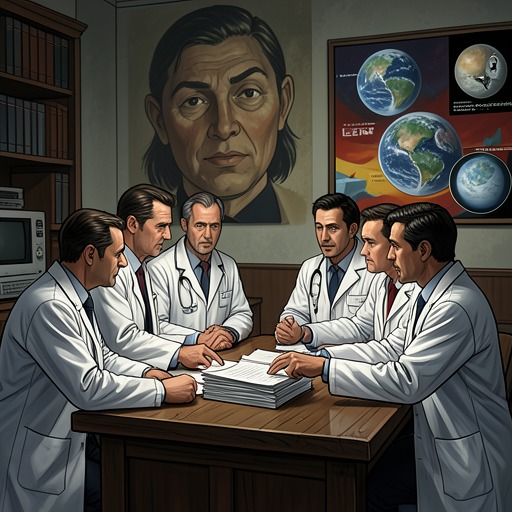
Nygren
The InvincibleNygren is the Invincible’s physician and one of the expedition’s principal medical interpreters. His role is defined less by a private biography than by the disciplined authority with which he examines bodies, distinguishes evidence from speculation, and participates in the crew’s attempt to understand what happened to the Condor. At the same time, his repeated admissions of uncertainty show that the expedition’s most advanced knowledge can describe the aftermath without yet explaining its cause.
Identity and Professional Role
Nygren is introduced as a diminutive doctor, a head shorter than Horpach, and his physical smallness contrasts with the seriousness of the medical responsibility placed before him. When the expedition discovers the Condor, he is already present at the ship and refuses to examine the frozen man found in its hibernation chamber without another physician or colleague present. His caution is practical rather than ceremonial: the body presents an abnormal clinical problem, and he does not treat a single examination as sufficient grounds for a conclusion.
The hibernation chamber makes ordinary medical categories unstable. Its temperature reads one degree Fahrenheit, too high for full reversible death but too low for ordinary hypothermic sleep. The man lies in his underwear, apparently asleep, yet microscopic ice crystals fill the tissue beneath his pale skin. Nygren helps establish the conditions under which the body must be read, and he works alongside Sax while Rohan watches. When Sax determines that the man is dead, Nygren begins warming the chamber, allowing the examination to proceed. The scene presents medicine as a careful sequence of observation, intervention, and interpretation rather than as an instant revelation.
The Condor Investigation
Nygren’s expertise becomes part of the expedition’s formal reconstruction of the disaster. At Horpach’s briefing, he reports that twenty-nine bodies have been recovered around the Condor and thirty-four inside it, including the preserved body from the hibernation chamber. His account separates nine mummified bodies from skeletons and fragments excavated from the sand. He explains that the ship’s low humidity, lack of saprogenic bacteria, and low temperatures produced mummification indoors, whereas rain, reactive iron compounds in the sand, and long exposure outside accelerated decomposition and polished the exposed bones.
Horpach interrupts to insist that the central issue is not preservation but cause of death. Nygren answers that the best-preserved bodies show no signs of violent death and that the general picture suggests natural causes. This conclusion is important precisely because it is limited. The bodies have been found amid wreckage that looks violently destroyed, yet the medical evidence does not show corresponding physical violence. Nygren’s testimony therefore separates the destruction of the ship from the deaths of its crew, preserving the mystery instead of forcing the two into a single explanation.
His clinical restraint continues when the frozen man is discussed. The body does not seem to have been deliberately prepared for survival in controlled hibernation conditions; it appears to have ended up in the chamber accidentally, in circumstances as irrational as the rest of the Condor’s condition. Nygren’s work can identify freezing, decomposition, mummification, and the absence of obvious trauma, but it cannot convert those facts into a motive or mechanism. The medical record becomes a catalogue of precise unknowns.
The Grave-Sounder and the Limits of Evidence
Nygren is also present when Sax uses the grave-sounder, a device designed to retrieve the last functional contents of a recently dead brain. Because the Condor victim has not decomposed, the apparatus may still trace electrical pathways formed immediately before death. Sax explains that the results are never entirely reliable, but that they may yield crucial information in a catastrophe whose cause remains hidden. Nygren receives the headphones from Sax and listens with the others as the device produces an enigmatic mental image.
The image appears to show people moving, marked by strange signs. Nygren asks whether the apparent movement and the marks are illusions. Sax explains that engrams are recorded like photographs, although several images can sometimes form a composite; in this case, he says, the movement is an illusion rather than evidence that the people were alive. Concerning the marks, Sax refuses certainty and asks Nygren for his opinion. Nygren answers that he does not know and raises the possibility that the image may not even be an artefact. His hesitation preserves the distinction between a recorded neural trace and a trustworthy account of events: the grave-sounder supplies access to consciousness, but not transparent testimony.
This episode gives Nygren a distinctive epistemic function. He is neither the person who deciphers the image nor a skeptic who dismisses it. He stands at the boundary between clinical fact and interpretation, acknowledging that an apparent record can remain ambiguous. The body is available for examination, yet the consciousness associated with it cannot be made fully legible.
Scientific Debate and Collective Crisis
Nygren contributes to the expedition’s wider debates about the forces operating on Regis III. When the crew considers whether metal helmets could protect people from the black cloud’s magnetic field, he asks whether such shielding is possible. The physicists conclude that it would fail: a sufficiently powerful field would generate eddy currents, heat the helmet until it burned, and force its wearer to remove it. Nygren’s proposal is therefore answered by physical constraints, but his intervention shows the medical perspective searching for a direct means of protecting human bodies.
The episode also places his work within a larger chain of professional interpretation. Scientists compare the Condor’s deaths, the planet’s vanished land life, the metallic strata, and the behavior of the black cloud. Geological evidence suggests that land life disappeared over millions of years while metallic layers formed, although the calculated radiation was too weak and too dispersed to account for the extinction. The ocean still contains life, while land does not. Nygren does not resolve these planetary questions, but his medical findings provide the human-scale evidence around which the larger hypotheses turn: bodies have died without clear violence, minds may be destroyed without visible wounds, and protection designed according to human assumptions may itself become lethal.
Narrative Significance
Nygren embodies the expedition’s effort to respond to catastrophe through professional procedure. He counts bodies, classifies remains, observes temperature, evaluates tissue, and tests possible protective equipment. His methods impose temporary order on scenes that otherwise resemble senseless ruin. Yet the narrative repeatedly refuses to let that order become mastery. He can demonstrate that the Condor’s dead were not obviously murdered, describe how their remains were preserved, and question whether a neural image is authentic; he cannot explain the agency behind the disaster or guarantee that the evidence retrieved from death is intelligible.
His medical perspective also sharpens the book’s contrast between human intention and impersonal process. The crew wants an enemy that can be identified, opposed, and destroyed, while the evidence increasingly points toward mechanisms that may not possess hostile intention at all. Nygren’s cautious language belongs to this tension. He does not transform uncertainty into reassurance, and he does not pretend that every physical trace carries a complete story. Through him, the investigation retains its most responsible form: care for the dead, protection of the living, and an acknowledgment that knowledge can remain exact at the level of symptoms while failing at the level of meaning.