Regis III
The InvincibleRegis III is not merely the destination of the Invincible’s expedition but the book’s central planetary mystery: a world that appears barren, preserves the material traces of immense stretches of time, and may sustain on land an autonomous evolution of mechanical matter. Its decisive significance lies in the reversal it imposes on human exploration. The expedition arrives expecting to observe an environment and investigate the fate of another vessel; it leaves confronted by a system whose history cannot be reduced to human categories of civilization, hostility, or usefulness.
Planetary Setting and First Survey
Regis III lies at the edge of the Lyra constellation, beneath a sun scarcely hotter than an ordinary red dwarf. When the Invincible lands, the planet is presented through a severe contrast between technological arrival and apparent emptiness. The ship, a class II cruiser and the largest vessel stationed at its base, carries eighty-three sleeping crew members while its automatons revive the vessel, inspect its hull, restore its systems, and prepare it for landing. Once the ship settles onto the surface, the planet seems almost motionless, turning beneath a purple sky in which the brightest stars remain visible around the red sun.
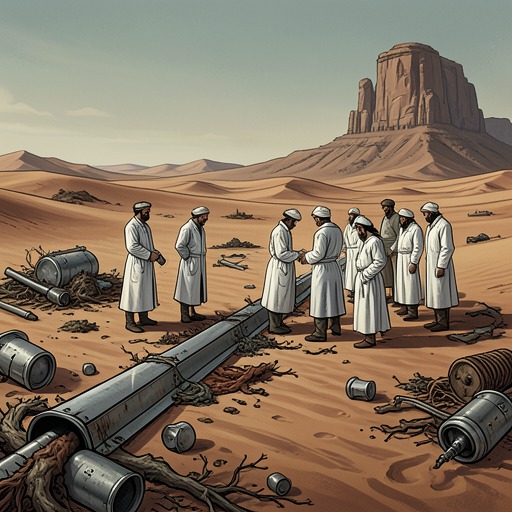
The landing site is a desert of red and black slopes, dunes, volcanic rock, and persistent wind. The expedition’s instruments measure the air, sand, and radioactivity, while an Arctan automatic machine supports the drilling equipment. The force field protects the ship and its personnel without stopping the movement of gases, so the wind crosses the invisible boundary and leaves the explorers unable to see where the shield ends. This detail makes the planet’s space both physical and militarized: the landscape remains open to air and weather, yet the human camp is enclosed by an unseen defensive architecture.
From the ground, the desolation is difficult to reconcile with the fate of the Condor, another ship of the same class that has disappeared on Regis III. The Invincible possesses enough power to release a billion megawatts in an instant, generate an impenetrable energy field, or turn its energy into rays capable of reducing mountain chains to dust. Nevertheless, the earlier vessel and its crew of eighty have vanished without a trace or an SOS signal. The apparent weakness of the planet beside the enormous capacities of the ship is therefore deceptive: Regis III is quiet, but its silence already contains an unexplained defeat.
Ruins, Maps, and the Work of Exploration
The first orbital observations provide only a coarse map. The Mercator projection records the principal continents and seas, the polar icecaps, and the largest craters; the landing point is marked at eight degrees north. Rohan recognizes that observation from orbit is insufficient, since continents cannot disclose what lies in their waters and telescopes cannot replace direct investigation. A complete photographic survey would take almost a month, while the expedition is under pressure to understand the Condor’s fate. The map consequently functions less as knowledge than as a declaration of limited knowledge: it outlines Regis III while leaving the decisive parts of the planet concealed.
The expedition soon investigates structures visible several miles from the selected landing site. The so-called city consists of angular, mostly black constructions, often broader at the base than at the top, of differing heights and apparently riddled with holes. Some surfaces gleam like metal, but even the strongest telescope cannot resolve their details. The closer view strengthens the impression that they were artificially made, yet the structures resist the ordinary meaning of a city. When Rohan is asked what should be reported to the commander, he proposes sending comprehensive televisual images and then concludes that the site was not a city at all. The encounter turns classification into a problem: the explorers can describe the ruins, but their inherited categories do not explain what they are.
Human presence on Regis III is organized through machinery as much as through people. Energobots form a ring around the landed ship, turrets bearing Weyr guns emerge from the sand, inforobots take up positions, and a protective force field rises over the camp. At the ruins, rovers and a mobile antimatter cannon accompany the survey. The expedition therefore approaches the planet as a defended military installation, even before it has identified an enemy. Its methods combine measurement, excavation, communication, mapping, and weaponry; the same instruments that produce knowledge also establish a capacity to occupy or destroy.
Deep History and Ecological Reconstruction
The geological evidence transforms Regis III from an empty desert into a planet with a long and discontinuous history. Sedimentary strata contain ruddy-black layers of material that are neither geological nor planetary in origin. Specialists consider whether enormous quantities of metallic fragments may have fallen through the atmosphere, perhaps after the explosion of a nickel-iron meteor, then oxidized and entered chemical reactions with the surrounding environment. The deposits appear as brownish-black or dark crimson seams embedded in ancient rock, suggesting that what looks like geology may preserve the consequences of a catastrophe or an intervention from beyond the planet.
Drilling reveals that land life existed on Regis III more than once. Rock above a basalt layer roughly a billion years old contains organic carbon, while coal seams preserve fossils of plants that could grow only in dry conditions. The record includes primitive reptiles that moved through jungles approximately three hundred million years ago, but the planet never produced mammal-like forms. Around one hundred million years ago, plants and animals died out abruptly, probably after a nearby nova, though life later flourished again in new forms. A second stellar explosion occurred ninety million years afterward, farther away and apparently too weak at the surface to destroy life on a massive scale. Yet from that point onward, biological traces become progressively rarer.
As biological remains disappear, compressed mineral material becomes more abundant. The layers contain antimonite, molybdenum oxide, iron oxides, and salts of nickel, cobalt, and titanium. Deposits dating from eight to six million years ago include localized centers of radioactivity, as though violent nuclear reactions had occurred in scattered places. The total radiation, however, amounts to no more than twenty or thirty megatonnes distributed across hundreds of thousands of years—far too little to account for the destruction of land life. The central chronological fact is therefore not simply that life vanished, but that the decline of biological traces coincided with the appearance and spread of metallic strata without being directly caused by radiation.
The connection between the strata and the ruins encourages further excavation. Open-pit digging is difficult because it would require moving immense masses of earth, while underground work would take place beyond the protection of the force field. The decision to continue is strengthened by the discovery, about seventy feet down in an iron-oxide seam, of corroded fragments resembling parts of microscopic mechanisms. Regis III thus preserves a history in which the boundary between natural deposit and technological remnant has become almost impossible to maintain. The planet’s past is not divided neatly into a biological age followed by a mechanical one; the evidence lies mixed in rock, ruin, mineral, and corrosion.
Ocean, Land, and Mechanical Evolution
The apparent contradiction between oxygen in the atmosphere and the absence of visible land life leads the explorers toward the ocean. Rohan suggests that aquatic beings may have survived below the surface and developed a civilization there, but the captain rejects the proposal as implausible, arguing that intelligent aquatic beings would eventually have attempted to conquer the land. The exchange reveals the expedition’s implicit standard for intelligence: a civilization is expected to expand, build, and claim environments beyond its original habitat.
A biologist later states the more limited but more consequential observation: life exists in the ocean, while land life ended more than five million years ago. He proposes that a rocket from another system may once have landed on Regis III, perhaps from a region threatened by a nova. The hypothesis develops into an explanation of the planet’s strange division. A tool created by rational beings may have become independent after its makers disappeared, then evolved over millions of years until it formed part of Regis III’s natural forces. Oceanic life survived because mechanical evolution did not extend into the sea, while the continents became deserts because the mechanical forms did not build a civilization or create anything of value in the human sense.
This interpretation does not make the mechanical organisms secretly human. Their behavior is presented as persistence rather than intention: they endure and act in ways that allow them to endure further. Their evolution is inanimate and probably unthinking, yet it is still active, adaptive, and capable of producing a stable planetary equilibrium. Regis III therefore unsettles the distinction between life and matter. The planet does not contain a conventional machine civilization waiting to be deciphered; it may contain a necrosphere, a system in which once-purposeful mechanisms have passed beyond their makers and entered a form of nonbiological evolution.
Storms, Silence, and the Limits of Human Authority
Regis III repeatedly converts the expedition’s communications infrastructure into a source of danger and uncertainty. During a violent storm, lightning joins sky and rock in continual strikes, floodwaters submerge the excavated walkways, and a black wall of weather obscures the horizon over the ocean. The returning teams find tiny black metal specks scattered across the sand, the infamous “flies,” which are collected and examined despite the certainty that they are not insect remains. The storm is not only weather in the ordinary sense; it is part of a planet whose atmosphere, mineral history, and mechanical phenomena cannot be cleanly separated.
The subsequent northern expedition demonstrates how quickly planned exploration becomes isolation. Under Regnar’s command, twenty-two men travel with oxygen, food, nuclear fuel, energobots, transporters, the Condor’s mobile cannon, and Arctans equipped with automatic excavators and drills. Communication is maintained through a television relay after the planet’s curvature blocks direct ultra-short-wave contact. When the convoy stops near sand-covered ruins, radio reception deteriorates, then television reception fails as well, even though the latter signal is relayed from outside the atmosphere. At a distance of one hundred miles, the expedition becomes inaccessible, as if a wall of metal has descended across the desert.
The failure is not explained when the storm subsides. Horpach sends two reconnaissance craft after repeated unanswered messages, but the loss of contact confirms that the planet’s distances are not merely geographic. Regis III can interrupt the systems by which the expedition imagines itself connected, visible, and in control. Its spaces are measured by maps and relays, yet those infrastructures remain vulnerable to an effect the physicists cannot identify.
By the later stages of the investigation, the planet has forced a moral reconsideration of exploration. Horpach still seeks certainty and wants samples of the flying mechanical fauna, partly because the formations might someday threaten space travel in the region. Rohan, however, recognizes the danger of treating an unfamiliar planetary process as an opponent. Humanity’s desire to conquer at any cost, to avenge the Condor, and to prove its heroic survival appears less like justified defense than the consequence of rashness and excessive faith in cannons and sensors. Regis III has maintained its own equilibrium for millions of years; its existence is neither better nor worse than the survival of animals or humans. The planet’s final significance is therefore ethical as well as scientific. It is not an empty place awaiting human meaning, but an already occupied and historically complex world whose apparent barrenness conceals an order that human beings may neither understand nor possess.