Regnar
The InvincibleRegnar is the geologist and leader of the expedition sent into the northeastern desert of Regis III, where geological investigation, scientific ambition, and survival become inseparable. His disappearance marks the point at which the expedition’s attempt to classify the planet’s strange metallic history turns into a direct encounter with forces the crew cannot yet explain; his recovered body and equipment later provide Rohan with the first tangible evidence of what happened to the missing men.
Identity and Scientific Role
Regnar belongs to the scientific expedition organized after researchers found unusual minerals beneath the ravines and iron-rich seams of Regis III. Those strata contained ruddy-black material of non-geological, non-planetary origin, apparently formed from metallic fragments deposited millions of years earlier and altered by oxidation and chemical reactions. The deposits were not a minor curiosity: they coincided with the disappearance of land life over geological time, while the total radiation associated with them was too weak and too dispersed to account for that extinction. Regnar’s field of expertise therefore placed him at the center of an investigation into a planetary history that resisted ordinary categories.
The expedition also followed the discovery of corroded remains resembling microscopic mechanisms at a depth of about seventy feet. This finding connected the geological record to the ruins and raised the possibility that the metal seams were related to ancient artificial activity rather than to a simple meteorological or astronomical event. Regnar was consequently not merely surveying an empty landscape. His mission entered a terrain treated as a scientific archive, where mineral deposits, buried mechanisms, ruins, and the continuing activity of the black mechanical cloud might belong to one long planetary process.
The Northeastern Expedition
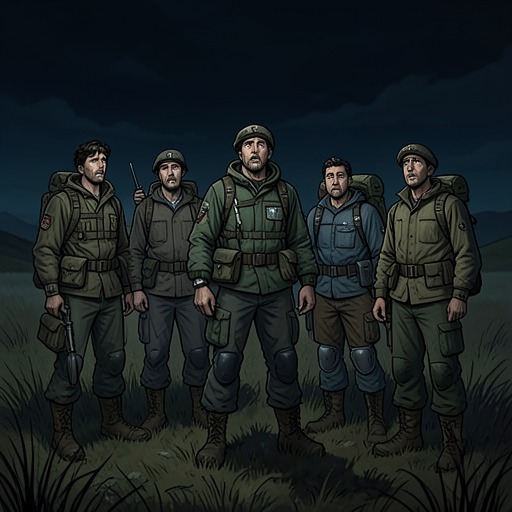
The expedition departed under Regnar’s command with twenty-two men, oxygen, food, nuclear fuel, energobots, the Condor’s mobile cannon, transporters, robots, and a dozen Arctan automatons equipped with automatic excavators and drills. Permanent radio and television contact was maintained while the convoy remained within direct communication range. At night the vehicles formed a defensive circle under a force field, showing that even a formally scientific mission was organized as a military-grade operation in a hostile environment.
Regnar led the convoy beyond the previously explored ravines and mineral seams because small quantities of unfamiliar minerals had been found on the caterpillar tracks of the Condor’s transporters. The expedition traveled for a full day and, around noon on the following day, stopped at ruins inside a small, shallow crater. The ruins were almost entirely covered by sand, and Regnar wanted to examine them more closely. His choice of this site made the expedition’s purpose concrete: the search for geological evidence and the search for the remnants of an earlier civilization were already converging.
Soon afterward, communication began to deteriorate. Heavy static interfered with the radio signal, and technicians changed to a clearer short-wave band. The strange phenomenon did not affect only ordinary radio communication: television reception worsened at the same time, even though the signal was relayed from outside the atmosphere and should not have depended on the ionosphere. After a series of increasingly powerful fadings, contact ceased completely when the convoy was about one hundred miles from the Invincible. The technicians and physicists could not explain the failure; it appeared as if a wall of metal had descended somewhere in the desert.
The storm moving toward the expedition initially seemed a possible explanation, but communication remained impossible after the storm died down. Horpach therefore dispatched two reconnaissance craft, and the command crew watched the desert through the low-flying craft’s transmission. The landscape changed from shadowed ravines and dunes to craters, extinct volcanic cones, jagged hills, cliffs, rubble, and deep tectonic cracks, while the picture itself became increasingly unstable. Regnar’s expedition had not simply gone out of range. It had entered a zone in which the planet’s atmosphere, terrain, and mechanical phenomena interfered with the instruments meant to make the expedition visible.
Disappearance and Search
When Rohan later reported the missing personnel, Regnar was named first, together with Bennigsen, Korotka, and Mead. The planes sent to locate the expedition were also unaccounted for, and the black cloud remained part of the unresolved threat. Regnar’s disappearance thus had consequences beyond the loss of one scientist: it severed the command team’s access to an entire convoy and deepened the uncertainty over whether the expedition had been destroyed by the cloud, by an atomic clash, by the automatons, or by some interaction among these forces.
Rohan eventually organized a search for the missing men after detecting their trails with electric bloodhounds, or olfactometric sensors. He led a convoy consisting of two large energobots, four all-terrain caterpillar transporters, and a small amphibian craft, traveling with Jarg and Terner in the amphibian vehicle. The group followed degree three procedures, with an energobot in front, Rohan’s craft behind it, the four transporters after that, and the second energobot at the rear; together the two energobots maintained a force field around the formation. This careful arrangement shows the danger surrounding the search and the practical burden Regnar’s disappearance placed on Rohan.
Death and Material Remains
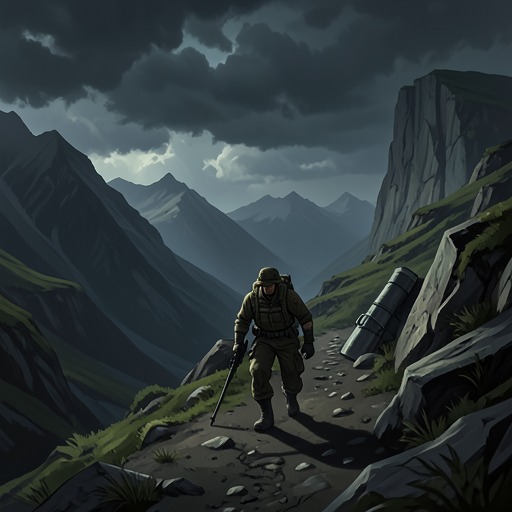
Rohan finds Regnar after following a trail of blood through a rocky valley. The trail runs almost straight toward what appears to have been an atomic battleground before turning sharply aside, making the geologist’s survival long enough to travel so far seem astonishing. Beneath a bare rock fin, Rohan discovers the broken metal sole of a robot, apparently split by fire from a Weyr, and then sees Regnar sitting half-collapsed against a boulder. Regnar is dead, his helmet blackened with soot, and his gun still hangs from his unclenched hand with its muzzle touching the ground.
Decay has distorted Regnar’s face, but Rohan recognizes him by the broad, flat geological bag hanging from his shrunken shoulder. The bag contains only rock samples. That detail preserves Regnar’s identity with unusual force: even at the end of the expedition, the geologist’s last visible possession is not a personal keepsake or a weapon but the material evidence he had gone out to collect. Radioactive readings show that the Arctan had been struck by a Weyr blast, with the counter registering the characteristic rare-earth isotopes. The immediate cause of death is therefore clearer than the larger circumstances surrounding it.
The scene does not resolve who attacked whom. Regnar may have fired at the robot, but Rohan cannot determine whether the robot had attacked Regnar or Bennigsen, and he cannot know how a man suffering from the expedition’s peculiar memory destruction might have defended himself. The uncertainty is essential to Regnar’s function in the story: his body confirms violence without supplying a human explanation for it. The evidence is physical, but its meaning remains unstable.
Rohan removes Regnar’s geological bag and later prises the monogram from his leather jacket without touching the body. He also takes the still-full oxygen tank from Regnar’s apparatus, leaving his own empty tank behind. Before departing, he piles rocks over the remains for nearly an hour. Regnar’s death thus becomes part of Rohan’s survival as well as his mourning: the dead geologist gives him the oxygen needed to continue the search, while the improvised grave acknowledges a debt that the mission’s machinery and official reports cannot express. Rohan notices too late that Regnar’s Weyr may still be loaded and leaves without it, a small missed opportunity that reinforces the search’s exhausted, improvised character.
Narrative and Thematic Significance
Regnar is introduced chiefly through collective action and scientific responsibility rather than through personal biography. He is defined by command of the convoy, attention to ruins and minerals, and the material traces recovered from the planet. That relative absence makes his end more stark. He becomes legible only after death, through a bag of specimens, a damaged robot, a soot-blackened helmet, rare-earth isotopes, and an oxygen tank that extends Rohan’s life.
His expedition also embodies the tension between exploration and intrusion on Regis III. The crew maps the planet, excavates its layers, examines its ruins, takes samples, and considers capturing specimens of the flying mechanical fauna for transport aboard the Invincible. Horpach insists that the mission requires certainty rather than revenge, yet the language of investigation is already linked to possession and possible weaponization. Regnar’s death exposes the cost of that posture: the expedition enters a system that has endured for millions of years, assumes that its anomalies can be classified and controlled, and then loses the means even to communicate its findings.
Rohan’s later reflections sharpen the contrast. He concludes that humanity has not earned the supposedly elevated stance of galactocentrism if that stance means understanding only what resembles humanity and attacking what does not. He recognizes that the black mechanical cloud may be an inanimate process of self-organization rather than a thinking enemy, and that the crew’s losses resulted partly from its own rashness and excessive faith in cannons and sensors. Regnar’s fate is one of the facts that makes this realization unavoidable. He is neither a villain nor a triumphant pioneer, but a scientist whose disciplined expedition ends in a landscape where the categories of organism, machine, weapon, and natural force have become impossible to keep separate.