Rohan
The InvincibleRohan is the navigator and senior field officer of the Invincible, a man whose importance grows from technical competence into moral responsibility. He begins as the officer who records the landing of Regis III and receives the commander’s unprecedented order to begin with Degree Three Ground Procedure rather than the regular procedure. By the end of his expedition, he has become the person forced to decide whether the ship should abandon the planet, and the witness who understands that Regis III cannot be treated merely as an unexplored resource or an enemy to be defeated.
Identity and Introduction
Rohan is introduced at the moment when the Invincible lands on Regis III. While Horpach looks over the log book and records the customary landing symbol, the time, and the planet’s name, Rohan asks whether the landing will follow regular procedure. Horpach answers that the crew will begin with degree three instead. Rohan masks his surprise and responds professionally, although he admits that he would rather not be the officer required to make the announcement. The exchange establishes both his disciplined position within the ship’s command structure and his capacity to register the human consequences of abstract procedure.
His work is not confined to navigation. When the crew debates why Regis III has no visible life on land, Rohan considers the possibility of concealed aquatic beings and proposes that the expedition examine the water. The hypothesis is rejected as implausible, but his suggestion shows a willingness to keep several explanations in play while the evidence remains incomplete. Later, when the coastline is estimated at about a hundred twenty miles from the landing site, he is assigned to lead an ocean expedition with Fitzpatrick or another oceanologist and six reserve energobots. The mission is strictly limited to a force field: no sorties onto the ocean and no diving. Rohan therefore operates within a culture that values exploration but increasingly constrains it through precaution.
Life and Plot Trajectory
Rohan’s responsibilities expand as the investigation develops. After the Condor is discovered a hundred eighty miles away, he becomes the coordinator of all exploratory work. He leaves the vicinity of the Invincible only for short periods and not every day, suggesting a role that combines central oversight with carefully limited exposure. The expeditions uncover layers of ruddy-black material embedded in Regis III’s sedimentary rock, metallic seams that appear non-geological, and evidence that the planet’s land life disappeared over millions of years as these layers emerged. The discoveries complicate the expedition’s original assumptions: the planet is not simply barren, and its history cannot be explained by a single obvious catastrophe.
The research also reveals a disturbing relation between the vanished biological world and the planet’s metallic deposits. Fossils show that dry-land plants and primitive reptilians once flourished, while later strata contain increasing quantities of metallic material, including antimonite, molybdenum oxide, ferrous oxides, and salts of nickel, cobalt, and titanium. The radioactive centers in layers dated between eight and six million years ago are too limited, in total and duration, to account for the extinction of land life. Rohan’s expedition thus moves through a landscape where the central mystery is not only what destroyed the Condor but what kind of evolution replaced biological life on land.
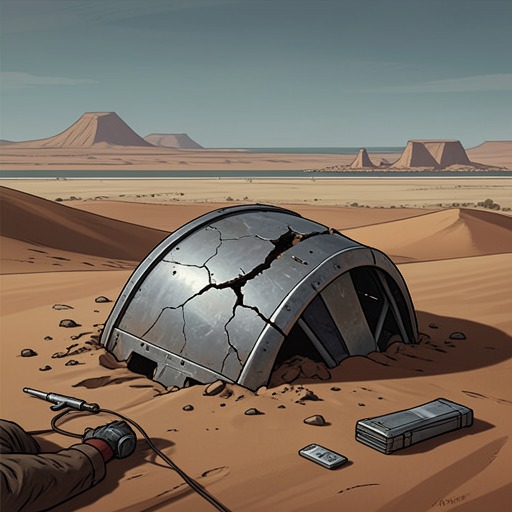
When an alarm reports that the other team has found the Condor, Rohan immediately answers the communication and agrees to return. His face turns pale when he learns the news, and the discovery becomes a decisive reversal in the mission. The missing ship is not an abstract research clue: it is the material sign of an earlier expedition’s destruction and a warning about what the Invincible’s own crews may face.
Key Actions and Objectives
Rohan later leads a rescue convoy after detecting the trails of four missing men from Regnar’s team with olfactometric sensors known as “electric bloodhounds.” He undertakes the mission because the men, wandering through the rocky landscape without paths, will die of hunger or thirst unless they are found. His convoy includes two large energobots, four all-terrain caterpillar transporters, and a small amphibian craft. Rohan travels in the amphibian with Jarg and Terner, while the vehicles maintain the configuration required by degree three procedures: an empty energobot in front, Rohan’s reconnaissance craft behind it, four vehicles carrying two men each, and a second energobot at the rear. The two energobots project the force field around the whole group.
The search follows physical traces rather than speculation. Near a broad, shallow ravine, the team discovers three clear sets of footprints in the mud of a drying creek and a fourth set partly washed away by trickling water. These traces draw the rescuers into the ravines, where the expedition encounters the lethal and incomprehensible forces of Regis III. Rohan’s objective remains rescue, but the mission exposes the limits of human equipment and procedure: the convoy’s formation can protect the group from some dangers without giving its members any real understanding of the world around them.
Rohan survives the destruction of the team and reaches the Invincible in a condition so severe that he passes out while reporting that all the others are gone. The physicians revive him in an oxygen tent, and Gaarb transmits his account to the ship. The survivors of Rohan’s team are eventually brought back in good physical condition, though lethargic; the ship must convert two additional cabins into hospital rooms. Yet Rohan’s survival remains baffling, since he and Jarg were indistinguishable from the others in clothing, weapons, and appearance. The fact that the three men had traveled together in the amphibian seems insufficient to explain the difference.
Relationships and Conflict
Rohan’s closest command relationship is with Horpach, who both permits him a degree of familiarity and repeatedly places him under severe responsibility. Horpach knows that Rohan has formed strong views about whether the Invincible should remain on Regis III. Instead of deciding by chance between leaving and staying, Horpach makes Rohan responsible for the choice. He tells him that, for the moment, Rohan is the commander of the Invincible and must give the order.
The transfer of authority exposes a conflict between calculation and solidarity. Rohan had previously believed that the ship should leave without delay, especially because four men were almost certainly dead. But “almost” becomes morally decisive. He recognizes that abandoning the missing men would alter the crew permanently: the survivors would remember that the ship had taken off while comrades remained behind. The principle that no one should abandon another under any circumstances is absent from the formal regulations, yet Rohan understands it as the condition that makes a crew capable of flying together. His reasoning turns rescue from an optional act into a test of whether the expedition still possesses a human community.
Horpach’s challenge therefore does not merely promote Rohan or settle a disagreement. It forces him to discover what his own earlier arguments mean when converted into an order. Rohan’s anger at Horpach’s despotism is joined to the realization that the commander has deliberately placed both the authority and its burden in his hands. The episode makes Rohan a threshold figure between institutional command and personal conscience: he is still operating within the ship’s hierarchy, but his judgment can no longer hide behind the commander’s decision.
Change and Ending
Rohan’s most important change occurs after he witnesses the black mechanical cloud’s action in the ravine. Crystals covering the rocks come alive, emit warmth, and rise into the air. The black specks gather into columns and form a spherical mass above the valley. Other clouds rush toward it; what appears to be a battle proves instead to be absorption, as the clouds open and incorporate the sphere until no trace of it remains. The scene overturns the language of ordinary warfare. Rohan initially feels that he is watching a battle, but the conflict is revealed as a process belonging to inanimate forms whose purposes cannot be translated into human intention.
He stands there holding a Weyr gun taken from a dead man and suddenly feels ridiculous and unnecessary. The weapon represents the expedition’s inherited confidence that force can make an unknown environment legible or safe. Against the cloud’s vast, self-organizing activity, it has no meaningful place. Rohan does not respond with simple horror. He experiences stunned admiration, recognizing an order of action that the scientists would be unable to share or perhaps even properly name.
This vision changes the purpose of his return. He is no longer merely a messenger carrying news that the missing men have been destroyed. He wants to return as someone who will demand that Regis III be left alone. His conclusion is expressed in the thought, “Not everything everywhere is for us.” The statement is the culmination of his arc: exploration has brought him not possession, explanation, or triumph, but a limit placed on human claims.
Even the journey back becomes a final test of that insight. Rohan crosses a battlefield of melted transporters and glazed rocks whose radiation grows increasingly intense. He turns the oxygen tanks to maximum and runs through the dark along the smooth, frozen lava left by the retreating Cyclops, watching the counter’s dial glow red. His return is therefore neither a conventional heroic victory nor a secure homecoming. It is an escape from a place whose material processes exceed human categories, carrying back a warning that knowledge may require restraint rather than conquest.
Narrative Role and Significance
Rohan serves as the novel’s principal human instrument for converting investigation into ethical recognition. Scientists describe Regis III through planetary age, fossils, metallic strata, radiation, and evolutionary hypotheses; commanders describe it through procedures, force fields, rescue obligations, and the decision to stay or leave. Rohan passes through all these systems but is not finally contained by any of them. His experience joins the geological deep time of the planet to the immediate vulnerability of the expedition’s bodies.
His role also concentrates the novel’s tension between calculable and unknowable risk. Procedures can specify convoy order, field limits, and equipment use, while estimates can measure distance, oxygen, and radiation. They cannot settle the meaning of an apparent battle between clouds, explain why some people are spared, or determine whether an alien process is hostile when it has no conscious intention at all. Rohan’s authority comes from recognizing that absence of human intention does not make the environment available for unrestricted use.
For that reason, Rohan is not defined by mastery of Regis III. He is defined by the painful revision of mastery. He begins by carrying out orders and proposing explanations; he becomes a coordinator and rescuer; he is made commander by Horpach; and he ends as the expedition member who has seen enough to argue for withdrawal. His decisive achievement is not defeating the planet but learning to distinguish survival from victory, and exploration from entitlement.