Rohan–Regis III relationship
The InvincibleThe Rohan–Regis III relationship is the novel’s central movement from exploration to ethical restraint. Rohan first approaches Regis III as an officer responsible for recovering knowledge and determining the fate of the missing crew, but the planet steadily resists human categories: its land appears lifeless while its oceans may still sustain life, its ruins refuse easy interpretation, and its metallic strata suggest a history extending across millions of years. By the end of his ordeal, Rohan has encountered Regis III not as an object awaiting human mastery but as a self-maintaining planetary system whose forms of existence do not require human recognition.
First Contact and the Planetary Unknown
Rohan’s first relation to Regis III is physical as well as scientific. He walks across its terrain, breathes its atmosphere, feels its wind and sand, and sees the vast desert directly rather than through instruments alone. The apparent emptiness is made more disturbing by the knowledge that the Invincible’s sister ship, the Condor, vanished there without an SOS signal, despite possessing immense energy reserves, impenetrable force fields, and weapons capable of destroying mountains or drying oceans. Regis III therefore appears simultaneously passive and victorious: its dunes and volcanic rocks offer no visible explanation, yet the planet has already defeated a major human machine.
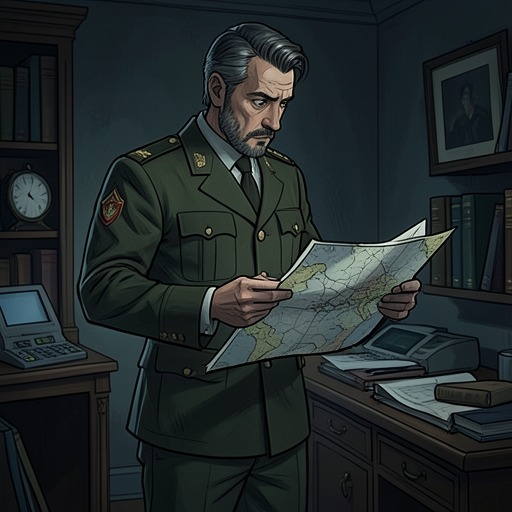
The expedition’s early interpretations remain provisional. Rohan considers whether hidden aquatic beings might inhabit the ocean and have developed an underwater civilization, but Captain Horpach rejects the idea as implausible, arguing that an intelligent aquatic species would eventually have taken the land. The map available to them is itself an instrument of limited knowledge: based on earlier unmanned probes, it shows only continental and oceanic outlines, polar icecaps, large craters, and the landing point at eight degrees north. The planet is thus encountered through acts of measurement and naming, but what is measured continually exceeds the map.
Rohan nonetheless chooses to remain close to the city because he believes that its secret lies there. His decision links scientific curiosity with a form of planetary attachment: he does not merely seek a safe assignment or accept the desert as an interchangeable alternative. When asked where he wishes to work, he selects the city and accepts additional Arctan automatons and hand-held lasers for the investigation. Yet even this investigative posture is unsettled when the ruins resist classification. After examining what appears to be the remains of a settlement, Rohan abruptly concludes that it was not a city, exposing the inadequacy of human architectural and civilizational assumptions when applied to Regis III.
Deep Time and the Shape of Regis III
As the investigation expands, Regis III becomes legible not as a blank landscape but as a layered history of biological extinction, mineral transformation, and mechanical persistence. Sedimentary rock contains ruddy-black, non-geological material that may have originated as metallic fragments deposited in an ancient burning rain. Over immense periods, oxidation and chemical reactions fused the fragments with the environment, creating brownish-black and dark-crimson seams. The expedition’s drilling reveals that these deposits are not isolated curiosities but part of a planetary pattern.
The geological record also reconstructs a vanished land biosphere. Fossils show that plants requiring dry conditions once flourished and that primitive reptiles inhabited the jungles roughly three hundred million years ago. Life on land appears to have arisen twice. The first biological world ended abruptly around a hundred million years ago, probably after a nearby nova; later life returned in new forms, though the evidence is too fragmentary for precise classification. The planet never produced mammal-like forms, and in more recent strata biological traces become increasingly rare while metallic material becomes increasingly abundant.
The relation between biological disappearance and metallic accumulation remains puzzling because radiation alone cannot explain the extinction. Metallic layers dated to between eight and six million years ago contain localized radioactive centers and evidence of violent nuclear reactions, but the total radiation is estimated at only twenty to thirty megatonnes spread across hundreds of thousands of years. That quantity could not have posed a serious threat to biological evolution across the planet. The more defensible conclusion is therefore not a simple radioactive catastrophe but the emergence of a different evolutionary regime, one in which inanimate mechanisms became decisive while continental life disappeared.
This planetary history also reframes the question of life. A biologist tells Horpach that life exists in the ocean but not on land, while the land fossils are more than five million years old. Rohan’s earlier speculation about underwater beings is gradually displaced by a broader possibility: the oceans retain biological processes, perhaps including algae that help account for the atmosphere’s oxygen, while the continents have been shaped by mechanical evolution. Regis III is not dead in any absolute sense. It contains incompatible or separated modes of persistence, and the human expedition mistakes the absence of familiar land life for the absence of life altogether.
Human Investigation and the Ethics of Occupation
The expedition’s methods reveal the colonial structure of its encounter with Regis III. Human teams map the planet, remove geological samples, excavate ruins, drill into ancient strata, and debate what the remains might signify. The city and the metallic seams are treated as evidence to be possessed and interpreted, while the question of whether humans have the right to remain is postponed until the planet’s dangers become impossible to ignore. Even the proposal to send the commander images of the ruins rather than a verbal account shows how the expedition converts an unfamiliar place into a record for distant institutional judgment.
The mining investigation makes that posture materially consequential. Further research requires the removal of large masses of earth and the construction of an underground adit, where workers cannot rely on the protection of the force field. The discovery, about seventy feet down in an iron-oxide seam, of rusted fragments resembling microscopic mechanisms intensifies the suspicion that the metallic strata are connected with the ruins and with the planet’s later history. Scientific inquiry thus becomes inseparable from physical penetration of the planet, and the desire for certainty exposes personnel to new danger.
On the nineteenth day after landing, violent clouds and an electrical storm force the mining teams to abandon their excavations. Lightning strikes the force-field dome, floodwaters submerge the walkways, and the storm forms a black, lightning-riven wall over the ocean. The men find tiny black metal specks scattered across the sand on their return. Regis III responds to investigation not through a visible act of hostility but through environmental processes that overwhelm the expedition’s controlled workspace. The planet’s weather, geology, and mechanical formations together make the distinction between natural hazard and adversary increasingly unstable.
Horpach resists leaving without certainty. He wants samples of the flying mechanical fauna aboard the Invincible so that the expedition can return more than a hypothesis; he also worries that such formations might eventually threaten space travel in the region. This demand expresses the institutional logic of scientific and military exploration: uncertainty is treated as an unacceptable condition, and the planet must yield a diagnosis before humans can withdraw. Rohan’s later understanding challenges precisely this logic, asking whether the right to know can justify continued interference.
From Hostile Enemy to Planetary Process
The black mechanical cloud initially appears to be an opponent with intention. Its attacks, its ability to disrupt communications, its freedom of movement, and its capacity to regenerate make it seem like an organized enemy. Yet the expedition’s analysis proposes that these mechanisms may be inanimate products of evolution rather than a reasoning civilization. They are not described as intellectually superior; they are perfectly adapted to Regis III’s conditions and destroy whatever is alive or intelligent because that is how their inherited survival process operates.
This distinction changes the moral structure of the encounter. The cloud can scatter when struck, multiply after partial destruction, and migrate to another continent if one region is attacked. Human weapons, however powerful, cannot reliably eliminate it without destroying the planet itself. An antimatter strike might devastate a local concentration, but the swarm’s dispersal and regenerative capacities make total victory impossible. If the formations are treated as a force of nature, retaliation for the Condor becomes as irrational as punishing the ocean for sinking a ship.
The Cyclops battle dramatizes the destructive dead end of the human response. The vehicle fights while reversing toward the ravine entrance, apparently seeking open ground, as atomic explosions collapse rock and confuse fire, smoke, cloud remnants, and debris. A later antimatter burst converts the air, rubble, steam, gases, and smoke around the Cyclops into hard radiation, splitting the ravine and enclosing the cloud in an annihilating blast half a mile wide. The Invincible, forty miles away, rocks under the shock; seismic waves cross the desert, heat strikes those sheltering beneath vehicles, and a wall of sand moves across the wilderness. Human technology can produce a spectacle of planetary violence, but the scale of the strike does not establish human mastery.
Rohan’s altered perception reaches its clearest form after the encounter with the clouds. During a single day, his attitude toward them changes so thoroughly that he no longer seeks shelter when two clouds approach through the ravine. He remains protected by a concealed device and does not court danger, but his stillness matters: he observes rather than immediately attacks. The clouds gather, form columns, interpenetrate, and absorb a spherical mass of black mechanical particles. What resembles a battle may only be a process of organization or redistribution. The apparent drama belongs partly to the human observer, who instinctively translates unfamiliar activity into conflict.
Rohan’s Transformation and the Meaning of Regis III
Rohan’s authority to interpret Regis III derives from bodily exposure. He has crossed its ravines and hills on foot, mixed his sweat with its terrain, and breathed its native atmosphere. His insight therefore differs from the expedition’s abstract theories: it is not simply a conclusion reached from instruments but an understanding acquired through endurance and proximity. The planet’s beauty, including the black vegetation and purple-lit cliffs, becomes perceptible to him even amid exhaustion and danger, and this perception signals that Regis III has ceased to be merely a problem to solve.
The transformation is not sentimental. Rohan does not discover a benevolent nature, nor does he deny the deaths caused by the mechanical formations. He knows that the missing men are almost certainly dead, and he returns through a battlefield of melted transporters and intensely radioactive rock. His movement downhill becomes a race against lethal radiation, with oxygen tanks opened to maximum flow and the red counter dial marking the danger. The planet remains capable of killing him; ethical respect does not require denying its indifference or its violence.
What changes is the interpretation of that violence. Alone aboard the Invincible, Rohan recalls the deaths and questions the fury directed toward the cloud. Since Regis III is uninhabited by humans, he asks what justifies sacrificing more men in order to destroy an inanimate process that was first mistaken for a lurking enemy. He recognizes that the expedition trusted cannons and sensors too readily, made errors, and is now trying to convert its own misjudgment into a campaign of retribution. The planet did not necessarily ambush the Condor or plan the expedition’s ruin; human beings imposed those intentional categories upon an unfamiliar process.
Rohan’s revised idea of galactocentrism is consequently a principle of restraint rather than expansion. Humanity has not earned the right to claim universal understanding merely by seeking beings that resemble humans. To occupy an empty place may be permissible, but to attack an existing equilibrium because it does not fit human expectations is not. Regis III’s survival is neither morally better nor worse than the survival of animals or humans; it is simply a material and energetic process that has endured for millions of years. The planet’s decisive lesson is that existence does not need to resemble human life in order to possess its own continuity and claim against interference.
Rohan therefore wishes to return not only as a messenger reporting the destruction of the missing men but also as someone demanding that Regis III be left alone. His relationship with the planet culminates in a refusal of conquest. The expedition begins by asking what Regis III contains and how its secrets can be secured; Rohan ends by asking whether humans have the right to take anything from it at all. In this reversal, the planet becomes an ethical subject without becoming a humanized character: its silence, geological depth, mechanical swarms, oceanic life, and indifferent survival force the human observer to abandon anthropocentric certainty.
Narrative Significance
The Rohan–Regis III relationship joins scientific investigation to a critique of planetary possession. Regis III is surveyed, mapped, excavated, sampled, weaponized, and interpreted, but its most important effect is to expose the limits of those procedures. The landscape is not a passive background for human adventure. Its deserts, oceanic division, ancient extinctions, metallic deposits, storms, radiation, and autonomous clouds generate the conditions under which human purposes fail.
The relationship also contrasts human solidarity with the swarm’s replaceability. Human beings regard each crew member as unique and therefore worth extraordinary risk, while the mechanical swarm gains survival value from the interchangeability of its individual units. Rohan’s encounter with Regis III reveals that the clash is not simply between humanity and an enemy but between incompatible evolutionary and ethical systems. Human values remain powerful within the crew, yet they cannot automatically govern a world whose persistence is distributed across inanimate mechanisms rather than individual lives.
For Rohan, the planet’s refusal to become an enemy, a colony, or a solved scientific puzzle produces the most consequential form of contact: self-limitation. Regis III does not communicate a doctrine, request recognition, or offer a reciprocal alliance. It changes him by remaining irreducibly other. His final understanding is that not everything everywhere belongs to humans, and the relationship ends when he carries that recognition back toward the Invincible as both information and warning.