The discovery of the Condor
The InvincibleThe discovery of the Condor is the expedition’s first direct encounter with the material evidence of the earlier mission’s catastrophe. When the Condor is located 180 miles from The Invincible, the investigation transforms an abstract disappearance into a physical mystery: the ship is still present, but its crew has been reduced to bones, its interior has been violently disordered, and the nature of the force responsible remains unreadable. The event establishes the central problem of Regis III—not simply how to survive an attack, but whether the planet’s destructive agency can properly be called an enemy at all.
The Signal and the Approach
The investigation begins when an alarm interrupts the group’s examination of the ruins. Rohan answers the call, recognizes Horpach’s voice, and receives the news that another team has found the Condor. The abruptness of the announcement changes the emotional temperature of the expedition: speculation about the planet’s missing civilization gives way to an urgent return, because the wreck may provide the first concrete explanation for the disappearance of the sister mission.
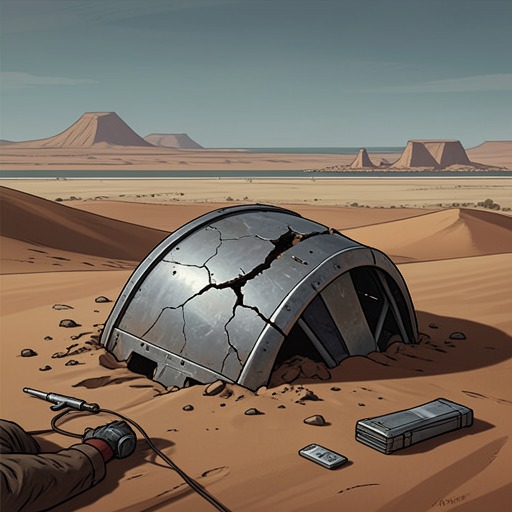
The Condor appears from a distance like a crooked tower, its outline distorted by dunes shaped by the prevailing wind. The western sand rampart rises higher than the eastern one, while tractors near the vessel are almost buried and even the immobilized antimatter cannon is half submerged. Only the stern jets remain exposed in a hollow sheltered from the wind. The transporters form a broad defensive ring, their rays joined into a force field, while the men and inforobots stop roughly a hundred feet from the sand gathered around the ship. The approach is therefore both archaeological and military: the explorers are entering a site of death while assuming that whatever destroyed the Condor may still be present.
The first visible objects complicate any simple account of a battle. The ramp hangs about twenty feet above the ground, as though its descent had been interrupted, while the personnel elevator remains fixed in position with its cage empty. Oxygen canisters protrude from the sand, their aluminum surfaces still bright; a plastic container, jars of preserves, surveying instruments, cameras, telescopes, tripods, and mess kits lie scattered across the hollow. Some are intact and others damaged. Their disorder suggests that objects were thrown or expelled from the ship, yet there is no immediately visible combatant, crater, or conventional pattern of attack.
The Bodies and the Ship
Rohan’s discovery gives the scene its irreversible meaning. He notices a pale yellowish sphere under a thin layer of sand, turns it over with his boot, and picks it up before realizing that it is a human skull. The shock draws the attention of everyone nearby. Further searching reveals more bones, fragments, and a complete skeleton still wearing a jumpsuit. An oxygen mask remains between the jaws, and its pressure dial is fixed at 46 atmospheres. When Jarg turns the valve on the attached canister, gas escapes with a prolonged hiss. The dry desert has preserved the steel regulator from corrosion, making the equipment seem operational even though the person who depended on it is long dead.
The physical arrangement of the Condor resists a single explanation. Its elevator can be operated from the cage, but the electrical system is dead, forcing technicians to climb the forty-meter structure by rope. When Rohan, Ballmin, Hagerrup, and Kralik reach the ship, they see that the titanium-molybdenum outer casing has been pierced in countless places. The marks are shallow and closely spaced, like chisel points, but no known chisel could dent the riveted hull. Rohan concludes that the damage may have been chemical rather than mechanical, although he has no opportunity to determine the process before entering the airlock.
Inside, the wreck presents a sharp contrast between preserved order and incomprehensible ruin. The emergency generator has restored the lights, and the upper deck remains clean and brightly lit, with only isolated objects—an oxygen mask, a plastic plate, a book, and part of a spacesuit—abandoned on the floor. The lower decks, however, including the cartography and star cabins, messes, crew quarters, radar rooms, engine room, passageways, and gangways, are filled with chaos. The bridge is worse still: every glass monitor and dial appears to have been destroyed, with shatterproof glass reduced to silvery powder across consoles, chairs, cables, and switches.
The library bears evidence of destruction that is both violent and strangely deliberate. Microfilm lies unspooled in tangled masses; books are torn, compasses and slide rules are broken, and analytic tapes are scattered. Cameron’s large star catalogues have been treated with particular fury, their thick plastic pages ripped out one by one. In the clubroom and projection room, heaps of crumpled clothing and strips of leather torn from upholstery block the way. In the navigation cabin, a mummified body lies curled against the wall beneath a tarpaulin, its brown skin clinging to the bones. The ship is not merely damaged; its instruments, records, furnishings, and bodies have all been subjected to a force whose pattern the investigators cannot yet recognize.
From Wreckage to Hypothesis
The uncanny resemblance between the Condor and The Invincible intensifies the horror of the discovery. The two vessels are sister ships, so their identical cabins should be reassuring evidence of shared design. Instead, every familiar corner of the Condor recalls the frenzy that has marked the lost ship. The expedition’s own vessel becomes visible within the wreck as a possible future: the same corridors and rooms that organize human life can be converted into a field of pulverized instruments, scattered clothing, and preserved corpses.
The investigation also reorients the expedition’s scientific questions. Earlier, Rohan and the others had wondered whether Regis III might contain an underwater civilization, since the planet showed oxygen and possible traces of life in the ocean while its continents were barren. The planet appeared extremely old, perhaps six billion years, and its sun had nearly become a red dwarf. Yet the Condor could not be explained by a simple aquatic attack or by the ruins of a former city. Rohan eventually states that the site they have been exploring was not a city, a conclusion that strips away the most familiar human framework for interpreting the planet.
Subsequent geological research deepens rather than resolves the mystery. Sedimentary strata contain ruddy-black layers of material that are non-geological and non-planetary in origin, apparently metallic fragments deposited millions of years earlier and transformed through oxidation and chemical reactions. Fossils show that land life once flourished, including dry-land plants and primitive reptiles, but it disappeared over a period of millions of years as metallic layers began to form. The total radiation associated with the layers amounts to only twenty to thirty megatonnes spread across hundreds of millennia, insufficient to explain the destruction of biological life. The evidence therefore suggests a connection between the planet’s metallic deposits, the ruins, the Condor disaster, and a long process that cannot be reduced to a single explosion.
A biologist later states the ecological distinction plainly: life exists in the ocean, but not on land. Land organisms vanished more than five million years ago, while the ocean remained alive. This division supports the emerging hypothesis that a technological or artificial process may have become independent of its creators and entered a form of evolution outside biology. The Condor is consequently not only a wreck to be examined; it is a historical object linking human death to a planetary history measured in millions of years.
Consequences for the Expedition
The wreck forces the crew to abandon any comfortable division between exploration and combat. Horpach insists that the expedition cannot return with hypotheses alone. He wants certainty: an accurate diagnosis, established facts, and, if possible, samples of the flying mechanical fauna believed to exist on Regis III. His concern is not framed as revenge for the Condor, but as the need to determine what the expedition has encountered and whether the formations might eventually threaten space travel elsewhere in the galaxy.
That demand for certainty produces a dangerous momentum. The exploratory teams continue to investigate the ravines and metallic seams. When a storm releases violent electrical discharges, tiny black metal specks—the infamous “flies”—are found scattered across the sand and brought back for examination. A further expedition under Regnar’s command sets out with twenty-two men, supplies, vehicles, robots, the Condor’s mobile cannon, and a dozen Arctan automatons equipped with excavators and drills. Communication with the convoy fails after increasingly severe interference, even though television reception is relayed from outside the atmosphere and should not depend on the ionosphere. The failure resembles a metallic wall descending somewhere in the desert, and the loss of contact leads Horpach to dispatch reconnaissance craft.
The discovery of the Condor thus becomes the precedent for later losses. It teaches the crew that their communications, force fields, sensors, and weapons do not guarantee comprehension or control. The Invincible can wake itself from hibernation, activate its reactors, deploy energobots, and raise an invisible protective dome, yet the Condor shows how quickly technological infrastructure can become useless or unreadable. Later, while moving through the ship at night, Rohan hears an unidentified crewman say that the missing expedition is dead after exposure to a thousand roentgens within a radius of five miles. The earlier wreck has already made such news imaginable, but not intelligible.
Ethical and Narrative Significance
The Condor investigation is the event through which Rohan’s interpretation of the mission begins to change. At first, the wreck naturally invites the language of ambush, enemy action, and retaliation. The dead crew, the damaged hull, and the wrecked instruments seem to demand an adversary. Yet the accumulated evidence gradually undermines the assumption that destruction requires a conscious attacker. Horpach can speak of samples, diagnosis, and possible future danger; the biologists can imagine an evolved mechanical species; but none of these explanations restores the human scale of intention to the catastrophe.
Rohan eventually recognizes the expedition’s responsibility in harsher terms. Humanity had trusted too much in cannons and sensors, entered a situation it did not understand, and sent people toward danger through its own mistakes. The desire for conquest at any cost and the impulse to avenge fallen comrades appear less heroic than rash. His reflection leads to a broader conception of galactocentrism: not the search for beings resembling humanity, but the recognition that humans should not interfere in processes that do not concern them. The Condor’s dead therefore alter the meaning of survival. Their fate is not simply a challenge to be answered by greater force; it is evidence that the explorers may have mistaken an ancient equilibrium for an enemy.
The discovery also gives the novel one of its strongest reversals. A missing ship normally promises clues to a crime, and the scattered equipment, destroyed bridge, and preserved remains initially encourage that expectation. But the investigation ends by widening the unknown rather than solving it. The Condor reveals what happened to its crew only in the most immediate sense: they died amid an assault whose mechanism and agency remain uncertain. Its deeper revelation is that Regis III may contain a form of nonbiological evolution—an active survival established over immense time—that cannot be judged by the moral vocabulary of human warfare. The wreck is therefore both a crime scene and a warning against treating every unexplained existence as a hostile one.