The exploration of the Regis III ruins
The InvincibleThe exploration of the Regis III ruins is the expedition’s first sustained attempt to give physical meaning to the structures seen from orbit. What appears from a distance to be a city proves to be a dead, eroded, and radically nonhuman formation: a place where scientific observation, military preparedness, and the desire to name an alien past repeatedly confront the limits of human interpretation.
Approach and Mission
The Invincible landed at a carefully selected site almost three and a half miles north of the ruins, close enough for the formations to be clearly visible from the bridge. Their angular silhouettes, generally broader at the base than at the top and extending for several miles, seemed unmistakably artificial. They were blackish, sometimes metallic in their gleam, and so riddled with holes that even the most powerful telescope could not resolve their details. The apparent city therefore became both an object of scientific inquiry and a possible source of danger.
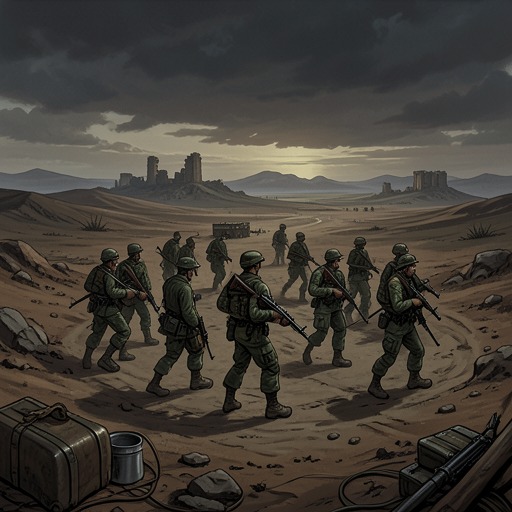
The landing procedure preserved that double status. The Invincible extended its ramp and elevator scaffolding, surrounded itself with energobots, and assembled a protected mobile column. Five rovers gathered inside the force field, accompanied by a larger vehicle carrying a mobile antimatter cannon. Rohan led the mission, standing in the open turret of the first rover while the ship prepared to open a passage through its defensive field. Infobots marked the route with long-action green flares, and the vehicles advanced in pairs, with a scout robot hovering ahead of them.
The convoy was not merely a group of explorers carrying instruments. It was a moving system of shields, weapons, sensors, and repair machines. Three unmanned craft established a local force field at the edge of the ruins, the two manned vehicles continued within the mobile protection, and the antimatter cannon followed behind on jointed legs. When one of its limbs fell into a concealed gap beneath the sand, two Arctan automatons dropped from the lead rover and freed it. Even before the expedition reached the structures, the planet had forced the humans to depend on a network in which machines performed navigation, defense, rescue, and interpretation.
The Ruins and Their Appearance
The formation called a city was unlike any terrestrial settlement. Dark edifices were submerged to an unknown depth in shifting dunes and rose several stories above the sand. They had no recognizable windows, doors, or walls. Some resembled tangled nets folded and crosshatched in every direction, thickening where their elements intersected. Others suggested spatial arabesques made from mutually penetrating honeycombs or sieves with three- or five-sided openings. Their regularity was unmistakable, but it was not the homogeneous regularity of a crystal; it repeated in rhythms interrupted by decay.
Other structures consisted of angular branches twisted together into arches or opposing spirals. Some projected vertically from the sand, while others leaned like drawbridges. Wind from the north had filled their horizontal surfaces and shorter overhangs with fine sand, making distant sections resemble truncated pyramids. At close range, the apparent smoothness broke apart into shaggy rods and slats, so tightly enmeshed that they retained sand within their meshes. The ruins repeatedly invited comparison with geological or biological forms, then defeated each comparison through their alien geometry.
Rohan initially imagined cubic or pyramidal rock remains overgrown by dead vegetation. That impression disappeared as the expedition approached. The structures were neither solid nor empty: gaps allowed the explorers to see into them, yet the entire interior was filled by the same metallic tangle. They had no evident chamber to enter, no surface that promised an intact room, and no visible center from which their design could be understood. Their dominant quality was not the presence of a vanished population but an emptiness devoid of life.
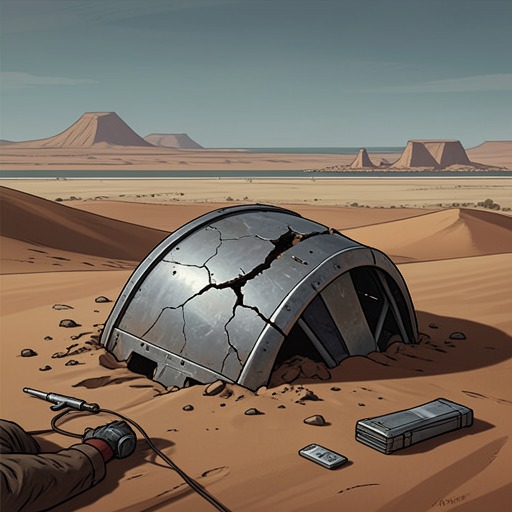
Sand, rather than inhabitants or machinery, supplied the only continuous movement. Wind drove stinging dust between the bastions, slowly filling the regular black openings and forming small cones around their bases. The antennae, Geiger counters, ultrasonic microphones, and radiation sensors remained silent. The column heard only the crunch of sand beneath its wheels and the intermittent whine of engines as the vehicles changed formation, passing in and out of the cool shadows cast by the ruins.
Survey, Fissure, and Oceanward Route
The expedition eventually reached a tectonic fissure roughly a hundred yards wide. It appeared bottomless and was certainly deep, since windblown sand had not filled it. Rohan sent a flying robot scout across the gap, but its cameras returned only more of the same formations. After recalling the scout, he consulted Ballmin and the physicist Gralev and decided to examine the ruins more closely rather than treat the distant images as sufficient evidence.
He then used an ultrasound probe to estimate the depth of the sand covering the supposed streets. The work was laborious, and successive soundings contradicted one another, probably because the bedrock had undergone internal decrystallization during the shock that produced the great crack. The trough-shaped depression seemed to contain twenty to thirty feet of sand. This uncertainty mattered: even the basic geography of the site could not be separated from the geological violence that had buried and distorted it.
The column turned east toward the ocean, following a winding route through ruins that grew lower and more deeply submerged in the dunes. Eventually the structures vanished, and the explorers reached sandless rock on a high cliff. The waves sounded far below as only a faint whisper. This naked, unnaturally smooth strip marked the cliff line, which rose northward into peaks reflected in the ocean. The movement from the black formations to the sea also reinforced the expedition’s central planetary question: if the land was dead, perhaps the ocean preserved the living history that the ruins could not disclose.
That possibility had already entered the crew’s discussion. Rohan suggested that concealed aquatic beings might have developed an underwater civilization, while Horpach rejected the idea as implausible, arguing that an intelligent aquatic species would have attempted to conquer the land. Earlier, Horpach had characterized Regis III as an ancient, declining planet, perhaps six billion years old, orbiting a sun approaching the condition of a red dwarf. Poor insolation outside the equatorial zone and immense polar icecaps made an ocean expedition seem more promising than a search for ordinary land life, yet the absence of terrestrial life remained inseparable from the mystery of the ruins.
From Archaeological Mystery to Planetary History
The exploration did not produce a readable city, a surviving population, or a recoverable technology. When asked what he should tell the commander, Rohan was advised to send televisual images of the entire site. He then concluded that the place was not a city at all. This was more than a correction of vocabulary. It marked the failure of the expedition’s first interpretive framework: the structures could not be treated as a human-style settlement merely because their regularity implied design.
Later geological work gave that failure a much larger temporal dimension. Sedimentary strata contained layers of ruddy-black material of non-geological, non-planetary origin, as if immense quantities of metallic fragments had once fallen onto an ancient basalt shield and gradually oxidized into seams within the rock. The specialists considered a gigantic nickel-iron meteor that had exploded in the atmosphere, though other hypotheses linked the deposits to the catastrophe of the Lyran system and to possible atomic clashes during an attempted colonization of Regis III.
The strata also contained organic carbon, fossils of dry-land plants, and evidence that primitive reptiles had lived in jungles roughly three hundred million years ago. Land evolution appeared to have occurred twice. After an abrupt extinction perhaps a hundred million years ago, possibly caused by a nearby nova, life returned in new forms. Yet later layers showed fewer and fewer traces of plants and animals while metallic “loam” containing antimonite, molybdenum oxide, iron oxides, and nickel, cobalt, and titanium salts increased.
The most puzzling metallic layers dated from eight to six million years ago. They were relatively shallow, sometimes strongly radioactive, and seemed to preserve violent but localized nuclear reactions. Nevertheless, the total radiation was calculated at no more than twenty to thirty megatonnes spread across hundreds of thousands of years, insufficient to explain the destruction of biological life. The pattern remained clear even when its mechanism did not: land life disappeared over several million years at the same time that the metal strata appeared.
The connection with the ruins strengthened when drilling, undertaken despite the dangers of working beyond the force field, found rusted shapes about seventy feet down in an iron-oxide seam. They resembled corroded fragments of microscopic mechanisms. The expedition had begun by looking for the remains of a civilization above ground; it now confronted the possibility that the planet’s deep geological record preserved the material traces of systems whose makers had vanished millions of years earlier.
Communication Failure and Ethical Consequences
The ruins investigation also unfolded within a wider chain of failed contact and escalating uncertainty. When an alarm interrupted discussion aboard the expedition, Rohan learned that another team had found the Condor a hundred eighty miles away. Later, during a northern expedition led by Regnar, radio and television contact deteriorated near buried ruins and then broke off completely. The simultaneous degradation of ordinary radio and externally relayed television suggested that a wall of metal had descended somewhere in the desert, blocking communication with the team a hundred miles from the Invincible.
These failures transformed the ruins from a historical puzzle into a strategic threat. Horpach insisted that hypotheses were not enough: the expedition needed certainty, an accurate diagnosis, and samples of the supposed flying mechanical fauna before deciding whether it could leave. He also warned that such formations might eventually threaten space travel in the region. Against this demand for knowledge secured through extraction and possible force, Rohan increasingly understood the danger of treating the unknown as an opponent simply because it resisted human explanation.
Rohan’s later reflection recast the whole exploration. Humanity had trusted its cannons and sensors too readily, made mistakes, and was now paying for them. The idea that humans possessed a right to conquer or annihilate whatever did not resemble them appeared to him as an immature form of galactocentrism. A place could be occupied, he recognized, but that did not authorize an attack on an existing system that had established an equilibrium of survival over millions of years. The ruins therefore become the expedition’s most eloquent evidence that Regis III is not an empty background awaiting human meaning. They are fragments within a planetary history whose agents may be mechanical, whose evolution may be inanimate, and whose silence does not make it available for possession.