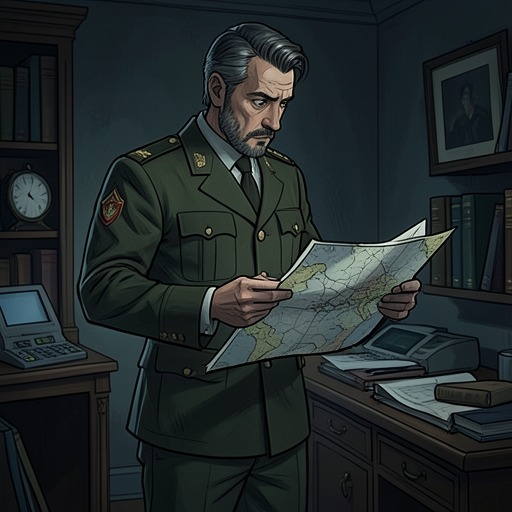
Weyr gun
The InvincibleThe Weyr gun is a compact nuclear weapon carried in a holster and used by the expedition’s personnel on Regis III. Its decisive significance lies in the contradiction built into its design: it is meant to preserve human life, yet its power is so disproportionate to the user’s judgment that a moment of confusion can transform a rescue scene into a massacre. The weapon is therefore not merely equipment. It is a material force that repeatedly rearranges the relations among intention, survival, memory, and responsibility.
Definition and Military Function
The weapon belongs to the expedition’s normal technological arsenal, alongside transporters, energobots, force fields, and breathing apparatus. Its destructive capacity is illustrated by the radioactive traces left by its fire and by the explanation that the expedition’s most violent means include an antimatter strike, although the Weyr gun itself remains a distinct hand-held weapon. The surviving account treats it as powerful enough to destroy a robot and fatally injure a human at close range, while also emphasizing that the black mechanical cloud can disperse when attacked and is not something that can simply be eliminated by concentrated fire.
The Weyr gun consequently occupies an uneasy position in the expedition’s strategy. Human beings depend on machines for their operations, and their weapons are necessary for defense, but the cloud has freedom of movement, virtually inexhaustible means of regeneration, and immunity to forces fatal to biological life. Even a weapon capable of producing lethal radioactive damage cannot solve the larger problem. The gun offers local protection, not mastery over the planet’s self-sustaining mechanisms.
The Condor Rescue and Accidental Catastrophe
The weapon’s most terrible human use occurs when Rohan reaches the survivors of the Condor expedition. The men do not recognize him and appear calm, but their slow, clumsy movements show that they are unable to understand the vehicles around them. One of them, a radar technician and friend of Jarg, handles a transporter hatch as though he had never encountered such an object. Their condition explains the round hole burned through a partition on the Condor’s bridge and reveals that the expedition’s disaster involved more than an external attack.
A man sitting among the rocks draws his Weyr gun and accidentally pulls the trigger. The purple flash bursts above Rohan, and the shooter continues emptying the nuclear magazine as though he were enjoying fireworks. Rohan crawls among the boulders while heat sears the air. The gun’s destructive force is made grotesquely banal by the shooter’s behavior: the weapon remains technically functional, but the mind directing it has lost the ability to assign meaning to its operation.
Jarg then runs toward the gunman, apparently trying to stop him. Before he can halt, a shot strikes his left shoulder and severs his arm. The gunman does not seem to notice what he has done. He rises and advances with the bent, tottering movements of an infant carrying a rattle, while continuing to fire. The comparison makes the weapon’s danger inseparable from the survivor’s damaged consciousness: the Weyr is not transformed into a toy, but its nuclear violence is treated by the amnesiac man as if it were one.
Rohan fires only when another seated man is nearly hit in the face. He acts reflexively rather than after a deliberated decision, and the shot kills the gunman, whose own weapon falls onto the rocks. This moment distinguishes defensive necessity from revenge. Rohan has to use the same kind of weapon in order to prevent further deaths, but the necessity does not restore moral clarity to the scene. The Weyr gun saves the remaining men from immediate danger only by adding another death to the disaster.
Evidence in the Search for the Missing Men
The Weyr gun also becomes physical evidence during Rohan’s search. He follows a blood trail into a channel beneath a bare rock fin and finds a broken robot foot beside a dead man in a soot-blackened helmet. The body is Regnar, leader of the expedition attacked in the crater. The radioactive readings show that Regnar was struck by a Weyr blast, with the counter detecting the characteristic presence of rare-earth isotopes. His geological bag still contains rock samples, linking the weapon’s aftermath to the expedition’s scientific mission as well as to its combat.
Rohan cannot determine whether Regnar fired at the robot or whether the robot attacked him or Bennigsen. The Weyr gun establishes the physical fact of the fatal blast without resolving the sequence of intention. That uncertainty matters because the men’s amnesia has erased the mental evidence that might have explained the encounter. The weapon preserves an energetic signature while leaving human motives inaccessible.
Later, near a dried stream bed, Rohan discovers an unidentifiable headless corpse in a scorched jumpsuit. A damaged but undamaged-enough holster beside the body contains a battered Weyr gun that shines as though newly polished, and Rohan takes it. Here the weapon passes from an unknown dead man into the hands of the living searcher. It is both a remnant of the expedition’s failed attempt to defend itself and a practical resource that may extend Rohan’s ability to survive. The recovered gun carries no name and no explanation, only the mute residue of violence.
The Weapon Against the Nonhuman World
The Weyr gun’s human-scale violence forms part of a much larger technological conflict. The black mechanical cloud does not behave like an army with a unified command. It scatters when struck, moves from one location to another, and can regenerate or multiply after destruction. The expedition’s weapons therefore produce spectacular local effects without creating a decisive victory. Their power is real, but it is strategically insufficient against an inanimate system adapted over millions of years to destroy intelligent and living forms.
The distinction between the Weyr gun and the cloud’s mode of survival becomes central to the expedition’s ethical crisis. The cloud is not presented as a conscious enemy seeking revenge; its actions arise from an inanimate evolutionary process. A Weyr blast can kill a person or damage a robot, but it cannot make the planet’s mechanisms answerable to human moral categories. The weapon thus exposes the error of imagining every destructive force as an opponent that can be punished into submission.
The contrast reaches its most violent scale in the battle between the Cyclops and the black mechanical cloud. The clash culminates in an antimatter burst that converts the air, debris, steam, gases, and smoke around the Cyclops into intensely hard radiation, splitting the ravine and enclosing the cloud in an annihilating zone half a mile wide. The Invincible, forty miles away, rocks from the strike; seismic waves cross the desert, nearby vehicles shift, and a wave of heat and sand reaches those sheltering beneath them. The Weyr gun is not the weapon responsible for this planetary-scale event, but its presence belongs to the same continuum of escalating force: the expedition’s portable violence exists within a technological order capable of turning a local battle into a geological disturbance.
Material Agency and Narrative Significance
The Weyr gun repeatedly ceases to be a transparent tool and becomes conspicuous as an object. In the Condor survivors’ hands it is detached from coherent human purpose; in Rohan’s hands it becomes an instrument of reflexive rescue; beside Regnar’s body it records a death without revealing its cause; beside the headless corpse it survives its owner and is reclaimed by another person. Each change of location alters what the weapon means and what it can do. Its physical persistence outlasts memory, identity, and intention.
This pattern also complicates the idea that technological superiority guarantees control. Rohan and the expedition possess formidable weapons, but the Weyr gun cannot prevent amnesia, cannot restore the minds of the Condor survivors, cannot explain Regnar’s death, and cannot defeat the black mechanical cloud. The object amplifies whatever condition surrounds it. In a competent hand it is protection; in a damaged mind it is indiscriminate destruction; in the aftermath it is evidence and salvage.
For that reason, the Weyr gun helps shift the narrative away from revenge and toward restraint. Rohan comes to understand that humanity has no right to attack every form of survival merely because it does not resemble biological intelligence. The weapon embodies the danger of the opposite belief: that possessing the means to destroy something creates the right to destroy it. Its repeated appearance makes technological power visible not as a guarantee of human supremacy, but as a burden whose consequences exceed the intentions of the person holding it.