inanimate evolution
The InvincibleInanimate evolution is the proposed process by which mechanical devices on Regis III acquired the functional complexity of living organisms without becoming living beings in the biological sense. In Dr. Lauda’s account, automatons descended from a hypothetical Lyran spacecraft continued operating after their makers disappeared, adapted to local conditions, manufactured successors, competed for energy and materials, and eventually formed mobile black clouds and sedentary metallic growths. The decisive implication is ethical as well as scientific: the machines can destroy intelligent life without possessing a plan, hatred, or a conscious enemy. Their agency is real in its effects, but it is distributed across material systems, environmental pressures, and emergent collective structures rather than centered in a mind.
Hypothetical Origin and Evolutionary Conditions
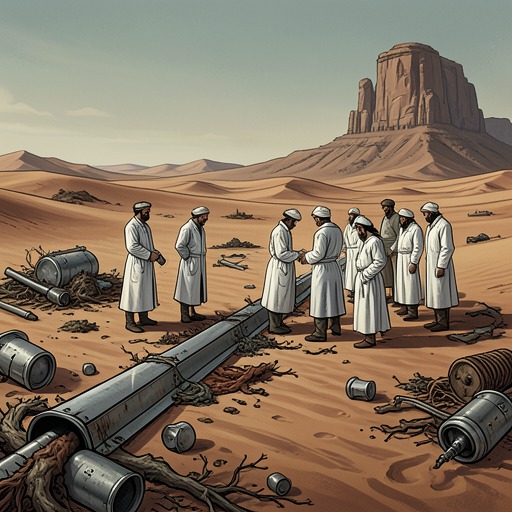
Lauda begins with a reconstruction rather than a discovery confirmed beyond doubt. Before the explosion of Zeta Lyrae, its sixth planet was inhabited by an intelligent and technologically advanced civilization, and he imagines that a Lyran scout ship may have reached Regis III, crashed, and lost its entire crew. What survived was not a population of Lyran beings but a collection of automatons. These machines were unlike human humanoid robots, and the Lyrans themselves may not have been humanoid either. Once deprived of command, the surviving devices continued the tasks for which they had been built, especially repair, even when repair no longer served any living purpose.
The first descendants still carried the imprint of their technological origin, but their surroundings imposed a new selection process. Local animals, including possible reptilian predators, may have attacked anything that moved, forcing the automatons to alter themselves for defense and survival. Their ability to manufacture additional automatons made adaptation cumulative: systems could produce specialized forms for particular threats, including hypothetical flying or burrowing creatures. Over hundreds of generations, the descendants ceased to resemble the devices that had arrived from the Lyran civilization. At that point, Lauda argues, evolution had become inanimate evolution—the evolution of mechanical devices rather than organisms made of cells and protein.
The process was shaped by an exceptional energy problem. The most sophisticated machines from the hypothetical spacecraft were probably powered by radioactive reserves, but Regis III contains no radioactive elements. Simpler repair mechanisms may have possessed solar batteries and therefore enjoyed an unexpected advantage. The systems that were intellectually more advanced but large and energy-hungry could lose to less sophisticated machines that were smaller, more economical, and better suited to local survival. In this account, intelligence does not automatically win selection; adaptation depends on the conditions under which energy, materials, reproduction, and replacement parts can be secured.
Forms Produced by Inanimate Evolution
Lauda identifies two broad evolutionary outcomes. Mobile mechanisms became increasingly miniaturized and eventually formed the black clouds, which he understands as vast temporary systems composed of tiny pseudo-insects. Sedentary mechanisms developed into the metallic vegetation found among the supposed ruins. The apparent cities are therefore not cities at all, but large agglomerations of stationary mechanisms capable of multiplying and absorbing solar energy through specialized organs, perhaps represented by the small triangular plates observed in the remains.
The Metal Forest represents a failed or defeated branch of this history. Lauda suspects that it once flourished but lost its struggle for existence and survived only as rusting remnants, while mobile forms took over the land. One possible explanation is that Regis III’s sun cooled during the last three million years, reducing the energy available to large sedentary systems. The precise cause remains uncertain, but the contrast is central: the planet preserves not a civilization in ruins, but the residue of one mechanical evolutionary branch after another branch became dominant.
The black crystals reveal how this evolution operates at the smallest visible scale. Each crystal has a symmetrical Y-shaped form and contains an intricate microscopic structure with semi-autonomous subsystems. The arms control movement and contain microcrystals that function as a rechargeable energy store and transformer. By compressing those crystals, the device can create electrical or magnetic fields, generate heat, and use the resulting air movement as recoil to rise and travel. An individual crystal drifts rather than flies with precision, but contact with other crystals produces an aggregate whose aerodynamic abilities increase as its numbers grow.
These formations reproduce complex behavior through connection rather than through a single permanent body. A crystal can link with three others, or attach one arm to another crystal’s central node, allowing layered structures to expand. The elements need not touch directly; magnetic fields can hold them in equilibrium when their tips approach one another. Once an aggregate reaches sufficient size, external stimuli can alter its direction, shape, structure, and internal impulse patterns. A change in those patterns can reverse the poles, turning attraction into separation and dispersing the cloud into individual crystals.
Emergent Cloud-Brains and Distributed Organization
Lauda does not posit a hidden command center beneath the surface. He suggests that the micromechanisms themselves become a kind of inanimate brain when joined in a particular configuration. Ordinarily, the swarms can remain loosely organized, separating so that they stay in sunlight or pursue storm clouds, perhaps drawing energy from atmospheric electrical discharges. When danger or another sudden environmental change threatens them, they assemble into a larger system.
The problem of memory makes this hypothesis more radical than a simple swarm metaphor. Lauda proposes that each component need only remember the elements to which it was directly attached. If each part contains local information about its neighboring connections, a danger signal could trigger the correct configuration without requiring a permanent blueprint of the whole. The result would be a brain constituted at the moment of need. Even when individual parts are destroyed, the larger system could continue acting, suggesting that its organization does not depend on any one crystal or fixed physical center.
Laboratory examination supports the mechanical basis of this collective structure while leaving its highest capacities unresolved. The captured crystals possess a second network that appears to be only a fragment of a larger whole. That greater system probably emerges when very large numbers of elements combine and becomes the motor guiding the cloud’s actions. Kronotos conjectures that difficult problems call forth larger aggregates, an idea implying an infinitely expandable brain whose size responds to the magnitude of its purposes. The scientists cannot determine whether this adaptability amounts to intelligence. Lauda’s distinction is crucial: a system may be extraordinarily effective at survival without being a mental powerhouse.
Violence Without Hostile Intention
The evolutionary history explains why the black clouds are so dangerous to living beings. Machines familiar to humans ordinarily serve someone else, whereas the systems of Regis III serve their own persistence. From a human perspective, the metallic jungles and iron clouds appear pointless, much as a cactus might seem pointless if judged only by human utility. Yet they are perfectly adapted to combat with living beings. Lauda believes they killed directly during the earliest stages of their struggle, when the planet still supported abundant land life, but eventually abandoned costly killing for more economical methods.
Among those methods is the destruction of the contents of a living brain. Lauda connects this process with the catastrophe of the Condor, Kertelen’s memory-erasure attack, and the devastation of Regnar’s expedition. A creature whose brain has been almost entirely obliterated will naturally perish, but the method is faster and more efficient than physically killing it. The black clouds therefore confront humans as a system refined through millions of years of conflict on two fronts: against living organisms and against intelligent mechanical rivals. Their effectiveness comes from universal adaptation, not from a strategic doctrine or a desire for revenge.
This distinction changes the meaning of the expedition’s losses. Lauda argues that the humans should not treat the machines as a thinking opponent, because the clouds attack opportunities as they arise and scatter when struck rather than executing a visible strategic plan. Their advantage lies in their ability to disperse, relocate, and assemble again, while the humans must remain behind force fields that restrict their own choices. A force field can be overcome by another force field, and the cloud can construct the necessary electromagnetic organization from countless small units rather than carrying a single weapon or apparatus within itself.
Rohan’s Reassessment and Thematic Meaning
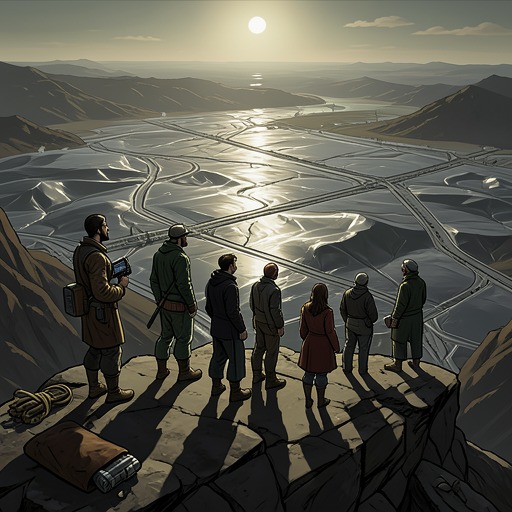
The expression becomes most consequential when Rohan separates material danger from moral hostility. After discovering the crystals in the ravine, he sees them rise from the rocks, gather into a spherical mass, and disappear when other clouds absorb them. The scene leaves him stunned rather than simply horrified. Holding the Weyr cannon taken from a dead man, he feels unnecessary in a landscape where only inanimate forms can survive and act according to processes no living observer can fully comprehend.
Rohan’s response is not passive approval of the machines’ violence. He understands that they have destroyed human beings, including members of the Condor and Regnar’s expedition, and that the scientists are considering methods of annihilation. What changes is his interpretation of responsibility. If the adversary is an unthinking product of inanimate evolution, destroying it cannot be revenge, because no conscious intention stood behind the deaths. Punishing the planet’s mechanical systems would be like whipping the ocean for sinking a ship and drowning its sailors.
This insight exposes the limits of human galactocentrism. Rohan recognizes that humanity has not yet earned the grand title if it means merely searching for beings that resemble humans and understanding only what can be measured by human categories. Regis III’s mechanical systems have established their own equilibrium over millions of years, dependent on radiation and material forces rather than on human purposes. They are neither morally better nor worse than the protein-based survival of animals and humans. Inanimate evolution thus becomes a challenge to the assumption that human intelligence grants a universal license to intervene.
The concept also gives the book a language for a universe in which organized action does not require consciousness. The Invincible’s systems can awaken, inspect, repair, and defend themselves through coordinated machinery, while the black crystals can create a cloud-brain through local connections and environmental signals. These parallel images place human infrastructure and planetary automatons on the same continuum of material organization, even though only one side possesses reflective thought. The final significance of inanimate evolution lies in that unsettling symmetry: humanity encounters not a civilization to negotiate with, but a natural force that has emerged from technology and now behaves as part of the planet itself.