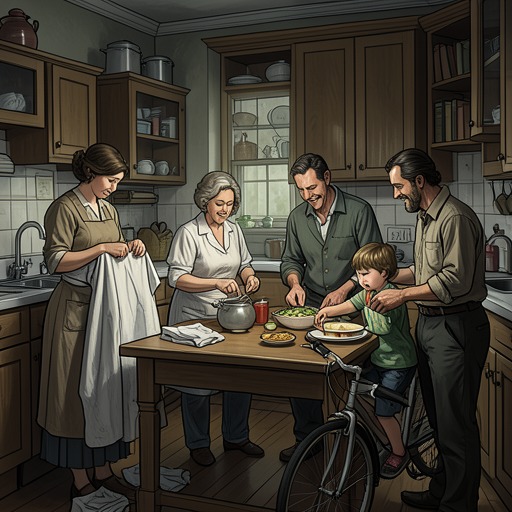
Anna Ruiz
The Journey CollectionAnna Ruiz is introduced as Cal Hendricks’s serious partner and as the primary caregiver for her younger brother, Ben Ruiz. Her responsibilities have forced her to mature quickly, but the narrative presents that maturity as active commitment rather than mere hardship: she balances school, two jobs, and Ben’s needs while still imagining a future in medicine. Through Anna, the story enlarges its idea of family beyond blood and places care, perseverance, and chosen loyalty alongside romantic attachment.
Identity and Background
Anna Ruiz is described as a striking woman with shoulder-length raven hair and midnight-black eyes, noticeably petite beside Cal Hendricks, who is six feet five inches tall. The contrast between them is treated with affectionate amusement, but Anna’s characterization quickly moves beyond appearance. She is nineteen when Travis McCoy discusses her relationship with Cal, who is roughly a decade older, and Travis recognizes that her age does not capture the extent of her life experience.
Anna’s accelerated adulthood began after both of her parents were killed in a car accident shortly after she turned seventeen. Her brother Ben was in the vehicle and suffered severe trauma to his frontal lobe; at ten years old, he consequently struggled academically and lost confidence despite being highly intelligent. With no practical parental support available—Anna explains that her parents were only children and that her grandparents were too old to care for a child with Ben’s needs—the responsibility fell to her. She accepts that responsibility without presenting it as a grievance. Her family’s insistence that relatives should care for one another becomes a principle she lives rather than merely repeats.
Responsibilities and Ambitions
Anna has graduated from high school a year early and is studying pre-med while working two jobs and raising Ben. She is completing her basic courses and hopes to finish them by the following fall, after which she will have to consider which medical school to attend. The combination of professional ambition and domestic labor makes her future demanding, but the text does not reduce either goal to an obstacle for the other.
Her account of Ben’s first appearance on the A honor roll in two years shows how closely she measures progress through effort and confidence as well as grades. She regards hard work and discipline as one of the greatest gifts she can give him, because his academic achievement matters in the context of the trauma he survived. Her emotion at describing his happiness is not embarrassment at weakness but evidence of how fully his struggles and victories occupy her attention. Anna’s ambitions therefore coexist with a sustained ethics of care: education is both her own path forward and a way of helping Ben recover a sense of possibility.
Relationships and Family
Travis McCoy first speaks of Anna while explaining that Cal has been seeing her for about a year and that the relationship appears serious. Russ McCoy is immediately concerned by the age difference, while Travis defends Anna as mature, hardworking, and good for Cal. Travis’s defense also reveals his own admiration for her ability to sustain school, employment, and guardianship under circumstances that would overwhelm many adults.
At dinner with Cal, Anna, Russ, and Travis, Anna is initially uneasy about meeting Russ. The tension eases as Russ speaks with her, and her shoulders gradually relax. She greets him respectfully, while Russ responds warmly and invites her to call him Russ. Their exchange helps place Anna inside the McCoy family’s social world rather than leaving her as an outsider defined only by Cal’s romance.
Anna’s understanding of family is deliberately inclusive. She identifies Ben as her family, then takes Cal’s hand and identifies him in the same terms. Cal answers that she and Ben are his family as well. This reciprocal declaration gives their relationship a structure deeper than attraction: Cal is not simply an older romantic partner but someone Anna regards as a participant in the household of obligations she has built around Ben. Russ’s favorable impression of her follows from seeing this combination of tenderness, discipline, and loyalty directly.
Connection to Travis McCoy’s Arc
Anna’s conversation with Travis provides a compact emotional mirror for his return to Clarendon. When she asks about Penelope Stone, Travis admits that Penelope never lost his heart, that he has loved her since he was fourteen, and that he was foolish to let her go instead of fighting for her. He calls Penelope the love of his life and Max McCoy the best part of himself, adding that he cannot wait to return to them because that is where he belongs.
Anna’s response is simple encouragement, but her presence gives weight to the confession. She is herself trying to build a future from responsibility, loss, and renewed attachment, so the conversation places Travis’s recovery of Penelope and Max beside her own work of making family endure. The contrast is important: Travis has spent years pursuing professional football and has missed ten years of Max’s life, whereas Anna has been compelled to remain present for Ben. Her story makes visible the cost of absence that Travis is only beginning to confront.
Narrative Role and Significance
Anna functions as a supporting character who broadens the novel’s recurring movement from isolation toward connection. Travis leaves Clarendon believing that football must come first and later recognizes the damage his absence caused Penelope. Anna’s life offers a different model of maturity: she does not abandon ambition, but she refuses to separate ambition from responsibility to the person who depends on her. Her future in medicine and her care for Ben are presented as mutually reinforcing commitments.
Her relationship with Cal also participates in the book’s pattern of second chances and expanded households. The narrative does not make Anna’s difficult past disappear once romance enters her life; instead, it shows Cal being welcomed into the family she has already created and Anna allowing Russ to see the person beneath the age difference that initially alarms him. In that sense, Anna’s significance lies in the way she turns survival into belonging. Her presence helps establish that family is sustained through work, recognition, and repeated acts of care, not simply through uncomplicated history or biological ties.