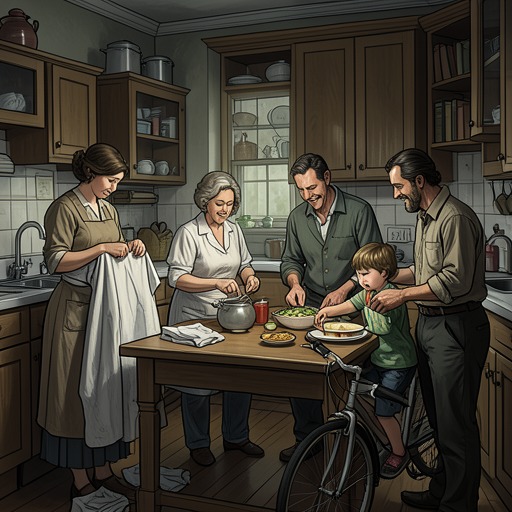
Anna Ruiz–Ben Ruiz relationship
The Journey CollectionThe Anna Ruiz–Ben Ruiz relationship is a sibling bond transformed into a caregiving partnership. After their parents died, Anna became responsible for Ben, whose severe frontal-lobe trauma made school and self-confidence difficult; her daily care, advocacy, and insistence on his potential make their relationship one of the clearest examples of family expressed through responsibility rather than sentiment alone.
Family Responsibility
Anna explains that Ben was in the car with their parents when he suffered severe trauma to his frontal lobe. The injury left him struggling to keep up with his classmates despite being, in her view, exceptionally intelligent. Because their parents were gone, and their grandparents were too old to manage a child with Ben’s needs, the responsibility fell to Anna. She does not present this as a burden she wishes to escape. Instead, she frames Ben as her family and treats caring for him as an obligation she accepts without complaint.
That responsibility also places Anna’s own life under pressure. She is working and studying pre-med while managing Ben’s needs, yet she interprets this demanding balance through the values their parents taught them: hard work, discipline, and loyalty to family. Her relationship with Ben therefore affects not only her private choices but also her ambitions. Education becomes a way to build a future while demonstrating to Ben that difficulty does not cancel the possibility of achievement.
Ben’s Recovery and Self-Confidence
Ben’s progress at school provides the relationship’s most concrete measure of hope. Anna tells Russ McCoy that Ben has made the A honor roll for the first time in two years. For another student, the achievement might seem ordinary, but for Ben it represents a meaningful advance after trauma and prolonged difficulty keeping pace with his class. Anna is proud not simply because of the grade, but because Ben came home happy. His happiness signals a recovery of confidence that matters as much to her as the academic result.
Anna’s account resists reducing Ben to his injury. She acknowledges the neurological damage and its consequences, but she also insists that he is highly intelligent and capable. Her care combines practical advocacy with an active refusal to let other people define him only by what he has lost. The relationship is thus built around both protection and expectation: Anna supports Ben’s limitations while continuing to recognize his abilities.
Chosen Family and Mutual Belonging
Anna’s understanding of family extends beyond the narrow structure left by their parents’ death. During dinner with Cal Hendricks and Russ McCoy, she identifies Ben as her family and then includes Cal in that same emotional circle. Cal answers that Anna and Ben are his family as well. The exchange gives the sibling relationship a wider social setting: Anna cares for Ben, but she is not represented as entirely alone, because her bond with Cal creates another form of mutual belonging around them.
This broader family structure also explains Anna’s nervousness about meeting new people. Cal worries that others will judge her by her age rather than take the time to know her, while Anna’s life has been shaped by responsibilities that outsiders may not immediately understand. Russ approaches her with respect and interest, asking about Ben rather than treating him as an embarrassing complication. His acceptance allows the relationship to be seen within a developing network of family connections rather than as an isolated private hardship.
Narrative Significance
Anna and Ben’s relationship offers a counterpoint to the damaged family relationships elsewhere in the story. Travis McCoy’s absence from Max’s first ten years results from competing choices, silence, and fear, while Anna’s response to loss is continued presence. She cannot undo Ben’s trauma or restore their parents, but she can accompany him through its consequences. The contrast makes family care an active practice: presence, advocacy, patience, and recognition.
The relationship also supports the novel’s larger distinction between biological identity and lived parenthood. Ben is Anna’s brother by birth, yet the scale of her care gives the relationship a quasi-parental dimension without erasing its sibling foundation. Her commitment shows that family roles can be reorganized by crisis, and that love becomes visible through the work required to protect another person’s dignity. Through Anna and Ben, the story presents family not as a fixed arrangement but as a continuing promise to remain responsible for one another.