Clarendon High School football
The Journey CollectionClarendon High School football is both a team and a civic inheritance in Travis McCoy’s story: it gives him his first vision of the life he wants, turns him into a local legend, and later becomes the setting in which he learns that home can still receive him. The Broncos’ field is not merely a place where games are played. It is the ground of Travis’s childhood dream, the public stage of his return, and the communal space where football is finally joined to memory, family, faith, and responsibility.
Origins and Local Meaning
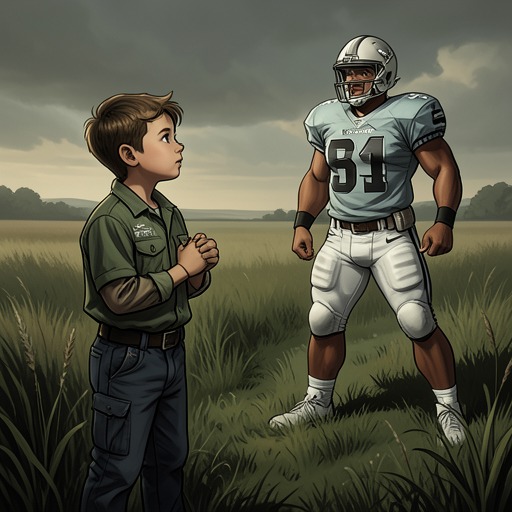
Travis’s attachment to Clarendon High School football begins shortly after his fifth birthday, when Russ McCoy drives him to Austin, Texas, to watch Clarendon High School football win the state championship for the first time in the school’s history. Travis does not yet understand the rules or fundamentals. What captures him instead is the spectacle: opposing players meeting at the forty-yard line, helmets colliding, the crowd’s roar, and the winning touchdown sending the stadium into celebration. The experience gives form to an ambition that will define him: he wants to stand on that field and play the game he has fallen in love with.
The team therefore functions as the origin point of Travis’s athletic identity rather than simply its first employer or school affiliation. His later professional success with the Miami Sharks rests on a desire first awakened by the Broncos. When a hard hit damages his right shoulder and threatens his ability to play again, the injury does more than interrupt a career. It places the entire identity built around that childhood vision in doubt. Travis remembers the field as the place where he had shed sweat, tears, and blood, and the memory makes the possibility of losing football feel like losing a part of himself.
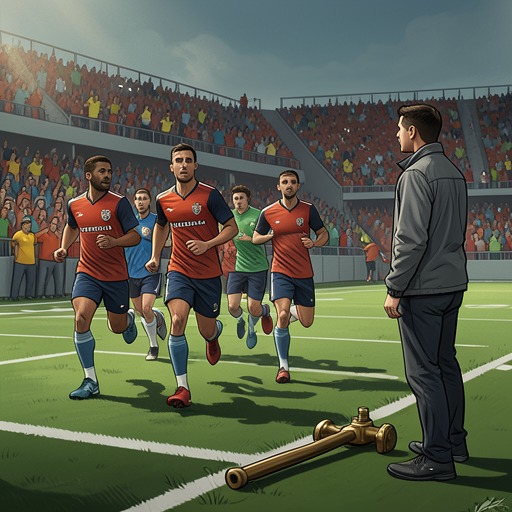
The Broncos also carry a distinctly communal meaning. Homecoming is organized around the school’s football tradition, and the team’s games bring together students, teachers, parents, and townspeople. The gym is filled with maroon jerseys, white numbers, school posters, cheerleaders, and the chant “Go, fight, win.” The team’s colors and symbols turn a school contest into a shared public language, one capable of joining elementary-school children, current players, former champions, and older residents in a single local identity.
Travis McCoy’s Return to the Team
After six seasons of professional football, Travis returns to Clarendon at a moment when his shoulder has made his future uncertain. Jack Garrison’s invitation to the week-long homecoming celebration specifically invokes the inspiration Travis represents. The current players had begun playing pee-wee football when Travis led the school to its second championship, and they have grown up treating his achievement as a model. Their request that he come home transforms him from distant celebrity into a living connection with the school’s recent history.
At the pep rally, Travis initially remains hidden at the gym’s doorway, second-guessing his decision to return. The packed bleachers, standing spectators, cheerleaders, maroon-and-white decorations, and varsity players in uniform recreate the public world he once both loved and hated. His hesitation gives the return its emotional tension: the team welcomes him as an icon, but the familiar setting also forces him to confront what he surrendered when he left Clarendon.
When Jack introduces him as a member of the championship team and one of the school’s most successful alumni, Travis answers by refusing the easy pose of the untouchable hero. He tells the players to enjoy every moment on the field, play the game they love, and give it everything they have. Rather than presenting victory or fame as the essential lesson, he directs attention toward commitment to the game itself. His advice is especially significant because his own career is ending; football’s value must survive even when his body can no longer sustain the role that once defined him.
The players then ask Travis to lead them through the Lord’s Prayer. Kneeling together, they place the team within a ritual that is simultaneously religious, communal, and athletic. Afterward, they run through the inflatable tunnel as the band plays the fight song. Travis follows them to the field, where the grass, painted yard lines, and large maroon C return him to his senior year, before the offer from the University of Texas and before he left town. The same symbols that once marked the beginning of his departure now make him question whether leaving had been worth the cost.
Homecoming and the Transfer of Belonging
Travis’s second public encounter with the Broncos deepens the meaning of his return. At the homecoming pep rally, the band plays the fight song, the players enter before the crowd, and the cheerleaders lead the Pledge of Allegiance before the national anthem. The ceremony places football beside civic and national ritual, while the annual rivalry with the Gruver Greyhounds supplies the competitive focus. A drought has forced the cancellation of the traditional bonfire, but the rivalry’s spirit remains, showing how local tradition can persist even when one of its physical ceremonies disappears.
Jack identifies Travis as a former championship leader, but Travis redirects the crowd’s admiration toward the present team. He acknowledges that the players may regard him as a role model for refusing to abandon his dreams, then insists that their own dedication has inspired him. He points to the spectators who endure ninety-degree heat and twenty-degree snow to glimpse the players’ passion. The team’s importance thus moves in two directions: Travis once gave the community a champion to celebrate, but the current players now give Travis evidence that the game still possesses a form of purity beyond professional ambition.
Before the game, Travis leads the Broncos from the field house through the inflatable tunnel. At midfield, surrounded by the crowd’s noise, he tells them that the cheering has been earned through hard work and respect. He calls them men with the courage of an entire community behind them, although they are still boys in age. Jack observes that Travis’s presence has set off a spark in them and that they no longer look like the same team. The change is not presented as a tactical improvement but as a transformation in confidence, visibility, and communal accountability.
The game itself begins according to football’s formal structure: the Greyhounds win the coin toss and choose to receive, so the Broncos kick off. Yet the narrative has already shifted the stakes away from the scoreboard. Travis recognizes that the community’s pride will not depend entirely on victory or defeat. The game matters because the players have become custodians of the town’s faith, and because Travis has re-entered the social world from which he once separated himself.
From Athletic Fame to Mentorship
Clarendon High School football gives Travis a new role when his professional role disappears. The Miami Sharks can offer him a coaching position after his shoulder ends his playing career, but Travis declines because his future now lies with Penelope Stone and Max. His decision does not mean that football has become irrelevant. Instead, his return to the Broncos shows him how football can be practiced as teaching, remembrance, and service rather than as the sole measure of his worth.
His relationship with the players is therefore built on reciprocal recognition. The young Broncos admire the former champion, but Travis tells them that they are an inspiration to him. He no longer stands above the game as its celebrated professional representative. He stands at its edge, guides the players onto the field, speaks to their responsibilities, and then returns to Penelope, Max, and Russ McCoy. The movement from center field back toward family dramatizes a reordering of priorities: the team remains sacred, but it no longer excludes the rest of his life.
The team’s rituals also help reunite Travis with the people he loves. During one crowded pep rally, Max sits among the elementary-school children and waves at him, while Penelope Stone watches from nearby. Travis realizes that his love for Penelope has survived their separation and that he wants her and Max as a family. The football gathering becomes the setting not only for public recognition but for private moral clarity. The community’s welcome, later echoed in Cal Hendricks’s assurance that Travis is always welcome home, allows Travis to imagine belonging as something he can recover rather than something permanently lost.
Symbolic Function and Legacy
By the time Travis marries Penelope, the football field has become a ceremonial space for family as well as sport. The wedding is arranged at the fifty-yard line beneath a white wooden arch, with white chairs, gold satin bows, lanterns, balloons, and an aisle runner extending across the field. The setting carries the visual memory of the Broncos into a new rite of passage. The place that once launched Travis toward an individual athletic dream now witnesses his incorporation into a family.
That transformation reaches its clearest form when Max stands between Travis and Penelope to light the eternity candle. The act makes the field’s communal symbolism personal: the former player, the woman he has loved since adolescence, and the son whose legal name Travis wants changed to McCoy are joined before witnesses as a family. The later request to change Max’s surname confirms that Travis’s return to the team has been part of a larger return to responsibility. Football supplies the language of homecoming, but fatherhood supplies its lasting consequence.
Clarendon High School football consequently embodies the tension between departure and return. It first sends Travis outward, toward the University of Texas and professional fame, and later receives him back when injury and emotional reckoning force him to reconsider what success has cost. Its championship history makes him visible, its players make him useful, and its field gives form to his reintegration. The Broncos’ decisive legacy is not only the victories attached to their name, but their role in teaching Travis that a life once organized around the crowd’s applause can be reorganized around love, mentorship, and home.