Cody Holland
The Journey CollectionCody Holland is the Clarendon Broncos’ quarterback and one of the clearest beneficiaries of Travis McCoy’s return to Texas. He is introduced through his play on the field, where quick judgment matters as much as physical strength, and developed through the pressure of a state championship game against a much larger Panthers team. Cody’s leadership turns athletic skill into collective resolve: he reads danger, acts decisively, speaks for his teammates, and helps carry the Broncos to a state title. His later connection with Travis extends beyond football, linking the former professional player’s past identity to a new role as coach, teacher, and adult mentor.
Identity and Background
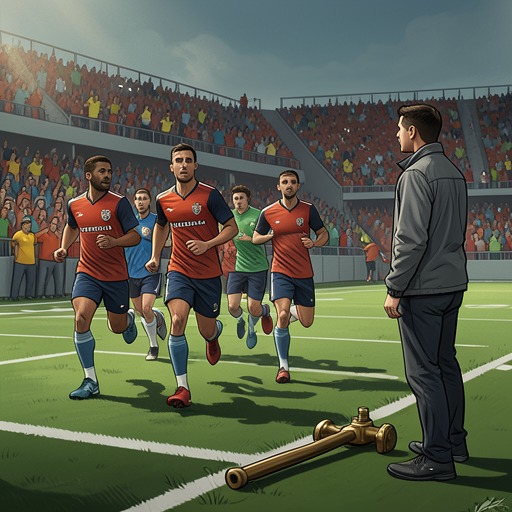
Cody is presented as a young quarterback whose position requires him to interpret the field almost instantaneously. During the championship game, he receives a snap, searches for an open receiver, recognizes that no pass is available, and changes course when a Panthers linebacker rushes from his left. He tucks the ball, runs to the right, spins away from a tackle, and gains five yards before being brought down. Travis admires the sequence because Cody does not freeze when the planned play fails; he sees the immediate problem, makes a decision, and acts on it.
Cody’s ability is set against a pronounced physical disadvantage. The Panthers’ six linemen and linebackers are all at least six feet two inches tall, with weights ranging from just under two hundred pounds to almost three hundred fifty. The contrast makes the Broncos’ effort appear strategically and emotionally demanding, particularly beside Trey Williams’s two-hundred-seventy-five-pound frame. Cody therefore functions not as an invulnerable prodigy but as a quarterback whose judgment must compensate for circumstances that seem designed to overwhelm his team.
Leadership Under Pressure
Cody’s most important contribution comes when the Broncos are struggling and the size of the opposing defense has begun to shape the team’s confidence. He steps through his teammates, acknowledges that the team is being dominated, and rejects the idea that the mismatch excuses surrender. His speech frames effort as a standard rather than a guarantee of victory: if the players give everything and still lose, they can at least leave knowing they put everything on the field. He refuses to settle for less from himself or from the players around him.
That declaration changes the emotional direction of the team. Trey Williams answers that he is not a quitter, while Andy recalls the Broncos’ comeback against the Bobcats and calls for the same aggressive identity against the Panthers. Cody’s leadership is consequently communal rather than ornamental. He does not simply deliver instructions from the huddle; he gives the other players a language for recovering their pride. The team’s response shows that his authority depends on shared labor and shared memory, not merely on the quarterback’s formal position.
Championship Performance
Cody’s leadership is confirmed by the plays that follow. He throws a pass toward a receiver who initially appears absent, but Andy finds the ball as it spirals downward and secures it before being tackled after enough yardage for a first down. On the next play, Cody fakes a lateral toss, spins, and runs to the right while Trey Williams blocks an approaching Panther. The sequence combines Cody’s deception and mobility with his teammates’ protection, making the offense a visible expression of the trust he had demanded from them.
The decisive moment comes after the Broncos reach the opportunity for an extra point. Cody calls for the snap but stumbles backward and finds no receiver open on either side. Rather than force an unsuccessful pass, he tucks the ball, dodges the linemen, spins left around a linebacker, finds a gap, and falls across the goal line. The officials signal that the two-point conversion is good. His choice is risky, but it is also consistent with his earlier principle that the championship game is precisely the moment when courage matters. The play converts uncertainty into victory and helps deliver the Broncos a state title.
The celebration gives Cody’s achievement a broader meaning. The crowd’s response includes tears of joy and embraces between strangers, while the players remove their helmets and acknowledge Travis from the sideline. Cody’s performance belongs to the entire community, yet the recognition also confirms his individual growth: the quarterback who had faced a larger team without yielding has helped become one of the men the town celebrates.
Relationship with Travis McCoy
Cody’s relationship with Travis is shaped by football but is not limited to it. Travis recognizes Cody’s reflexes and explains the perceptual skill behind his decisions by comparing the field to a grid. In this exchange, Travis is no longer only reliving his own professional experience; he is translating that experience into instruction that Cody and Max can understand. Cody becomes one of the young athletes through whom Travis’s former identity as a player is converted into useful knowledge.
After the championship, Cody remains close enough to Travis to appear at the birthday celebration in Travis’s home with his friends. He jokes about Travis’s startled reaction to finding the boys inside the house, then turns to a serious concern: a recruiter from Texas Tech University is pressuring him to make a decision. The conversation places Cody at another threshold, one involving education, athletics, and the future beyond Clarendon. Although the available evidence does not state what decision he makes, his later presence at Texas Tech University is confirmed through the success of Cody Holland, who reaches the Dean’s List and leads the Red Raiders to their first national championship in a decade.
Development and Narrative Significance
Cody’s trajectory extends the book’s concern with football as an identity that can be transformed rather than simply abandoned. Travis sees in Cody the qualities required for a successful athlete—quick perception, decisiveness, risk-taking, and endurance—but Cody also shows that those qualities become meaningful only when joined to responsibility for others. His championship speech and performance make him a younger counterpart to Travis: both understand football as work, judgment, and communal commitment, while Travis eventually learns that his own future cannot remain confined to professional competition.
Cody also helps mark the continuity between generations. He is a player whom Travis can teach, a quarterback who can lead teammates through fear, and later a successful student-athlete whose achievements exceed the immediate Friday-night contest. His arc moves from pressured decision-maker on the field to a figure associated with academic and collegiate success. In that progression, Cody embodies the possibility that the discipline learned in football can become a durable form of character, while Travis’s role in his development demonstrates that leaving professional football does not mean leaving the game’s values behind.