Forgiveness and Reconciliation
The Journey CollectionForgiveness and Reconciliation names the slow repair of relationships damaged by abandonment, grief, secrecy, and years of mutual misreading. In the story, reconciliation is not a single sentimental absolution. It develops through confrontations in which characters acknowledge what they did, hear the pain they caused, and then demonstrate changed commitments through family, love, and shared ritual. The process reaches beyond the reunion of Travis McCoy and Penelope Stone: it also includes Travis McCoy’s damaged bond with Russ McCoy, Travis McCoy’s acceptance of Max as his son, and the wider family’s decision to recognize the new McCoy household.
The Wounds That Make Reconciliation Necessary
Travis McCoy returns to Clarendon carrying an old accusation against Russ McCoy. After Loralie McCoy was diagnosed with Acute Lymphoblastic Leukemia, Travis McCoy watched his mother fight through two years and numerous rounds of chemotherapy before she became too weak to continue. She died when Travis McCoy was eleven. From his childhood perspective, Russ McCoy’s time in the workshop became evidence of abandonment: the father seemed to be building unnecessary things while Loralie McCoy was dying, leaving Travis McCoy to hold her hand and confront a loss he was too young to understand.
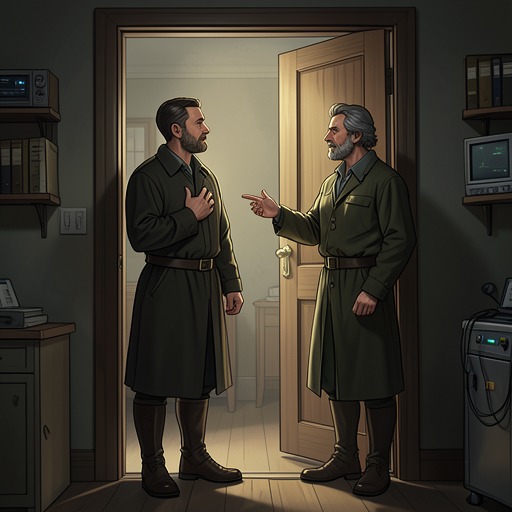
That grief hardens into a moral division between the son who stayed beside Loralie McCoy and the father whom Travis McCoy believed had failed her. When Russ McCoy arrives home, Travis McCoy immediately demands to know whether he knew about Max. The question joins two injuries at once: Russ McCoy’s silence about Travis McCoy’s son and the older wound of Loralie McCoy’s illness. The confrontation shows how unreconciled grief can make every later silence feel like proof of the same betrayal.
The separation from Penelope Stone carries a different but connected responsibility. Penelope Stone explains that she did not know she was pregnant when Travis McCoy left; she discovered the pregnancy two months later and drove to Austin to tell him. She had been frightened, especially after Travis McCoy told her they should see other people so that temptation to cheat would not exist. By the time she reached him, she believed he had already moved on. Travis McCoy’s departure and Penelope Stone’s decision not to disclose Max’s existence therefore produce a shared history of harm rather than a simple division between innocent victim and guilty offender.
Truth, Accountability, and Witnessing
Travis McCoy’s first movement toward reconciliation is not self-defense but recognition. He admits to Sherman Stone that he did wrong by Penelope Stone and cannot change the man he was ten years earlier. He does not demand Sherman Stone’s forgiveness; instead, he places greater weight on the judgment of Penelope Stone and Max, the two people most directly affected by his absence. This is a crucial distinction in the novel’s moral structure. Forgiveness is not treated as a right that the offender can claim, and regret is not allowed to substitute for responsibility.
The same principle governs Travis McCoy’s relationship with Russ McCoy. Earlier, Travis McCoy tells Russ McCoy that he had worked relentlessly for his scholarship and then had to prove himself among players from much larger schools, while Russ McCoy never came to watch him play or acknowledged the achievement. Travis McCoy says that he had already lost Loralie McCoy and, through one decision, lost Russ McCoy as well; he also tells his father that Russ McCoy was not the father he had needed. The accusation is harsh because it is specific: it names absence at the exact moments when Travis McCoy needed recognition.
Russ McCoy’s later letter supplies testimony that direct argument could not. He recalls promising to take four-year-old Travis McCoy onto the tractor, then discovering a picture of father and son clenched in the sleeping child’s hand. The image brings Russ McCoy to his knees and changes his action: he takes Travis McCoy into the field, where the boy sits on his father’s lap, laughing and talking. Russ McCoy also tells Travis McCoy that he has always been proud of him and that Loralie McCoy would look down with pride. The letter does not deny the workshop, the missed games, or the years of hurt. It reveals that Russ McCoy’s love existed beneath his failures, allowing Travis McCoy to receive an emotional truth that had previously been inaccessible to him.
The letter becomes effective because Travis McCoy reads it aloud with Max beside him. When Max begins to leave, Travis McCoy pulls him onto his lap and asks him to stay. The scene brings three generations into one act of witnessing: Russ McCoy speaks from the past, Travis McCoy receives the testimony in the present, and Max becomes part of the repaired family rather than a bystander to its old conflict. Travis McCoy has already forgiven Russ McCoy for abandoning him, but the letter allows him to accept Russ McCoy’s love at last. Forgiveness here means integrating love with injury, not pretending the injury never occurred.
Repairing the Romantic and Parental Family
Travis McCoy’s reconciliation with Penelope Stone is built around an explicit admission of the harm his choices caused. He tells her that he left her and Max alone because he had hurt her too deeply for her to tell him about their son. Penelope Stone, in turn, accepts responsibility for her silence, explaining that her parents urged her to tell Travis McCoy and give him the choice to be present, but she chose not to listen. Their renewed relationship therefore depends on mutual candor: neither character is reduced to a villain, and neither is freed from the consequences of what happened.
Love becomes credible through repeated acts of presence. Travis McCoy tells Penelope Stone that he cannot promise she will never cry, but he can promise to be there whenever she does, holding her and soothing her pain. The promise directly answers the loneliness that Max remembers from the years before Travis McCoy returned. Max had heard Penelope Stone crying and feared a return to that sadness; Travis McCoy responds by making care, rather than grand romantic language alone, the measure of his commitment.
The proposal transforms private remorse into a public future. Travis McCoy explains that he has loved Penelope Stone since he was fourteen and asks her to be his forever. He then links the proposed marriage to Max’s place in the family, requesting that Max’s last name be legally changed to McCoy. The request is not merely a legal detail. For Travis McCoy, sharing the name means taking visible responsibility for the son whose existence was once hidden from him and making fatherhood part of the family’s recognized identity.
Rituals of Reentry and Belonging
The homecoming pep rally and football field give reconciliation a communal form. Travis McCoy hears the band, the students, parents, and fans, and remembers both hating and loving the Friday gatherings of his youth. When he leads the team from the field house through the inflatable tunnel, the crowd’s response makes the stadium feel unlike the professional venues where he once played. Standing on the fifty-yard line, he experiences the moment as an embrace associated with being home.
His speech to the players extends the work of repair beyond private family life. He tells them that the crowd’s cheers have been earned through hard work and that they should be proud of the men they have become. He also insists that the community’s respect matters more than whether the team wins or loses that night. The scene reverses the terms by which Travis McCoy once measured himself. Football no longer functions only as proof of individual achievement; it becomes a means of returning to a community and helping younger players belong within it.
The wedding completes this reentry through ceremony. Travis McCoy and Penelope Stone exchange vows for richer or poorer, in sickness and in health, and in good times and bad. Max stands between them to light the eternity candle, making the child central to the marriage rather than an afterthought to it. The family is thus created through a visible, shared act witnessed by the community. Reconciliation moves from conversation to structure: the renewed relationship becomes a household with promises, names, and rituals that can endure beyond the immediate emotion of reunion.
Meaning and Limits of Forgiveness
The novel presents forgiveness as a practice of renewed responsibility. Travis McCoy tells Penelope Stone that he loves her and credits her support for his transformation, while Penelope Stone answers that she is proud of him and that she never gave up on him. Their exchange emphasizes reciprocity: his change is not achieved alone, and her forgiveness is not passive surrender. It is sustained by his willingness to remain present for her and for Max.
At the same time, the narrative preserves the cost of the past. Travis McCoy cannot make himself into the man he was not ten years earlier, and Penelope Stone cannot undo the years in which Max grew up without his father. Russ McCoy cannot restore Loralie McCoy’s life or recover the childhood in which Travis McCoy needed him. What can change is the interpretation and use of those losses. Russ McCoy’s letter turns silence into testimony; Travis McCoy’s confession turns defensiveness into accountability; Max’s inclusion turns biological revelation into lived fatherhood.
The later family celebration, in which Russ McCoy discovers the ultrasound photograph and learns that another child is coming, shows reconciliation extending into the future. The family gathered around the picture is no longer organized solely by the wounds that separated its members. The photograph becomes evidence of continuity: Loralie McCoy’s absence remains part of the family’s history, but the family now responds to loss by making room for new life. Forgiveness and Reconciliation therefore functions as the story’s ethical movement from inherited grievance toward chosen participation, where love is proven not by forgetting old pain but by refusing to let that pain determine every future relationship.