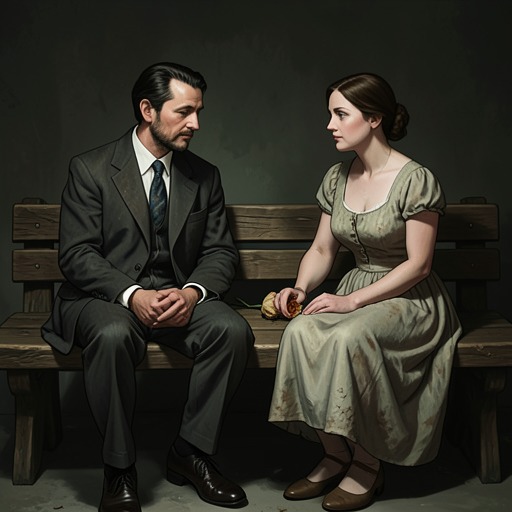
Russ McCoy’s widowhood and remarriage
The Journey CollectionRuss McCoy’s widowhood and remarriage form a story of grief carried forward rather than erased. After losing Loralie McCoy, Russ remains devoted to her memory, yet eventually chooses a life with Nadine. The narrative makes room for both attachments: his later happiness does not mean that he has stopped loving his first wife, and his remarriage becomes a way to continue living without disowning the past.
Widowhood and continuing attachment
By the time Russ considers marrying Nadine, grief is still present in his relationship with Loralie. Travis McCoy urges his father to let himself move forward, telling him that Loralie would not want him to grieve in a way that prevents happiness. Russ acknowledges the point, but his willingness to consider another marriage does not depend on forgetting her. The distinction matters: the story treats moving on as making space for a new relationship, not exchanging one beloved person for another.
Loralie remains part of the family’s present through what she left behind and what she anticipated. When Travis is preparing to marry Penelope Stone, Russ gives him gold cufflinks shaped like footballs. Loralie had ordered them when she became sick and had asked that they be given to Travis on his wedding day. The gift thus reaches the ceremony after her death, carrying her affection into a major family milestone. Russ explains that Travis had been her greatest gift to him; the object joins his remembrance of Loralie to his support for his son’s future.
The exchange also brings Russ and Travis closer. Russ is Travis’s best man, and he helps him put on the cufflinks. Travis says that Loralie would have loved Penelope; Russ replies that she did, recalling that she had expected the two to fall in love from the time they ran through the fields holding hands. In this moment, Loralie’s memory is not confined to private mourning. It becomes part of the family’s account of Travis and Penelope’s relationship, and Russ is able to share that memory with his son.
Choosing a future with Nadine
Russ first tells Travis that he intends to propose to Nadine. He does not yet know when he will do it, saying he will recognize the right time, but he asks whether Travis will be all right with his decision. That request makes the engagement a family transition as well as a private choice. Russ is not simply announcing a new relationship; he is checking that his son can accept a changed family life. Travis responds supportively, encouraging his father to believe that Loralie would want him to find happiness.
Russ proposes to Nadine on Christmas morning, while Travis, Penelope, and Max are opening presents. Nadine comes into the house and shows them the small, oval diamond ring on her left hand. The announcement takes place amid the family’s holiday gathering, so the proposal is immediately witnessed and welcomed by the people closest to them. Travis stands and hugs his father. He is surprised that Russ has taken this step so soon, but glad that his father will have someone to care for him.
The scene registers a change in Russ through the response of his son. Travis is amazed by the happiness on Russ’s face, and understands the proposal as a major step toward letting go of Loralie enough to be happy again. Yet the narrative does not describe this as the end of grief. Russ’s continuing love for Loralie remains explicit later, making the Christmas proposal a beginning rather than a closure: he can accept care and companionship while still holding his first marriage in memory.
A second wedding, shaped by experience
Russ and Nadine choose to marry in Red River because both have already been through large weddings. Travis, Penelope, and Max travel there to witness the ceremony. Their decision gives the wedding a distinct scale and setting from the earlier family celebrations, while keeping its central meaning in the vows and the people present. The family’s attendance makes Russ and Nadine’s marriage part of a shared life, not a relationship kept apart from the children and their partners.
At the ceremony, Russ promises to love and honor Nadine in sickness and in health, in good times and bad. Those vows have particular weight for Travis, who once felt that his father had disregarded the promises he made to Loralie. He now recognizes that Russ thinks of Loralie every day and never stopped loving her; he has found a way to be happy with Nadine as well. The wedding therefore revises Travis’s understanding of his father. Remarriage is not presented as evidence that the first vows have been discarded, but as a new commitment made by someone whose earlier love remains real.
Nadine’s own vows echo Russ’s, and the narrative likewise identifies her as someone who has not stopped loving her deceased husband. She has found a way to love Russ too. Their union is thus reciprocal in its understanding of bereavement: neither needs to claim that the former marriage no longer matters in order to make a promise to the living partner. After exchanging vows, Russ kisses Nadine, tells her he loves her, and walks up the aisle with her as Max follows. The simple public gestures affirm the new marriage without removing the history each spouse carries.
Family continuity and significance
Russ’s remarriage runs alongside the formation of Travis, Penelope, and Max as a family. At Travis and Penelope’s wedding, Russ stands beside his son; later, the family gathers again for Russ and Nadine’s marriage. These ceremonies place the generations in relation to one another: Russ’s new commitment is supported by Travis, while Loralie’s gift and remembered affection remain present at Travis’s own wedding. The family changes shape without requiring its earlier bonds to disappear.
The Red River wedding also coincides with a further change in the family. Penelope becomes emotional during the ceremony, and Travis learns that she is pregnant with another baby. The news arrives as Russ and Nadine begin their married life, bringing grief, remarriage, and the expectation of a new child into the same family gathering. It does not make Russ’s loss smaller; rather, it locates his renewed happiness within a continuing family life that includes remembrance, new partnerships, and the next generation.
The arc’s central distinction is between forgetting and moving forward. Russ’s happiness with Nadine is compatible with his enduring love for Loralie, just as his son’s wedding can carry a gift chosen by a mother who is no longer there. Through the proposal, the cufflinks, and the vows, the narrative presents remarriage not as a replacement of the dead but as permission for love and family to continue.