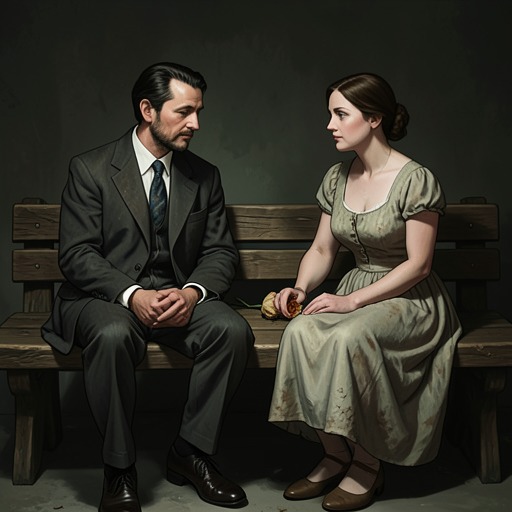
Russ and Nadine's wedding
The Journey CollectionRuss and Nadine's wedding is both a marriage ceremony and a public sign that damaged family relationships have entered a new phase. At dusk, in Brandenburg Park near the Red River Ski Area, Russ McCoy and Nadine exchange vows on a candlelit covered bridge, while Travis McCoy, Penelope Stone, and Max stand among the witnesses. The event gives formal shape to a love that has grown after bereavement and places Travis’s reconciliation with his father inside a larger family restoration.
Setting and Ceremony
At the brink of dusk, Travis escorts Nadine across the covered bridge. Lanterns and candles line the passage, creating a deliberate route from one side to the other and turning the park into a private yet communal ceremonial space. Russ, Penelope, and Max wait at the opposite end, so the wedding begins as a movement toward reunion rather than as an isolated exchange between the couple. Nadine answers Travis’s question about her readiness with confidence, and the two proceed slowly toward the people who will receive them.
When they reach Russ, Travis places Nadine’s hand in his father’s. Russ praises her appearance, and Travis reduces his advice to the essential duty of marriage: “Just love her.” Russ answers that he already does. The handover makes Travis a participant in, rather than merely an observer of, his father’s new life. It also reverses the emotional distance that had once defined the Travis–Russ relationship: Travis can now guide Nadine toward Russ and trust the couple’s bond.
Penelope then joins Travis, intertwining her fingers with his and leaning her head against his shoulder as the pastor from Faith Mountain Fellowship Church begins the service. The pastor describes finding true love once as a gift and receiving it a second time as a miracle. That language frames the wedding through recurrence and survival. Russ and Nadine are not beginning from untouched innocence; both have loved before, and both carry the history of a deceased spouse into their new marriage.
The Couple and Their Vows
Russ and Nadine repeat the vows that Travis and Penelope exchanged almost two years earlier. The repetition links the two marriages without making them identical. It gives the second ceremony the authority of a family pattern already tested, while also suggesting that love can be renewed after grief rather than invalidated by it. Nadine declares her love for Russ, and the narration presents her relationship with her late husband as continuing emotionally even as she finds room to love Russ as well.
The pastor pronounces the couple husband and wife and invites Russ to kiss his bride. Russ responds playfully, then places his hands on Nadine’s face and gives her a soft, chaste kiss before telling her that he loves her. Nadine answers in kind, slides her arm around her new husband, and walks with him up the aisle. Max follows them, extending the procession across generations. Penelope watches through tears and says that she is happy for them, while the ceremony’s tenderness is balanced by Russ’s humor and Nadine’s open emotion.
Family Reconciliation Around the Wedding
The wedding’s emotional force depends on the changes that precede it. After a professional football injury ends Travis’s career, he returns home prepared to fight with Russ over the choices that shaped their estrangement. Instead, father and son expose their wounded feelings and begin repairing their relationship. By the wedding, they are closer than they have ever been. Travis’s role in Nadine’s ceremony therefore becomes evidence of reconciliation: he is no longer approaching Russ as an adversary but standing beside him as a trusted son.
Max is identified as the person who brought the family together. Travis recognizes Max as his son, initially feeling anger over the years of fatherhood he missed, but later understanding why Penelope had concealed the pregnancy. Penelope had feared that Travis’s ambition to become a football star would make him resent a child and a life he had not expected. Travis eventually admits that, at eighteen, he was too immature to understand that he could have pursued his dream and still had a family. The wedding occurs after he has chosen both responsibilities rather than treating them as mutually exclusive.
Travis’s own reunion with Penelope follows the same movement from separation to public commitment. He had left her crushed, although she remained the woman who owned his heart and soul; when they meet again, she confesses that she never stopped loving him but believes it is too late. Their relationship changes when Travis tells her that he loves her, later proposes with a small black velvet box, and receives her tearful “Yes.” Before marrying her, he asks to change Max’s last name to McCoy so that the three of them can be a real family. Their wedding then makes that chosen and legal family visible, with Max lighting the eternity candle between them.
Significance and Aftermath
Russ and Nadine’s wedding extends the book’s pattern of family-making beyond the young central couple. It shows that a second marriage does not erase earlier love or grief; instead, the surviving characters carry those histories into a new arrangement. Nadine has found a way to love Russ after losing her husband, while Russ’s marriage gives him renewed companionship and allows Travis to occupy the role of supportive son rather than estranged child.
The ceremony also gathers the consequences of Travis McCoy’s return home into one image. He has moved from the airport and the painful memory of leaving Penelope, through the charged public world of Clarendon’s football community, to a bridge where he escorts Nadine toward his reconciled father. The football field once supplied his strongest sense of belonging, but the wedding relocates belonging into family ritual. As Travis stands with Penelope, watches Max follow the newly married couple, and sees Russ and Nadine walk away together, the narrative confirms that home is no longer a place he abandoned for a dream. It is a network of relationships he has learned to enter, protect, and share.