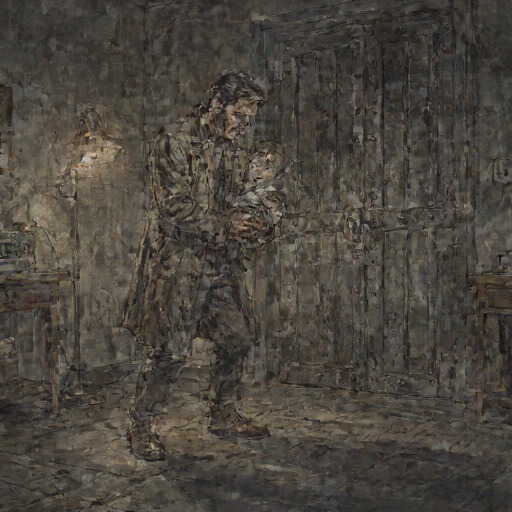
Travis McCoy
The Journey CollectionTravis McCoy is the central figure of a redemptive journey in which professional football first gives him an identity and later becomes the measure of what he must surrender. A shoulder injury ends his playing career, but the deeper crisis is emotional: returning to Clarendon exposes the son he never knew he had and the woman he left behind. His decisive achievement is not a victory on the field but the conscious reordering of his life, as he converts athletic ambition into fatherhood, education, coaching, and a durable family with Penelope Stone and Max.
Identity and Formative Background
Travis’s attachment to football predates his professional career. When he was just after five years old, Russ McCoy loaded him into a beat-up Chevy truck and drove him to Austin, Texas, where they joined thousands of spectators at the University of Texas stadium to watch the Clarendon High School Broncos win the state championship for the first time in school history. The memory binds football to childhood wonder, paternal approval, local pride, and the earliest formation of Travis’s sense of self. By adulthood, the sport is not merely his occupation; it is the language through which he understands achievement and belonging.
That identity is already under pressure when Travis sits on the examination table in the trainer’s office, waiting for the medical decision that will determine his future. He has spent six seasons thinking about football, yet the injury reveals that the game has been part of him for far longer. Cal Hendricks diagnoses an AC separation, explaining that Travis tore the ligaments between the clavicle and acromion bone. Surgery is unnecessary, but the damage is severe enough to place Travis on the team’s injured reserve list for the remainder of the season. The medical terminology gives physical form to a larger rupture: the body that carried his professional identity can no longer sustain it.
Return, Recognition, and the Cost of Departure
Travis’s return to Texas is physically exhausting and emotionally charged. After a flight from Miami to Dallas is delayed almost two hours, he runs for his connection to Amarillo and barely boards before the door closes. He hides behind sunglasses and a baseball cap as he moves through the airport, but his concealment cannot prevent the past from catching up with him. His arrival is not a triumphant homecoming for a famous athlete; it is the beginning of an encounter with consequences that fame and distance have postponed.
At the Clarendon High School gymnasium, the band plays the fight song while students, fans, and parents fill the pep rally with noise. Travis remembers every Friday afternoon spent under their watchful gazes, moments he both hated and loved. The scene places him inside the community that formed him, but it also makes clear that he has returned as someone changed by absence. When he leads the team from the field house through the inflatable tunnel, the familiar public ritual acquires a private meaning. Thousands of spectators and the largest stadiums of his professional life cannot equal the feeling of being home.
The emotional shock of that homecoming is Penelope Stone. Standing in the gymnasium doorway, she appears almost unchanged after ten years, with long honey-blond hair and brown eyes that move between Travis and the boy beside him. Her anguish becomes the visible sign of a history Travis has refused or been unable to face. When she rushes forward and pulls the child back into her arms, Travis is confronted not only by the woman he once loved but by the immediate reality of the son whose first decade he has missed. The narrative turns recognition into an ethical demand: seeing Max means accepting responsibility for the absence that preceded the moment.
Travis understands that his departure once crushed Penelope, the one woman who had cared for him. His later questioning of whether she “love[s]” him or merely “loved” him shows how urgently he needs the past to remain recoverable, but the relationship cannot be repaired by feeling alone. It requires him to acknowledge the damage caused by leaving and to remain present when presence becomes difficult.
Fatherhood Against the Football Dream
The central conflict in Travis’s arc is between the dream that made him and the family that needs him. He admits to his teammates that he has a son named Max and that, until returning to Texas the previous month, he did not know the boy existed. He also explains that Max’s mother is the love of his life and that Penelope withheld the truth because she believed football was Travis’s dream and did not want the child to become the reason he failed to achieve it. Travis initially wants to blame her for denying him the choice to be a father, but he eventually recognizes the painful logic of her decision: at that stage of his life, he might have tried to help while still allowing the game to determine every priority.
That realization does not excuse the lost years, but it changes Travis’s response to them. He chooses to put his family first and to become the kind of man Max can be proud to call Dad. The change is social as well as private. By revealing Max to the locker room, Travis allows the teammates who supported him when he had no one else to see the part of his life he had kept separate. His public confession marks the movement from guarded professional identity toward accountable fatherhood.
The transition is not immediately smooth. During a phone call, Travis hears Penelope knock on Max’s door and Max angrily tell her to leave him alone. Travis has never heard Max speak to his mother with such anger, and he feels guilty for leaving again. He knows he needs to be present to make up for the years he missed, yet he also believes that until matters in Miami are settled, he cannot be the father Max needs. Fatherhood therefore appears not as a feeling that automatically solves the past but as a practical obligation requiring time, stability, and repeated choices.
Max’s own response eventually gives the family a language for its future. He tells his mother not to worry because he is not angry and because Travis is there now; with Travis present, Max believes they can be a real family. The statement does not erase the history of separation, but it identifies the possibility Travis has been working toward. His journey is measured by whether he can make that possibility dependable rather than temporary.
Career Ending and Reconstructed Purpose
The end of Travis’s playing career arrives through institutional pressure as well as injury. When Stewart Thornton, owner of the Sharks, calls, Travis fears that the conversation will mean either a trade or release; he has dreaded the call for more than a month. Stewart instead offers him a coaching opportunity, acknowledging that Travis is finished as a player because his shoulder will never be strong enough to play again. The offer preserves his connection to football, but it also tests whether he can accept a version of the sport that no longer places him at its center.
Travis ultimately decides to leave Miami rather than accept the Sharks coaching job. His goodbye to the people who supported him is affectionate but firm: he says that he will miss Penelope and Max, recognizes what they have endured together, and understands that it is time to move on. The decision is not a rejection of football’s value. It is a refusal to let professional belonging remain more important than familial presence. Later, when he realizes that he will take the Clarendon coaching offer not only for himself but for Max, the meaning of work has changed. Coaching can become a way to remain useful to the community and to share his knowledge without repeating the old pattern of sacrificing family to the game.
Education completes that conversion. Travis passes the Certified Teachers Exam with a score of 98.3 percent, turning athletic expertise into a credentialed public role. The achievement matters because it demonstrates that his future is not simply a diminished continuation of his playing career. As a teacher and coach, he can guide younger players while inhabiting a different relationship to competition, authority, and care. The former athlete’s professional capital becomes educational and paternal capital.
Love, Reconciliation, and Family Membership
Travis’s reconciliation with Penelope depends on direct acknowledgment rather than nostalgia alone. He tells her that he has loved her since he was fourteen, perhaps earlier, and asks her to be his forever. The proposal joins the adult commitment of marriage to the adolescent origin of their bond: the boy who first understood that he needed Penelope to be his girl is now choosing her with the responsibilities of a man and father. The small black velvet box held in his trembling hand makes the decision tangible, while the question itself converts long-held emotion into a shared future.
His family relationships also undergo a marked transformation. At his wedding, Russ McCoy serves as best man, and Travis recognizes that the two have come a long way in nine months. He no longer sees Russ only as the father who failed to give him what he wanted; he sees a man he can respect and the father he had always wanted. Russ’s recollection that Loralie McCoy knew from the time Travis and Penelope ran through the fields holding hands that they would fall in love again places Travis’s present happiness within a larger family memory.
Travis also seeks to make Max’s place in the family legally visible. He asks to change Max’s last name to McCoy, explaining that if Penelope is going to be a McCoy, he wants Max to be one as well so they can be a real family. The request distinguishes biological fatherhood from social and legal belonging. Travis has already learned that being Max’s father cannot be reduced to genetics; the proposed name change is an attempt to align the family’s public identity with the relationship he is committed to building.
The wedding makes that reconstructed membership ceremonial. Travis, Penelope, and Max light the eternity candle together, with Max standing between the adults before returning to his place. The ritual gives the child an active role in the marriage rather than treating him as a witness at its edge. When Travis calls Penelope “Mrs. McCoy” and tells her he loves her, the words follow the shared candle-lighting, so the marriage is presented as an act joining three lives, not merely pairing two adults.
Change, Legacy, and Ending
Travis’s transformation culminates when Penelope becomes pregnant. Overwhelmed, he pulls her into his arms and weeps at the news that they are having a baby. His response is defined by a promise implicit in the scene: this time he will be there every step of the way. The future child therefore becomes a test of whether his new identity can endure beyond the immediate reconciliation with Penelope and Max.
The family’s announcement also reaches Russ with startling force. When he sees the ultrasound photograph in its silver frame, he rises so quickly that his chair falls backward and threatens, in shock, to punish Max if the news is a joke. The comic intensity of the reaction contrasts with the earlier estrangement between father and son; Russ is now emotionally invested in the expanding family and able to express that investment without the old distance dominating the room.
At the end, Travis lifts the newborn from a small plastic bassinet, the baby wrapped in a white blanket, and turns back to Penelope through tears. He tells her that she has given him a family. The line gathers the novel’s central reversal into one image. Football once seemed to promise the fullest version of Travis’s life, while family appeared as something lost or deferred. By the conclusion, the injured shoulder, the ended career, the return to Clarendon, the public admission of Max, the teaching examination, the coaching decision, the name change, the wedding, and the birth all point toward the same achievement: Travis has stopped treating love and fatherhood as obstacles to success and made them the grounds of his success.