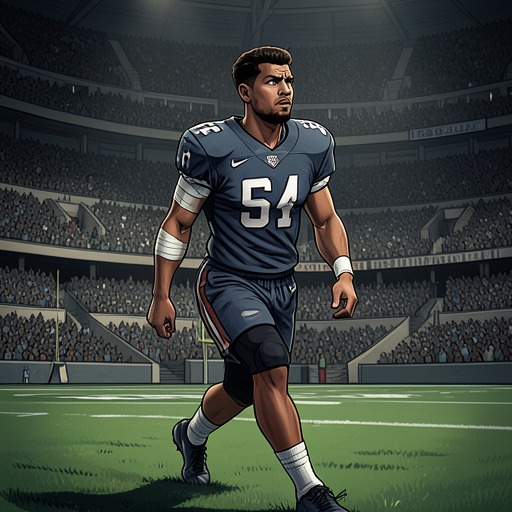
Travis McCoy retires from professional football
The Journey CollectionTravis McCoy retires from professional football as the decisive act in his transformation from celebrated Miami Sharks player to committed partner and father in Texas. The retirement is not presented as a simple defeat caused by injury: it is a deliberate transfer of identity, allegiance, and ambition from the professional stadium to the family and community waiting for him at home.
Causes and Background
Travis’s retirement follows a shoulder injury that leaves him unable to play again. His physical decline is set against the stature of the career he is losing. After six years in professional football, he is recognizable enough to be approached during flights for autographs on newspapers, magazines, and even barf bags. The Miami Sharks had recently come within one game of the national championship and were favored to win the next season, making his absence especially painful: he might not even be able to stand on the sidelines and watch them become champions.
The injury turns retirement into a public and professional uncertainty before it becomes a personal decision. When Stewart Thornton, the Sharks’ owner, calls Travis in Texas, Travis initially fears that the call means either a trade or release. Stewart instead offers him the chance to coach, acknowledging that Travis is finished as a player because his shoulder will never be strong enough for competition. The offer preserves a place for him inside the sport, but it also forces him to decide whether football remains the organizing principle of his life.
The Decision to Leave the Sharks
Travis explains that football had defined him since childhood. He had dreamed of standing in the largest stadiums while crowds chanted his name, and he had even slept with his football. He also recognizes that his career has been unusually successful, with more wins than losses. Yet the language of achievement no longer settles the question. He can still love the game while admitting that he cannot continue playing it, and the distinction becomes the emotional foundation of his retirement.
His return to Texas changes what he believes his future can be. Travis says that he went home to straighten out his life before considering what came next, but there he discovered that his future was already present in Penelope Stone and Max. They are people who love him and need him, and that need outweighs the professional continuity offered by Stewart. Travis therefore declines the coaching position rather than treating it as an automatic consolation prize. His choice makes family a priority without requiring him to deny the importance football once held.
Farewell to the Sharks
Leaving Miami requires more than ending a contract. Travis spends nearly two weeks packing his belongings with Russ McCoy, gives his furniture to the Salvation Army, closes his local accounts, transfers his banking to Texas, forwards his mail to Penelope’s home, and prepares to leave the apartment permanently. Even the practical arrangements register the finality of the decision: the rental company releases him from his lease, and he and Russ are left with little more than boxes, sleeping bags, pillows, and luggage while they wait for the movers.
Before the Sharks play Dallas, Travis returns to the stadium to speak with his soon-to-be-former teammates. He fears that they will believe the press’s version of his departure—that he is quitting merely because circumstances have become difficult. Malcolm Rollins challenges him directly, asking whether he is happy with whatever is taking him away from football. Travis answers that he is happy when he thinks of Penelope and Max, while also acknowledging that he will miss the team and the shared history created by years of struggle.
The farewell is especially difficult because the locker room has witnessed both his triumphs and his physical suffering. Travis remembers nights spent alone there, nursing an aching shoulder or sore elbow; the room has held his highest and lowest moments. He misses the Sharks, the stadium, and his teammates, but the knowledge that Penelope and Max are waiting makes it possible for him to leave with his head held high. His departure preserves affection for the team while refusing to let affection become an obligation.
Football Reimagined Through Family and Community
Retirement does not erase Travis’s relationship with football. Before making his final break with the Sharks, he returns to Clarendon and appears at the local high school pep rally. The gym is crowded with students, parents, fans, cheerleaders, posters, and the varsity team in maroon jerseys. The setting recalls the Friday afternoons of Travis’s youth, when he both hated and loved the scrutiny of the community.
At the rally, Travis leads the Clarendon Broncos onto the field through the inflatable tunnel. When the team reaches the fifty-yard line, he realizes that the homecoming crowd’s embrace means more to him than the largest professional stadiums ever did. He tells the players that the cheers belong to them because they have worked for the community’s respect, then reminds them that their worth does not depend on whether they win or lose that night. This moment provides a new use for his football knowledge: he is no longer seeking recognition through performance but helping younger players understand courage, effort, and communal responsibility.
The transition also appears in his relationship with Max. Travis learns that Max throws an excellent spiral and may love the game, but he insists that football must be taught as more than a route to money, magazine covers, or championships. His former teammates ask him to show Max what the game feels like. Travis accepts that responsibility while refusing the professional position that would keep him in Miami. Football survives in his life as inheritance and guidance rather than occupation.
Consequences and New Beginning
The retirement clears the way for Travis to build the family he has chosen and recovered. He proposes to Penelope, telling her that he has loved her since he was fourteen and that she has always owned his heart and soul. Before their marriage, he asks to change Max’s last name to McCoy so that the three of them can become a legally and emotionally unified family. Penelope agrees, and the name change makes visible the belonging Travis has already decided to protect.
At the wedding, Max stands between Travis and Penelope while they light the eternity candle together. The ceremony thus completes the movement begun by retirement: Travis leaves the professional team and enters a different kind of collective, one defined by mutual vows, shared naming, and family participation. His professional career ends, but his capacity to lead, teach, love, and take responsibility is redirected rather than discarded.
The later family gathering, where Russ reacts with shock to an ultrasound photograph and the family learns that a new child is coming, confirms the consequences of Travis’s choice. The future he selected in Texas continues to expand beyond Penelope and Max. Retirement becomes the threshold through which Travis moves from public celebrity and injured athlete into husband, father, and member of an enduring family network. Its significance lies in the value shift: the scoreboard and stadium once measured his life, but home, responsibility, and shared continuity now determine what winning means.