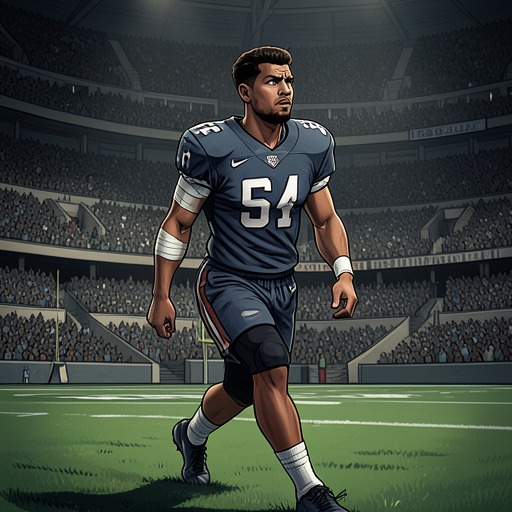
Travis McCoy's return to Clarendon for homecoming
The Journey CollectionTravis McCoy's return to Clarendon for homecoming is the turning point at which a celebrated past becomes an obligation to the present. The visit begins as a response to a school invitation but becomes a return to the people, place, and unfinished relationships that define his future: Clarendon, Penelope Stone, Max, Russ McCoy, and the possibility of belonging again.
Causes and Background
The immediate cause of the return is a letter from Jack Garrison, principal of Clarendon High School. Its maroon shield, silver C, and silver broncos identify the school Travis once led to a state championship. The letter invites him to a week-long homecoming celebration and presents his success as an inspiration to the town's young people. The current football team is having its best season since Travis left, and its players, who had only been playing pee-wee football when he led the school to its second state championship, specifically ask for him to come home. The invitation therefore treats Travis not merely as a former student or professional celebrity, but as the living source of a local athletic inheritance.
The invitation also exposes the distance between public admiration and Travis's private sense of damage. He rereads the letter before it falls onto his foot and wonders whether anyone in the small Texas town can welcome him after more than a decade of absence. His fear is not that Clarendon has forgotten him, but that its memory of what he did afterward will outweigh the glory of the championship. He considers the possibility that some damage is too severe to repair. The homecoming consequently carries two opposing meanings: a public ceremony honoring the past and a private test of whether the past can still be entered without destroying him.
A month later, Travis leaves his apartment in a yellow taxi for the airport. His injured shoulder remains stiff and painful even after he has stopped wearing the brace, with little mobility left in the joint and persistent rumors that his professional career is over. He decides that understanding his future requires facing his past, but he does not send Jack a formal confirmation. Instead, he simply books a flight back to Texas. That hesitation makes the journey an act of reluctant commitment rather than a confident homecoming; he crosses the threshold before he can promise anyone, including himself, that he will stay.
The Journey and Arrival
The return is physically complicated by delay, exhaustion, and displacement. Travis flies from Miami to Dallas, endures a delay of almost two hours, runs for his connection to Amarillo, and barely boards before the door closes. His sunglasses, baseball cap, and attempts to move inconspicuously cannot fully conceal him. During the flights, admirers ask him to autograph newspapers, magazines, and even barf bags, reminding him that professional fame still follows him even as his body may no longer permit him to play. The Sharks were one game from the national championship the previous season and are favored to win the next one, yet Travis can imagine himself lucky merely to watch from the sidelines.
The lost luggage at the Amarillo airport deepens the sense that the return is a stripping away of his old identity. He waits more than half an hour at the baggage conveyor before joining a line at the lost luggage office. The former star arrives in the region not surrounded by the controlled spectacle of professional football, but delayed, inconvenienced, and forced to wait among ordinary travelers. The journey thus moves him from celebrity privilege toward the exposed vulnerability of a man who has come back with unresolved history rather than a secure professional future.
Once in Clarendon, Travis retrieves Bertha, his classic black 1966 Pontiac GTO, from the barn. The car's familiar interior and roaring engine offer a temporary form of welcome, but the drive also brings Penelope Stone vividly back into his thoughts. He can picture her in the passenger seat and recognizes that she once made everything better, while also recognizing that he ruined what they had by leaving. The road through town turns memory into visible geography: a convenience store has replaced two failed gas stations, Clayton's Groceries remains but has fresh red paint and a new sign, and the bank, insurance offices, and pharmacy display support for the local team. Clarendon has changed just enough to register time, yet remains recognizable enough to confront him with the continuity he rejected.
The Homecoming Ceremony
Travis first approaches the school gymnasium from a position of concealment. From his car he hears the band's fight song and the roar of students, fans, and parents, sounds connected to every Friday afternoon when he sat before the town's watchful gaze. Inside, the bleachers are packed, three dozen people stand along the walls, cheerleaders wave maroon, white, and silver pompoms, and the varsity players wear maroon jerseys with large white numbers. The setting turns the gym into a civic theater in which school, sport, family memory, and local identity are publicly joined.
The ceremony is framed by communal ritual. The cheerleaders lead the crowd in the Pledge of Allegiance, the band plays The Star-Spangled Banner, and the assembled supporters chant for victory against the Gruver Greyhounds. The rivalry with Gruver has become one of the Texas Panhandle's defining football traditions; during Travis's senior year, the town even burned a papier-mache effigy of a Gruver player at the annual bonfire. Drought has forced the cancellation of the bonfire this year, but not the spirit surrounding it. The altered ritual shows both the persistence and fragility of Clarendon's traditions: the form can change while communal memory continues to gather around the team.
When Jack announces that the school is honoring a member of the championship team and one of its most successful alumni, Travis's private return becomes a public reentry. He later meets the players and tells them to enjoy every moment on the field, play the game they love, and give every ounce of themselves to it. Cody asks him to lead the boys through the Lord's Prayer, and Travis kneels with them while the team repeats the prayer in murmured voices. The sequence places Travis inside a chain of institutions and symbols larger than his individual career: faith, school, community, and football are expressed through shared words and coordinated action.
The most consequential part of the ceremony occurs when Travis leads the team through the inflatable tunnel. He has stood in the largest professional stadiums before thousands of people, but reaching the fifty-yard line with Clarendon's crowd around him affects him more deeply than those earlier triumphs. He tells the players that the cheering belongs to them because they have worked hard and earned the community's respect. Whether they win or lose, he insists, the town's pride in them will remain; for the players themselves, however, losing is not an option. His authority has shifted from performance to stewardship. He is no longer simply being celebrated for what he once accomplished; he is using the meaning of that accomplishment to strengthen younger players.
Private Consequences
The homecoming's public welcome immediately intersects with Travis's private family crisis. He sees Penelope and Max in the gym, returns Max's wave, and winks at Penelope. The gesture confirms that his feelings for Penelope remain strong and that his return is not only an encounter with an old town. He understands that he still loves her and needs both her and Max, and he begins to imagine them as a family. The community ceremony therefore supplies the outer setting for an inward recognition: home is no longer defined by the football field alone.
That recognition produces concrete decisions after the visit. Travis proposes to Penelope by invoking the love he has carried since adolescence and asking her to marry him; she answers yes. He then asks to change Max's last name legally to McCoy, explaining that if Penelope is going to become a McCoy, Max should be one too so that the three of them can be a real family. The return has consequently changed a symbolic homecoming into a legal and emotional claim of fatherhood. Travis does not merely recover a romance; he accepts responsibility for the child whose place in his life had remained uncertain.
The family-making continues through marriage. At the wedding, held on the football field beneath a white wooden arch covered with honeysuckle vines, Travis and Penelope exchange vows, while Max stands between them to light the eternity candle with the couple. The ceremony makes the child an active participant rather than a spectator and gives public form to the family Travis first imagined at homecoming. The field that once certified his athletic identity now witnesses his marital and paternal identity.
The return's consequences extend beyond Travis, Penelope, and Max. Later, a silver picture frame containing an ultrasound photo reveals Penelope's pregnancy to Russ McCoy and the family. Russ reacts with shocked emotion, while Max jokes that he had not intended to say anything. This revelation shows that the homecoming has initiated a continuing family future rather than concluded a single reconciliation. The man who returned uncertain that anyone would welcome him becomes part of a growing household whose relationships, names, ceremonies, and descendants all point beyond the old separation.
Significance and Aftermath
The event changes the meaning of football in Travis's life. Before returning, he is defined by the Sharks, professional acclaim, and the injured shoulder that threatens to end his playing career. The homecoming reconnects him with football's local and communal dimensions: young players ask for his presence, the town remembers his state championship, and the crowd's embrace makes him feel more fully at home than professional stadiums ever did. Football remains important, but its value is no longer measured only by championships, contracts, or the possibility of playing again.
The subsequent call from Stewart Thornton, the owner of the Sharks, crystallizes that transformation. Stewart explains that Travis cannot play because his shoulder will never be strong enough, but offers him a coaching position. Travis thanks him for six years with the Sharks and acknowledges that football has been his life since childhood. Nevertheless, he declines because the future he discovered in Texas includes people who love him and need him. The homecoming has therefore supplied the knowledge required for a decisive professional renunciation: he can leave the identity that once seemed inseparable from his existence because he has found a larger belonging.
As a narrative event, the return follows a clear movement from separation through threshold to reintegration. Travis begins outside Clarendon, physically injured and emotionally convinced that his past may be beyond repair. He enters the town through its roads, memories, school rituals, prayer, national symbols, and football field. He then crosses into renewed family membership through love, legal naming, marriage, and the prospect of another child. The decisive victory is not the night's scoreboard but the conversion of public memory into present responsibility. Clarendon does not erase the years Travis lost; it gives him a place from which he can finally answer for them and build a future with Penelope Stone and Max.