Travis McCoy–Russ McCoy relationship
The Journey CollectionThe Travis McCoy–Russ McCoy relationship begins in estrangement and resentment but develops into an explicitly renewed father-son bond. Both men love one another, yet years of silence have made that love difficult to recognize: Travis interprets Russ’s emotional and physical absence as abandonment, while Russ mistakes Travis’s independence and devotion to football for proof that his son no longer needs him. Their relationship changes only when grief, concealed family history, and the possibility of losing one another again force them to speak directly.
Identity and Background
Russ McCoy is Travis McCoy’s father and the keeper of the Clarendon home to which Travis returns after roughly a decade away. Their shared history is marked by two absences that Travis has never separated from one another: Russ’s failure, as Travis sees it, to care adequately for Loralie McCoy during her fatal illness, and Russ’s failure to support Travis during his childhood and football career. Travis’s anger is therefore not limited to a single argument. It is the accumulated judgment of a child who believed that his father had repeatedly chosen work, a workshop, and silence over the people who needed him.
Loralie’s illness fixes the original wound in the relationship. Travis was nine when she was diagnosed with Acute Lymphoblastic Leukemia, and he watched her struggle to rise from bed until chemotherapy and the disease left her too weak to continue. She died after two years of treatment, when Travis was eleven. In his memory, Russ spent too much time building and working rather than caring for his dying wife, leaving a child to confront sickness and death without the fatherly protection he expected. The adult Travis has never forgiven Russ for what he understood as abandonment, even though Russ’s own grief remained hidden from him.
Estrangement and Concealed Grief
When Russ collects Travis after his return, the meeting is outwardly practical and emotionally guarded. Russ says he could not let Travis stand alone and admits that he had not believed his son would actually appear; he wanted to see the return for himself. Travis suppresses the retort he wants to make because another confrontation with his father is the last thing he can bear. His silence is not reconciliation but exhaustion, and it preserves the old pattern in which both men avoid saying what they most need to hear.
The conflict erupts when Travis learns that Russ knew or suspected that Max was Travis’s son. Travis demands to know why his father never told him. Russ responds by accusing him of having made his position clear years earlier: Travis had said he would never come back, and Russ believed that nothing he said would change his mind. The argument exposes a family system organized around withheld information. Penelope Stone concealed the pregnancy because she believed football would always come first; Russ withheld his suspicions because he assumed Travis had chosen his career over Clarendon; Travis, meanwhile, treated the distance itself as evidence that neither his father nor his former home had truly wanted him.
Their confrontation also makes responsibility reciprocal rather than simple. Travis accuses Russ of never attending his school games, while Russ explains that he had to work and keep the ranch running. Travis then invokes Loralie, telling Russ that she needed him and that Travis needed him, yet Russ had not been there for either of them. Russ flinches because the accusation reaches the center of his guilt. The exchange shows how the same event can produce opposing narratives: Travis remembers abandonment, while Russ remembers labor, obligation, and a presence he believed he supplied in spirit even when he was absent physically.
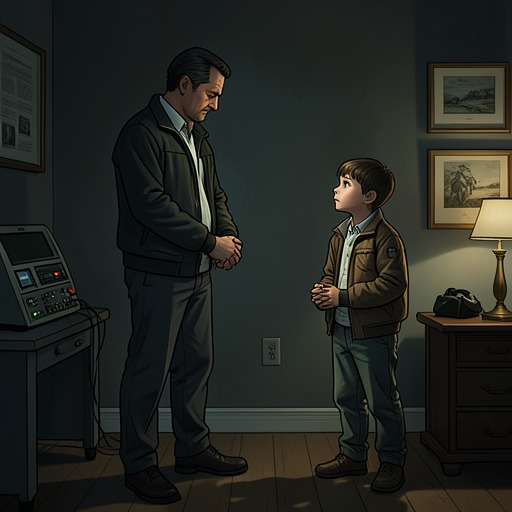
The first decisive reversal comes when Russ finally speaks about Loralie. Sitting at the kitchen table amid photographs, he admits that he still misses her every day, remembers her laughter and cheeky smile, and had held her while she struggled for breath. He had prayed that God would take him instead of her, but her death left him devastated. Travis had never seen his father reveal such grief, and the sight breaks the assumption that Russ’s apparent detachment meant indifference. The memory does not erase Russ’s failures, but it makes his silence legible as grief and emotional incapacity rather than simple lack of love.
Apology and Renewed Presence
Russ then acknowledges the part of the past he can no longer defend. He apologizes for not being a better father and tells Travis that he has always been proud of him. When Travis protests that Russ never said so, Russ explains that he did not think Travis wanted to hear it. He had believed that Travis preferred Loralie as a child and, after her death, gave all his attention to football; if Travis ever truly needed him, Russ assumed, Travis would say so. This explanation reveals a tragic mutual misreading. Travis wanted reassurance but interpreted silence as rejection, while Russ interpreted Travis’s self-reliance as a request to stay away.
The relationship begins to change through acts rather than declarations alone. Russ accompanies Travis to Miami despite hating to fly, explaining that he once made the mistake of letting his son go and will not let it happen again. His decision marks a practical correction to the very absence Travis has condemned: Russ does not merely claim to support Travis from a distance; he enters the son’s world and accepts discomfort to remain beside him. Later, when Travis again insists that Russ was not there when he needed him, Russ does not pretend that the past can be repaired. He says he cannot change who he was when Travis was younger, but he can be Travis’s father now.
That distinction becomes the moral basis of their reconciliation. Russ admits that pride kept him from calling, while Travis admits that he missed his father. Russ promises to be present every day if Travis will allow it. The promise is carefully limited to the present rather than offered as a false reversal of history. Their bond is rebuilt not by denying the years of separation but by establishing a different pattern for the years that remain.
Family Recognition and Reconciliation
Russ’s reconciliation with Travis is intertwined with Travis’s becoming a father to Max. At first, the concealed paternity intensifies the old conflict: Travis feels that Russ’s silence deprived him of the chance to know his son, just as Russ’s earlier silence had deprived Travis of needed support. Yet the later family scenes place the two generations together. Max openly asks when Travis intended to reveal that he was his father, forcing the adults’ withheld history into the child’s present understanding.
The state championship provides the clearest public image of the repaired family. After Cody Holland completes the two-point conversion, Max climbs onto the bench, embraces Travis, and thanks him as his father. Travis answers that Max has brought him home. Russ’s role in that homecoming is implicit but essential: the father who once watched his son leave now participates in the return that allows Travis to remain emotionally connected to Clarendon, Penelope, and Max.
Travis later reads Russ’s letter aloud while holding Max. The letter recalls Travis at four years old, begging to ride on the tractor. Russ had initially planned to postpone the promise because he was behind on the harvest, but Loralie warned him that his son would be gone before he knew it. Russ found a picture of himself and Travis clenched in the sleeping boy’s hand, took him into the field the next day, and remembered the child laughing on his lap. He repeats that he has always been proud of Travis, says that Loralie would look down on him with pride, and tells his son that he loves him. The written form matters because it gives Russ a way to say what pride and habit prevented him from saying face to face; reading it aloud turns a private confession into an act of witnessing shared by Travis and Max.
Change and Ending
By the time Travis asks Penelope to change Max’s last name to McCoy, he is no longer treating family as an obstacle to his ambitions. He explains that if Penelope becomes a McCoy, he wants Max to share the name as well, because that is how they can be a real family. Although the request concerns legal identity, it also completes the emotional work of Russ’s reconciliation. Travis accepts the McCoy name not as a burden inherited from a painful past but as a connection he actively chooses to extend to his son.
At Travis and Penelope’s wedding, Max stands between them as they light the eternity candle together. The ceremony makes family visible through vows, rings, and a shared ritual, while Russ’s presence at the later gathering places the repaired father-son relationship inside a larger household. Russ jokes with Max over the amount of food on their plates, and Travis observes a family that now includes his mother’s memory, his father, his son, his wife, and a baby on the way. The relationship with Russ has therefore moved from accusation to participation: Russ is no longer merely the father connected to an abandoned house and an unresolved loss, but an active member of the family Travis has chosen to build.
The relationship’s significance lies in its refusal of easy retroactive forgiveness. Russ cannot attend the games he missed, restore Loralie’s life, or remove the loneliness Travis carried from childhood. Travis cannot undo his departure or the years in which football mattered more visibly than his family. What they achieve is narrower and more credible: they name the injury, recognize the love that existed beneath the silence, and replace mutual withdrawal with present-tense responsibility. Their reconciliation makes homecoming an ethical act rather than a geographic one, because Travis can return only after father and son agree to remain available to one another.