Travis McCoy’s shoulder injury
The Journey CollectionTravis McCoy’s shoulder injury is the turning point that converts a celebrated football career into a question of what remains when playing is no longer possible. A severe AC separation, caused by a hard tackle and aggravated by a history of repeated shoulder injuries, places him on the Miami Sharks’ injured reserve list for the rest of the season. Its consequences extend beyond medical recovery: the injury removes Travis from the field, exposes the fragility of his public identity, and helps lead him toward a future defined by family, teaching, and home rather than professional football.
Injury and Football Identity
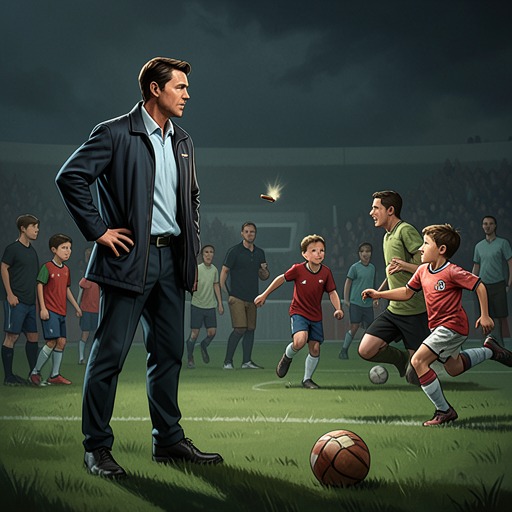
Travis’s attachment to football predates his professional career by decades. Just after his fifth birthday, his father took him from Clarendon to Austin, Texas, where he watched the Clarendon High School Broncos win the state championship for the first time in school history. He did not yet understand the rules or fundamentals, but the collision of helmets, the roar of the crowd, and the winning touchdown fixed the field in his imagination. From then on, playing football became his central ambition.
That ambition had shaped the previous six seasons of Travis’s life as the Miami Sharks’ star quarterback. The injury therefore threatens more than a season. It threatens the role through which he has understood himself since childhood. While waiting in the trainer’s office, he remembers that a single hard hit may prevent him from stepping onto a football field again, making the physical wound inseparable from the fear of an identity ending.
The Physical Event and Medical Consequences
The injury occurs when a receiver fails to reach the correct position and Travis turns the wrong way while searching for him. A three-hundred-pound defensive lineman drives him into the grass. Travis hears a loud pop in his right shoulder, followed by searing pain traveling through his arm and into his chest. He cries, though he keeps the tears from falling, and spends the next three days surrounded by ice packs, heating pads, and x-rays while awaiting a diagnosis.
Cal Hendricks, the Miami Sharks’ head athletic trainer and Travis’s longtime friend from the University of Texas, identifies the damage as an AC separation, or separated shoulder. The injury involves torn ligaments between the clavicle and acromion bone. Surgery is not necessary, but the tear is serious enough to keep Travis on the team’s injured reserve list for the remainder of the season. Cal also stresses that this is Travis’s third injury to the same shoulder. He had previously warned Travis to take time off and rehabilitate it properly, but Travis had refused to do so. The new injury thus combines external force with a pattern of overuse and stubborn resistance to limitation.
The medical decision becomes a professional verdict. The Sharks’ owner, Stewart Thornton, later tells Travis that his shoulder will never be strong enough for him to play again. The injury is therefore not treated as a temporary interruption from which an uncomplicated return is expected; it marks the end of his status as an active player.
Public Career Crisis
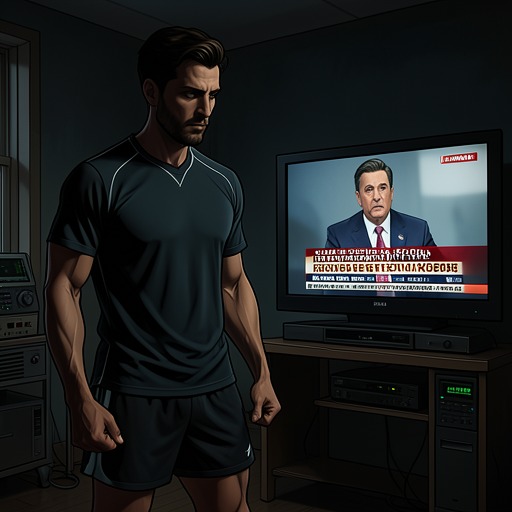
The injury quickly becomes a media narrative. In his apartment, Travis sees a television report stating that the Miami Sharks’ star quarterback is not expected to return for the rest of the season and suggesting that his recovery for the following year is uncertain. The report turns a private medical condition into a public prediction about his decline. Already doubtful about his own future, Travis switches off the television rather than continue listening.
The public story continues after he returns to Texas. Tamara Roberts reports that Travis is leaving the Sharks after turning down an offer to become special-teams coach, while noting that Malcolm Rollins has led the team to victory against Denver. Later, she directly identifies the shoulder injury as the reason Travis was placed on the reserved list and links his decision about coaching to Stewart’s refusal to clear him to play. A newspaper at the airport repeats the same information, prompting Travis to conclude that the media are making more of his departure than there is.
Even strangers interpret Travis through the injury. At the airport, a fan recognizes him, recalls seeing him defeat Chicago the previous year, and attributes his retirement to an inability to get over the last hit. The exchange reveals how quickly a complex career decision is reduced to a single bodily incident. For the public, the injury is a convenient explanation; for Travis, it is the immediate wound within a larger discovery about where his future belongs.
From Loss to Deliberate Departure
The injury creates the circumstance in which Travis must decide whether football can continue to define him in another role. Stewart offers him a coaching position, but Travis declines. He explains that football has been his life since childhood, that he once dreamed of standing in the largest stadiums while crowds chanted his name, and that he even slept with a football. He recognizes that he has had a successful career, with more wins than losses, yet success cannot make him continue in a game he can no longer play.
The refusal matters because Travis does not simply lose football; he chooses not to preserve a reduced version of the same professional identity in Miami. His injury closes the path back to quarterbacking, while the coaching offer provides an alternative route into the sport. He rejects that route after returning home and realizing that his future is in Texas, among people who love him and need him.
The injury also changes the meaning of home. At the Clarendon High School gymnasium, Travis hears the band, the students, fans, and parents cheering at a pep rally. He remembers both hating and loving those Friday afternoons when he had sat before the town’s watchful gaze. Later, he leads the team onto the field, and the familiar football ritual becomes newly intimate. Standing at midfield, he finds that the moment does not resemble the spectacle of the largest professional stadiums; it feels like being held by home. The same game that once defined his ambition now becomes a means of belonging without requiring him to remain a player.
Consequences and Narrative Significance
The shoulder injury is the physical hinge between Travis’s former life and his emerging one. It explains why his career is ending, but it does not determine the value of the life that follows. As the eighth-period History teacher, Travis inhabits a classroom rather than a professional locker room, and the narrative frames this later period as a new beginning in which football remains present but no longer has exclusive authority over his identity.
His changed priorities are clearest when he speaks about leaving the Sharks. Thinking of Penelope Stone and Max, Travis says that he is happy despite missing his teammates. The injury has separated him from the team, yet it has also made visible relationships that professional ambition had kept at a distance. At the Clarendon pep rally, he encourages the young players to recognize the respect they have earned and tells them that the community is proud of the men they have become. His authority now comes not from taking the field himself but from guiding others and interpreting football as a communal inheritance.
The injury consequently functions as more than a medical setback or a symbol of athletic vulnerability. It is the event that forces a public star to stop measuring his future by championships, sideline access, and the crowd chanting his name. Through it, Travis moves from quarterback to injured player, from injured player to retired professional, and from retired professional toward teacher, father, and member of the Clarendon community. The body that can no longer sustain his old ambition becomes the condition through which he discovers a broader form of belonging.