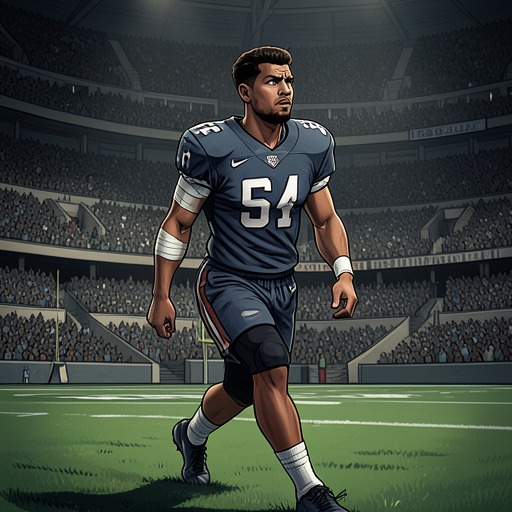
Travis accepts a high-school coaching position
The Journey CollectionTravis accepts a high-school coaching position in Clarendon after professional football can no longer provide a viable future. The appointment is more than a change of employment: it marks his passage from celebrated player and public figure to teacher, mentor, father, and rooted member of the community he once left behind. By choosing the Broncos over a continued role with the Miami Sharks, he turns the knowledge and prestige accumulated through six years of professional football toward the people who now need him at home.
From Professional Football to a New Vocation
Travis’s decision is made against the pressure of a career that had defined him since childhood. During his flight from Miami to Amarillo, he is still treated as a celebrity, asked to sign newspapers, magazines, and even barf bags. The Sharks had recently come within one game of the national championship and were favored to win the following season, yet his separated shoulder meant that he might not even be able to stand on the sidelines and watch them become champions. The contrast establishes what he is surrendering: not an unsuccessful career, but six years of public recognition, winning seasons, and the dream of hearing stadium crowds chant his name.
The decisive professional conversation occurs when Stewart Thornton, the Sharks’ owner, explains that Travis is finished as a player because his shoulder will never become strong enough for him to play again, but offers him a coaching position instead. The offer would have allowed Travis to remain inside the sport that had been his entire life. He nevertheless declines it. He acknowledges that football had been his identity since boyhood, even recalling that he slept with a football, but concludes that he can no longer continue in the same way. His refusal is therefore not a rejection of football itself; it is a rejection of allowing the professional game to determine the shape of his remaining life.
Choosing Clarendon and the Broncos
Travis’s return to Clarendon begins as a journey through exhaustion and uncertainty. After a delayed flight from Miami to Dallas and a rushed connection to Amarillo, his luggage fails to arrive, leaving him waiting more than half an hour before joining the line at the lost luggage office. The inconvenience mirrors his larger dislocation: he comes home physically short of his belongings and emotionally unsure of what can still belong to him. Yet the town’s familiar streets, businesses, and devotion to the local football team gradually restore a sense of continuity.
The high-school position gives that continuity a concrete form. Travis is not merely returning to watch the Broncos; he is accepting responsibility for their future. His acceptance is announced to the town after he passes the required examination, and the news spreads quickly enough that he receives at least ten congratulatory phone calls a day. The attention produces pressure as well as affection, because he is nervous about the new responsibility even while the community celebrates it. His transition from professional player to coach thus preserves his public visibility but changes its meaning: people no longer gather to admire what he can do on the field, but to trust what he can teach and build.
Coaching as Mentorship and Belonging
Travis’s first major public appearance in this new role is bound to the Clarendon homecoming rally. The gym is packed with teachers, students, parents, and community members. The cheerleaders lead the crowd in the Pledge of Allegiance, the band plays The Star-Spangled Banner, and the football players enter to the fight song before Jack Garrison introduces Travis as a member of the team that won Clarendon’s second state championship ten years earlier. The event places his past achievement inside a local civic ritual and makes his return a communal rather than private act.
His interaction with the players shows how he converts celebrity into guidance. He tells them to enjoy every moment on the field, play the game they love, and give it their full effort. At Cody Holland’s request, he leads the boys through the Lord’s Prayer before accompanying them through the inflatable tunnel and onto the field. Later, he leads the team himself, checks that the players are ready, and brings them to the fifty-yard line. Although he has stood in much larger stadiums before thousands of spectators, the homecoming entrance affects him more deeply because it surrounds him with the feeling of being home.
Once the team reaches midfield, Travis directs the players’ attention to the crowd’s cheers. He explains that the sound is for them because they have worked hard and earned the community’s respect, then tells them that everyone is proud of the men they have become. His words redefine victory as earned trust rather than merely a final score. Even as he returns toward Penelope, Russ McCoy, and Max, he taps the backs of the players’ helmets in an affectionate gesture that acknowledges both their youth and their courage. The coach’s authority is presented as physical encouragement, public affirmation, and inherited local responsibility.
The Position Within Family and Community
Travis’s coaching decision is inseparable from his renewed relationship with Penelope Stone and Max. At the rally, Max waves to him with an enormous grin, and Travis responds before winking at Penelope. He recognizes that his love for Penelope has survived the years of separation and that he needs both her and Max. His desired future is explicitly familial: he wants the three of them to become a family. Accepting the school position makes that desire sustainable, giving his return home an everyday structure rather than leaving it as an emotional promise.
The decision also alters his relationship with Russ. At the rally, father and son stand together against the gym wall while Penelope and Max sit among the elementary-school children. Later, Russ helps prepare Travis’s black 1966 Pontiac GTO, Bertha, for the wedding ceremony. That practical gesture belongs to the same movement as the coaching appointment: Travis is no longer trying to remain detached from Clarendon’s people and traditions. He is being received by his father, his former love, his son, and the town whose football culture shaped him.
The New Coach in Practice
The later opening of the school year shows that the position is not symbolic alone. Travis now teaches an eighth-period History class, where fifteen students wait for the final bell while he is distracted by plans beyond the classroom. He is addressed as Coach McCoy, a title that joins his work as an educator to his authority on the football field. The classroom is initially presented as a place of comfort, but his impatience reveals that coaching has become an active obligation rather than a ceremonial honor.
At the football field, Travis picks up Max from the Suburban and finds the returning sophomore, junior, and senior players already dressed and waiting beneath the goal post. Their readiness impresses him, and he acknowledges the leadership they have begun to display. In his office, he reviews physical forms required by the state for participating seventh-, ninth-, and eleventh-grade students, tracking which players have completed medical examinations and which still need to do so. The administrative work demonstrates a practical care for student safety that differs sharply from the spectacle of his professional career.
He then returns to the field with a football in hand and counts thirty-two boys who have come out for the season, including a dozen freshmen. It is the largest turnout during his three years coaching the Broncos, although he knows injuries, quitting, and academic difficulties will reduce the number. The position therefore demands patience with attrition and attention to the whole student, not just athletic ability. Travis’s coaching identity is built through preparation, health requirements, academic expectations, and sustained mentorship.
Narrative Significance
Travis accepts the high-school coaching position as the clearest expression of his changed priorities. Stewart Thornton offers him a way to remain professionally attached to the Sharks, but Travis chooses the family and community waiting in Texas. The decision transforms the meaning of football from a source of fame into a medium of service. The same sport that once carried him away from Clarendon now gives him a way to remain there.
The appointment also completes a sequence of public and private recognitions. At homecoming, the town recognizes the former champion; on the field, Travis recognizes the current players; in the classroom and office, he assumes the ordinary duties of an educator; and within his family, he accepts the need to be present for Penelope and Max. His coaching does not erase his professional past. Instead, it makes that past useful in a new setting, turning athletic capital into trust, instruction, and belonging. The result is a new beginning in which Travis can still lead a football team without allowing football to remain the only identity he possesses.