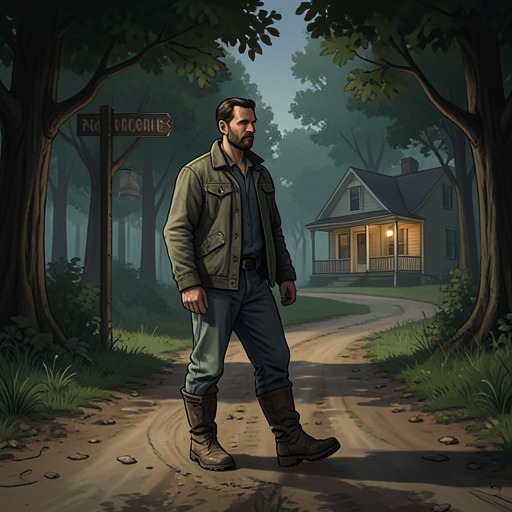
Travis and Russ’s return from Miami to Clarendon
The Journey CollectionTravis and Russ’s return from Miami to Clarendon is the logistical ordeal through which Travis’s retirement becomes a lived commitment to home. The journey begins with the deliberate dismantling of his Miami life and ends with Travis in Penelope’s arms, making the delayed trip a bridge between the identity he is leaving behind and the family he has chosen to reclaim.
Departure from Miami
Travis’s return is prepared as a permanent break rather than a visit. After almost two weeks of packing, he and Russ place the last box from Travis’s room beside the front door while waiting for the movers. The Salvation Army has already removed the furniture, leaving the men sleeping on the floor, but the discomfort is framed as evidence that they are one day closer to going home. The rental company releases Travis from his lease because prospective tenants are waiting, waives the next six months’ rent after he promises to leave by the following morning, and allows his apartment to become part of the past without a prolonged financial tie.
The practical details confirm the scale of the decision. Travis has his mail forwarded to Penelope’s home, closes his accounts, and transfers his banking to local institutions in Texas. He is not merely traveling away from Miami; he is relocating his administrative, emotional, and domestic life. The final obligation is to say goodbye to the Miami Sharks, who have been part of his life for six years and have come to resemble a family through both painful losses and celebratory victories. His departure therefore carries a double separation: from a professional team that helped define him and from the city where that career was sustained.
The journey’s delays
The trip repeatedly refuses to follow the straightforward path Travis and Russ expect. At Miami International Airport, they check their luggage and pass through security, anticipating a flight to Dallas. Half an hour before boarding, however, the announcement that Flight 2343 to Dallas has been delayed until eleven-thirty immediately turns the planned departure into uncertainty. Travis’s anxiety becomes part of the journey’s texture: reaching Texas is not difficult because he doubts where he belongs, but because every stage of transportation postpones his arrival there.
The airline’s next solution sends the men toward Chicago. A flight arriving from Washington, D.C., is delayed for another hour, so an employee offers Travis and Russ seats on a flight to Chicago leaving in ten minutes, with only standby status for the connecting flight to Dallas. Travis accepts the improvised route because it may be the only way to reach Texas that night. The new boarding passes are printed just in time, and the men board with Russ seated near the front and Travis at the back, carrying their hopes into another uncertain connection.
Even after they reach Dallas, the return remains incomplete. Travis and Russ leave the plane just after midnight knowing that they will spend the night there rather than continue to Amarillo. The airline provides a hotel and vouchers and books them on the first available morning flight, but these accommodations do not solve the central problem: they are still away from Clarendon. At six the next morning, they return to Dallas/Fort Worth International Airport, expecting to reach Amarillo by nine-thirty and Clarendon by eleven, only to face another three-hour delay. The repeated postponements stretch the journey into sixteen-and-a-half days before Travis finally gets back to Texas, turning an ordinary flight home into a test of persistence.
Arrival in Texas
At last, Travis and Russ board a small jet together, with Russ by the window and Travis in the aisle. The narrative marks the moment with unusual finality: Travis is finally on his way home. Shortly after noon, the plane lands at Rick Husband Amarillo International Airport, and Travis releases a relieved sigh. He and Russ are among the first passengers off the plane, hurry through the terminal, and wait impatiently for their luggage while Russ goes to bring up his truck. The details preserve the physical exhaustion of the trip while keeping Travis’s attention fixed on its emotional destination.
The drive from Amarillo to Clarendon completes the movement begun in Miami. After paying for two weeks of airport parking, Russ takes the highway toward town. An hour later, he pulls up outside Penelope’s house. Travis has barely opened the passenger door when Penelope rushes out with Max behind her. The long separation ends in immediate physical recognition: Travis meets Penelope halfway, lifts her into his arms, buries his face against her neck, and kisses her with the urgency of someone who has spent two weeks wanting that reunion. His return is not complete when the plane lands in Texas; it becomes meaningful only when he reaches Penelope and Max.
Homecoming and transformation
The return connects with Travis’s earlier reentry into Clarendon’s communal life. Before the final move from Miami, he has already confronted what coming home means at the local high school gymnasium, where the band plays the fight song and students, parents, and fans gather for the football team’s pep rally. The packed bleachers, standing spectators, maroon jerseys, posters, and cheerleaders’ chant of “Go, fight, win” revive the public world he once both hated and loved. His private return to Penelope’s house therefore follows a broader reattachment to the town and its football culture.
That reattachment becomes most visible when Travis leads the team through the inflatable tunnel and onto the field. At the fifty-yard line, surrounded by the community’s cheers, he recognizes that even the largest professional stadiums never gave him what this moment provides: the feeling of being held by home. He tells the players that the crowd’s support has been earned through hard work and that their pride should not depend solely on the final score. The journey from Miami thus culminates not only in romantic reunion but also in a changed understanding of football. Travis once left Clarendon to pursue the sport elsewhere; now he returns to use his experience in service of the young players and the community that raised him.
Family, belonging, and the road ahead
Russ’s presence makes the return a father-son journey as well as Travis’s individual homecoming. Russ helps pack the apartment, travels through the airport disruptions, drives from Amarillo, and waits with Travis until the reunion is possible. His admission that he knows what it feels like to lose a son, and that he will not let Travis go now that he has him back, gives the journey an additional meaning: the road home repairs not only Travis’s relationship with Penelope and Max but also the bond between Travis and Russ.
Once home, Travis’s choice acquires lasting legal and ceremonial forms. He asks Penelope to change Max’s last name to McCoy because he wants his son to share the family name if Penelope is to become a McCoy. At the wedding, Travis, Penelope, and Max light the eternity candle together, making the child’s inclusion visible at the center of the marriage ceremony. Later, when Travis speaks of his past, he acknowledges that he cannot change the man he was ten years earlier but insists that he now loves Penelope and Max and that they are a family. The return from Miami is therefore not an isolated trip with a happy arrival; it is the threshold event that enables Travis’s engagement, Max’s legal name change, marriage, and continuing life as a father and coach.
The journey’s decisive contrast is between movement away from home and movement toward it. Travis once believed that choosing to leave Clarendon meant choosing the future, only to discover that professional success could not settle the losses created by that departure. On the delayed route back, every canceled or postponed connection intensifies the distinction between destination and belonging. When he finally reaches Penelope’s house, home is no longer a place he abandoned for football. It is the family, community, and responsibility toward which his entire changed life is now directed.