Travis begins bonding with Max
The Journey CollectionTravis begins bonding with Max through a series of ordinary football-centered encounters that turn an unexpected biological revelation into lived fatherhood. What starts as Penelope’s invitation to watch Max practice becomes the first sustained proof that Travis can participate in his son’s life, and the relationship ultimately reshapes his priorities: the professional football star who once treated Clarendon as a closed chapter comes to understand that his future lies with Penelope and Max in Texas.
Identity and Circumstances
Travis arrives in Amarillo carrying the public identity of a celebrated professional football player and the private burden of discovering that Max is his son. His journey from Miami is exhausting: the flight to Dallas is delayed almost two hours, the connection to Amarillo requires a desperate run, and admirers ask him to sign newspapers, magazines, and even barf bags. Six years with the Miami Sharks have made him accustomed to public attention, but his injured shoulder leaves him uncertain whether he will even be able to stand on the sidelines while the team pursues a championship. This contrast matters to his bond with Max. Travis is still recognized as a football celebrity, yet the role that begins to matter most is not being watched by thousands of fans; it is being present for one ten-year-old boy.
Penelope makes that presence possible while also setting a moral condition for it. She tells Travis that Max idolizes him and may stop doing so after learning the truth, then invites him to Max’s five-o’clock peewee football practice and proposes dinner for all three of them. Her purpose is practical and protective: Travis can get to know Max while the adults work out how to tell him that Travis is his father. She warns him not to interfere with Max’s life unless he is serious about remaining there, because Max is an extraordinary child who sees the good in everyone. The invitation therefore carries a larger demand than attendance at a practice; it asks Travis to convert remorse into reliable action.
The First Practice
Travis arrives ten minutes before five and parks beside the curb overlooking the practice field, a modest strip of grass about a hundred yards between the school bus buildings and the First Baptist Church. The field is marked by the accumulated labor of the peewee league, where children spend every fall learning the game. That setting gives the scene a local, intimate scale very different from the stadiums and airports associated with Travis’s professional career.
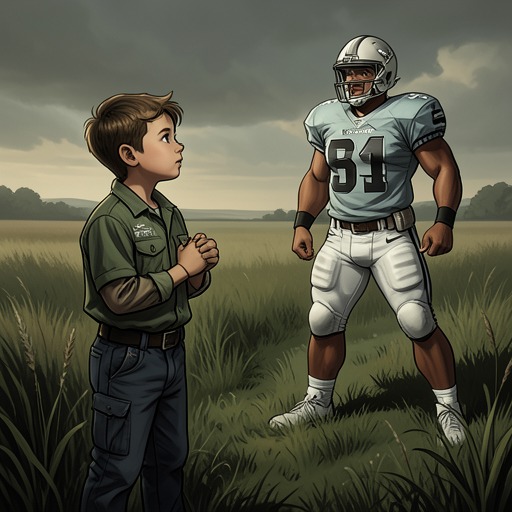
When Travis walks around the chain-link fence, Max sees him and runs from Penelope with an exuberant smile. Travis responds with a feeling that surprises him: pride. The emotion is not abstract knowledge of paternity but a bodily response to Max’s presence and movement. Max immediately asks what Travis is doing there, and the encounter begins without ceremony. Travis does not announce himself as a father or claim authority over the boy. He simply appears, watches, and enters Max’s world through the game they share.
The practice also lets Travis occupy football differently. For years, the sport has been connected to fame, competition, and the threat of losing his professional identity. With Max, it becomes a medium of attention. Travis notices the boy’s throwing ability and responds as a participant rather than as a distant star. Max jokes that Travis can throw a perfect spiral while his own passes still flop around, and Travis asks him to demonstrate. The exchange creates an opening in which Max can show what he can do and Travis can respond with encouragement rather than performance pressure.
Playing Catch and Recognizing Fatherhood
Max runs about twenty yards down the field, grips the football with both hands, and throws. The ball wobbles as he predicted, but Travis judges the attempt favorably, noting that it looks good for a ten-year-old and is better than Travis’s own throwing had been at the same age. Travis catches the pass, rotates the ball between his palms, and tosses it back. For several minutes, father and son play catch.
The importance of the scene lies in its ordinariness. Playing catch is an activity many fathers and sons take for granted, but Travis experiences it as something lost and suddenly returned. Max’s face shows pure happiness, and that visible joy brings guilt with it. Travis recognizes that his selfishness and departure helped create the distance between them; Penelope had not deliberately hidden Max, while Travis had placed everything connected with Clarendon behind him and thereby lost more than he knew existed. The football does not erase the past, but the repeated movement of throwing and receiving gives the two of them a shared rhythm in the present.
The practice leads directly to dinner, where Penelope has cooked for all three of them. After Max finishes his food and asks for seconds, the boy abruptly asks when Travis intended to tell him that Travis is his father. Travis chokes on his tea, and Penelope has to slap him on the back. The question reveals that the bonding process has been observed from Max’s side as well: Max has already assembled the clues and does not need the adults to manufacture a dramatic disclosure.
Max explains that his mother became emotional whenever the Sharks played and that he had seen photographs of Penelope and Travis in a box beneath her bed. At ten, he considers the mathematics obvious. His knowledge changes the adults’ immediate task from revealing the secret to responding to a child who has understood it independently. More importantly, Max is not angry. He tells Penelope that Travis is here now and suggests that they can become a real family. The statement turns Travis’s arrival from a temporary visit into a possibility Max is willing to accept.
From Professional Star to Present Father
Travis’s bond with Max develops alongside the collapse of his professional football identity. Stewart Thornton, the owner of the Sharks, eventually calls him, a conversation Travis has dreaded because he expects either a trade or release. Instead, Stewart explains that Travis is finished as a player because his shoulder will never be strong enough for him to play again, but offers him a coaching position. The offer would allow Travis to remain inside the sport that has defined him for six years.
Travis refuses. He describes football as the center of his life since childhood, recalling that he once slept with his football and dreamed of standing in the largest stadiums while crowds chanted his name. Yet his return to Clarendon has changed the meaning of the future. He tells Stewart that he went home to settle unfinished matters and discovered that his future was there, with people who loved him and needed him. Max is not mentioned as a separate obligation from Penelope; together they constitute the family that makes continued professional glory insufficient.
When Travis says goodbye to the Sharks, he admits that he will miss the players and acknowledges that they supported him through difficult years. Malcolm Rollins asks whether he is happy with what is taking him away from football, while Nate Birch asks whether he might regret staying home when the team wins a championship. Travis’s answer is grounded in his thoughts of Penelope and Max. The question is no longer whether he can continue being a football player, but whether he can accept becoming someone whose deepest allegiance is elsewhere.
His transformation does not mean football disappears. At the homecoming pep rally, he hears the band’s fight song and the roar of students, fans, and parents and remembers both hating and loving the scrutiny of his school years. Later, he leads the Clarendon Broncos onto the field through the inflatable tunnel. At midfield, he tells the players that the crowd’s support has been earned through hard work and urges them to show that the community’s faith was not misplaced. His authority now comes from a changed position: he is no longer the professional athlete seeking applause, but an adult using football to guide boys toward courage, discipline, and communal responsibility.
Trust, Family, and Lasting Change
The bond reaches its clearest emotional confirmation during the Broncos’ state-title victory. After Cody completes a two-point conversion by scrambling around defenders and falling across the goal line, the players celebrate with the community. Travis stands with Penelope and Max as the team removes its helmets and acknowledges him; he returns the gesture with a hand to his chest. The scene places Travis inside several circles at once: former player, mentor, local leader, partner, and father.
Max then climbs onto the bench, wraps his arms around Travis’s neck, and whispers, “Thanks, Dad.” The name is significant because Travis has not forced Max to use it. Max has had to trust that Travis will not leave again and will not hurt Penelope, but above all that he can love his son. Travis answers, “No. Thank you for bringing me home.” His response reverses the expected direction of rescue. Travis has come back to Clarendon, but Max is the person who makes the return meaningful and gives it permanence.
That permanence is later expressed through family decisions and public rituals. Travis proposes to Penelope by confessing that he has loved her since adolescence and asking her to marry him; she answers yes. Before the wedding, he asks to change Max’s last name legally to McCoy, explaining that if Penelope is going to become a McCoy, he wants Max to be one too because that is how they can be a real family. The request distinguishes biological fatherhood from legal and social belonging while joining all three forms of identity in a single family name.
At the wedding, Travis and Penelope exchange vows, and Max is called to stand between them as the three light the eternity candle together. The ceremony makes visible what began on the practice field: Max is not an observer of the adults’ union but part of its formation. Travis’s early decision to watch practice has expanded into shared meals, mutual trust, public family recognition, legal affiliation, and a marriage in which the child stands at the center of the household.
Narrative Significance
Travis begins bonding with Max at the point where the novel tests whether remorse can become responsibility. The decisive action is not a grand declaration but attendance: he arrives at a small field, catches a wobbling pass, and remains long enough for an ordinary father-son activity to acquire extraordinary meaning. The relationship then supplies the emotional foundation for his refusal of the Sharks’ coaching offer, his movement into community leadership, his proposal to Penelope, Max’s legal change of surname, and the family wedding.
The arc also converts football from a measure of public achievement into a language of care. Travis first encounters the game as a famous player whose body may no longer permit competition; he later uses it to meet Max, teach younger players, and re-enter Clarendon as someone accountable to others. The football that once represented the life he believed he had to protect becomes the path through which he recognizes what he abandoned. By the time Max calls him Dad after the championship, Travis’s most important victory is not the team’s title. It is the creation of a relationship that makes staying, loving, and belonging possible.