Travis's motivational speech at the Clarendon homecoming rally
The Journey CollectionTravis's motivational speech at the Clarendon homecoming rally is the central public expression of his renewed relationship with football and with Clarendon. Returning as a celebrated former player and professional athlete, he does not present his career as the final measure of success. Instead, he tells the current Clarendon Broncos that their devotion to the game and the faith of the people surrounding them matter more than his own fame, turning a homecoming appearance into an act of communal recognition and personal recovery.
Setting and Ritual
The speech takes place during a crowded homecoming pep rally in the high-school gymnasium, where teachers, students, parents, and community members gather to support the team. Travis stands against the wall with Russ McCoy and sees Max among the elementary-school children; Max answers his attention with a grin and a wave, while Travis winks at Penelope Stone. The family scene gives the public ceremony a private emotional center: Travis is not merely returning to the town that made him, but imagining a future in which Penelope Stone and Max belong with him as a family.
The rally follows a sequence of civic and athletic rituals. The cheerleaders lead the crowd through the Pledge of Allegiance, the band plays The Star-Spangled Banner, and the audience begins chanting for the Broncos before the evening game against the Gruver Greyhounds. Homecoming therefore joins national symbolism, school loyalty, and local football devotion in one public performance. The rivalry with Gruver has become one of the largest in the Texas Panhandle; even though drought conditions have forced the cancellation of the traditional bonfire, the competitive spirit remains intact.
The Speech
Jack Garrison introduces Travis by recalling that, ten years earlier, the Broncos had reached the state tournament and secured the second championship in the school's history. He identifies Travis as a member of that team and as one of Clarendon High School's most successful alumni. The introduction establishes the expectation that Travis will speak as a heroic product of past victory, someone whose professional career confirms the town's pride in him.
Travis immediately complicates that expectation. He recalls speaking to the boys before their victory over the Sunray Bobcats and admits that, while trying to invent something clever or inspirational, he realized that conventional advice would miss the point. He recognizes that the players may see him as a role model who never gave up on his dreams, but he rejects the idea that his personal trajectory is the speech's true subject. His authority comes not only from having succeeded, but from understanding that success can distort the game when it becomes more important than commitment.
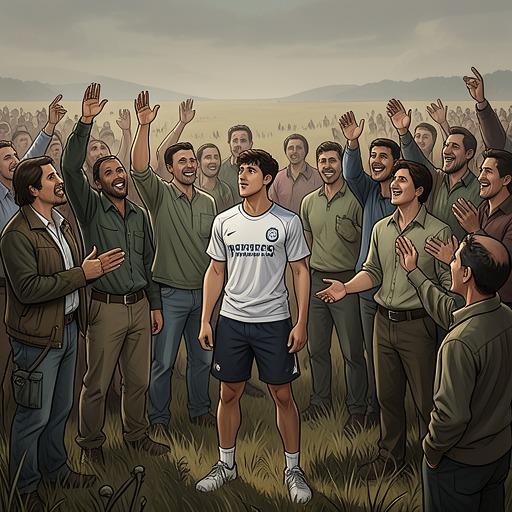
He directs the players' attention to the spectators behind him, especially the elementary-school children sitting in the gym. Those supporters endure ninety-degree heat and twenty-degree snowstorms merely to glimpse the passion the players bring to football. Travis acknowledges that reaching the state tournament opened doors for him and helped take him to Austin, but he identifies his commitment to the team and to the game he loved as the force that carried him forward. The distinction is crucial: opportunity may follow victory, but devotion gives victory its meaning.
The speech culminates when Travis reverses the usual hierarchy between celebrated alumnus and inexperienced players. Rather than claiming that they should learn from him, he tells them that they are an inspiration to him and that they have restored his faith in the game's purity. His thanks recognizes the young team as teachers, not merely recipients of instruction. When he hands the microphone back to Jack Garrison and returns to the wall beside Russ McCoy, the crowd applauds and praises him, but the private truth of the moment is that the players have taught Travis to love football again.
From Words to the Field
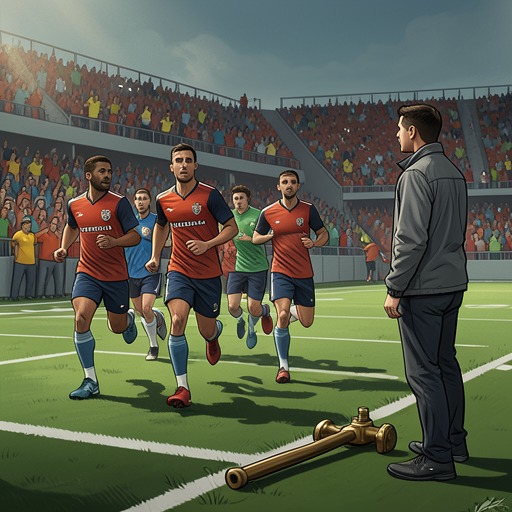
The speech is followed by a second, more physical form of encouragement. After the rally, Travis joins the team at the inflatable tunnel and leads them onto the field while the band plays the fight song. At the fifty-yard line, he feels that this homecoming surpasses the occasions on which he stood in the largest stadiums before thousands of people. The contrast relocates grandeur from professional scale to local belonging: the most meaningful crowd is the one that embraces him simply because he is home.
Facing the players amid the roar of the fans, Travis tells them that the noise is for them because they have worked hard and earned the community's respect. He urges them to show on the field that the community's faith has not been wasted and tells them that everyone is proud of the men they have become. As he leaves the field, he strikes the backs of their helmets in a gesture of solidarity. His speech thus becomes action: he does not remain an observer or a ceremonial celebrity, but physically leads the team into the shared space where their effort will be witnessed.
Consequences and Significance
The immediate consequence of the speech is a change in Travis's relation to football. He enters the rally carrying the authority of a former champion and professional player, but he leaves having received something from the high-school team. The Broncos do not simply inherit his legacy; they return the game to him as a source of passion rather than a measure of status. His speech marks the movement from athlete and celebrity toward mentor, community member, and prospective father whose values can be enacted rather than merely remembered.
The event also binds Travis's personal homecoming to the community's recurring football ritual. The prayer, pledge, anthem, fight song, crowded gym, uniforms, field, and fifty-yard line make the rally resemble a civic and quasi-religious ceremony, but the speech keeps that ceremony from becoming empty nostalgia. Travis honors the past championship while insisting that the present players create their own meaning through work and commitment. His return is therefore not a simple repetition of former glory; it is a re-entry into Clarendon on different terms.
Within the larger arc, the speech foreshadows Travis's movement away from professional football's demands and toward a life centered on teaching, coaching, Penelope Stone, and Max. Its deepest claim is that football can still matter after fame has become unstable, because its lasting value lies in shared effort and human loyalty. By telling the Broncos that they are an inspiration to him, Travis publicly accepts that belonging is not something he once earned and then lost; it is something he can practice again, with the community and family he is learning to call home.