University of Texas
The Journey CollectionThe University of Texas functions as the central threshold in Travis McCoy’s life. It first appears as the place where a childhood memory of football becomes an attainable future, then as the institution that enables his rise from Clarendon athlete to Miami Sharks star quarterback. At the same time, the university embodies the cost of that ascent: Travis chooses its scholarship and the professional path it opens over his relationship with Penelope Stone, only to return years later with a different understanding of what success requires.
Definition and First Significance
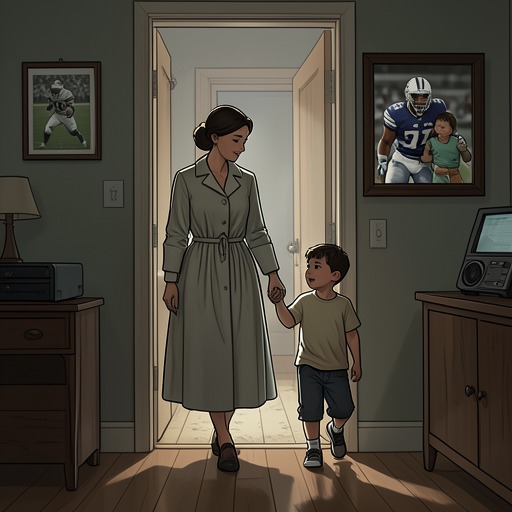
The University of Texas is the major university associated with Travis’s athletic development and early adult departure from Clarendon. When Travis was just past five years old, Russ McCoy loaded him into the front seat of a battered Chevrolet truck and took him to Austin, Texas. From the stands at the university stadium, Travis watched the Clarendon High School Broncos win the state championship for the first time in school history. The experience joins two scales of belonging that remain important throughout the novel: the immense public spectacle of a stadium and the intimate pride of a small Texas community.
That childhood visit becomes an origin point for Travis’s football identity. He later remembers that football was not merely an interest acquired during his six professional seasons; it had been part of him since that day in Austin. The University of Texas therefore operates in the narrative as a first imagined destination, a place where a boy sees the grandeur of the sport before he can yet see the consequences of pursuing it. The stadium’s size and collective excitement establish the institution as an arena of aspiration, while Russ’s presence connects Travis’s ambition to a father-son memory that becomes more complicated as the plot unfolds.
Education, Football, and Departure
As a high-school athlete, Travis receives a football scholarship to the University of Texas. The offer gives him the opportunity he has pursued, but it also creates the immediate geographical and emotional separation that changes his relationship with Penelope Stone. She remains in Clarendon to attend the local junior college, while Travis leaves for a university more than four hundred miles away. Believing that distance and fear of infidelity would make their relationship unsafe, he tells Penelope that they should see other people. He later recognizes this decision as a cowardly retreat rather than an act of protection, because the lie carries him through years in which he continues to long for her.
The university thus has a double function in Travis’s biography. It is the gateway to his dream and the setting, in retrospect, for the first major sacrifice made in the dream’s name. His departure is not presented as a simple triumph over small-town limitations. It is also a separation from Penelope, from Clarendon, and from the ordinary future that might have developed there. The institution makes his ambition possible while helping him construct the emotional distance that later leaves him grieving the ten years he has missed in Max’s life.
Travis’s adjustment to the university is remembered through contrast. He recalls that the stadium at the University of Texas was large, but that arriving in Miami was terrifying because the city contained skyscrapers unlike anything he had previously known. In that memory, a formative reassurance from his father becomes a private maxim: Russ knelt before him, placed his hands on Travis’s shoulders, looked directly into his eyes, and said, “Up is the only direction to go.” Travis carries those words from the university stage into his professional career and eventually reinterprets them when he decides that his new upward direction is back in Texas.
People and Institutional Connections
The University of Texas is also the shared starting point of Travis’s friendship with Cal Hendricks. The two men attend the university together and become roommates. Cal’s football career ends when he suffers a severe knee injury during his sophomore year after being clipped from behind. He then turns to sports medicine, eventually becoming the head athletic trainer of the Miami Sharks, the team that drafts Travis as its star quarterback. Their university connection survives the different consequences of injury: Cal remains within football through medicine, while Travis reaches the professional field and later loses that career to shoulder injuries.
Cal’s institutional role gives the University of Texas a continuing presence in Travis’s adult life. Cal is the person who must tell Travis that his career is over, and he experiences the conversation as especially painful because he knows how completely the game has defined his friend. Their history also reverses the usual image of athletic success. The university once brought both men into football, but their futures diverge when bodily damage forces Cal into a new profession and later compels Travis to search for a new direction.
The university remains part of Travis’s social capital after his playing career. When Travis takes Penelope, Max, Russ, and Nadine to a game at Darrell K. Royal Texas Memorial Stadium, he uses his status as a University of Texas alumnus to obtain seats behind the team and directly on the fifty-yard line. He is determined that Max will not miss any part of the game, and Max watches with the same excitement Travis once possessed. The scene turns an old institution of personal ambition into a site of father-son inheritance: Travis is no longer attending only as the boy who dreams of becoming a star, but as a father introducing his son to the spectacle that shaped him.
Return, Reinterpretation, and Consequences
After four years at the University of Texas, Travis is drafted by the Miami Sharks, and the professional dream he associated with college appears to come true. Yet a series of shoulder injuries ends his six-year career. The university’s promise of advancement is therefore followed by a forced transition. When Stewart Thornton offers Travis a coaching position with the Sharks after his playing career ends, Travis refuses. His decision shows that the path opened by the university no longer determines what he wants. The former athlete must decide whether to preserve his professional connection to football or return to the people and place he abandoned for it.
Travis ultimately identifies home in Texas as his new direction. His return does not erase what the University of Texas gave him: education, athletic opportunity, professional access, and friendships that shaped his adult identity. Instead, it changes the meaning of those achievements. The stadiums where he once stood before enormous crowds no longer outweigh the experience of being home with Penelope and Max. His former football success becomes something he can share with Max rather than something he must continue pursuing at the expense of family.
The university also remains present in later practical ambitions. Coach Reynolds encourages Travis to become certified and points him toward an examination scheduled for early April, framing education and responsible care for young players as the next stage of his life. Travis’s experience at the University of Texas, his professional knowledge, and the authority he has earned through football can now be converted into educational and coaching capital. The institution is consequently part of an identity sequence that moves from athlete to public sports figure, retired player, father, and possible mentor.
Narrative and Thematic Significance
In the novel’s structure, the University of Texas is a place of passage rather than a permanent home. Travis enters its orbit as a child spectator, returns as a scholarship athlete, leaves it for professional football, and later revisits its stadium as a father. Each encounter changes the relationship between football and belonging. The first visit teaches him to desire the game; the college years make departure seem necessary; the later family visit lets him share the game without surrendering his family to it.
The location also gives physical form to the novel’s contrast between public achievement and private responsibility. A university stadium can hold tens of thousands of spectators, while Travis’s decisive later choices are measured in quieter terms: acknowledging the pain caused by leaving Penelope, finding Max, asking Penelope to marry him, and seeking a family identity that includes Max. The institution’s grandeur remains real, but it is no longer the final measure of a successful life.
Finally, the University of Texas helps frame Travis’s stubbornness as both strength and danger. His persistence enables a small-town boy to earn a scholarship to one of the country’s best colleges and eventually reach professional football, achievements that once seemed unlikely. The same persistence nearly costs him his family. By the end, the university stands not as a rejected dream but as a completed chapter whose benefits Travis carries home. Its deepest narrative significance lies in that reinterpretation: ambition matters, but Travis learns that moving upward cannot mean moving away forever.