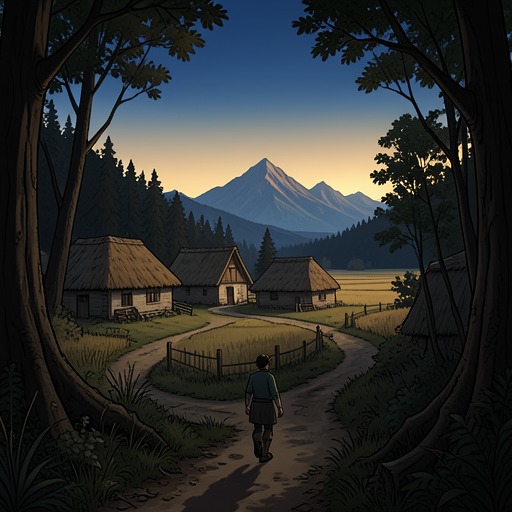
Autumn
The Jungle BookAutumn is not merely a date in the book’s natural calendar. It marks a change of condition: the season when Kotick leaves the familiar seal beach, turns away from the acceptance of inherited danger, and begins searching the Pacific for a place where seals can live beyond the reach of hunters. Across the wider work, seasonal and environmental cycles likewise expose how animal communities organize movement, shelter, labor, and survival.
Autumn as a Seasonal Threshold
Autumn arrives for Kotick after the white seal has witnessed the killing grounds at Novastoshnah. He has seen seals driven slowly toward slaughter, cooled for half an hour so their fur will not loosen during skinning, and then struck with iron-bound clubs. Ten minutes later, the bodies of his friends are unrecognizable, their skins ripped away and thrown into a heap. The experience changes the meaning of the beach: a nursery that offers abundant accommodation in summer is also connected to a human industry that turns living seals into seal-skin jackets.
The season therefore functions as a threshold between belonging and departure. Kotick returns to Novastoshnah, but the other seals do not share what he has seen. They regard the driving of the holluschickie as an ordinary part of the day’s work, while Kotick’s white coat and direct knowledge of the killing isolate him further. Even Sea Catch advises him to grow into a large seal, establish a nursery, and wait five years until he can fight for himself; Matkah tells him that the killing cannot be stopped and urges him to play in the sea. Autumn rejects that passive timetable. It sends Kotick away before he can accept survival as mere endurance.
Kotick’s Autumn Departure
That autumn, Kotick leaves the beach as soon as he can and sets off alone, driven by the idea of finding Sea Cow and discovering a quiet island with firm beaches where seals will be safe from men. His objective is practical rather than abstract: he seeks a habitat whose physical conditions and remoteness can protect a whole population. The seasonal movement becomes a deliberate act of ecological problem-solving, prompted by the failure of the community’s inherited routines.
Kotick’s search is vast and physically demanding. He explores from the northern to the southern Pacific and can swim as much as three hundred miles in a day and a night. Along the way he narrowly escapes the Basking Shark, the Spotted Shark, and the Hammerhead, and encounters many other creatures and hazards of the open sea. Yet the central difficulty is not simply predation. Every island that appears suitable carries evidence of human intrusion: a good hard beach may be shadowed by the smoke of a whaler boiling down blubber, or may show that seals once bred there and were killed off. Wherever men have come once, Kotick concludes, they may come again.
His search also includes failure. An old stumpy-tailed albatross directs him toward Kerguelen Island, but a sleet storm with lightning and thunder nearly smashes him against black cliffs. Even there he sees signs of a former seal nursery. Autumn thus begins a quest whose first result is not safety but a widening recognition that apparently empty landscapes may retain the history of exploitation.
Seasonal Cycles and Animal Society
Elsewhere in the book, seasonal time governs collective life. Seals arrive at Novastoshnah in the summer months by hundreds of thousands from the cold gray sea because the beach provides exceptional accommodation. Sea Catch returns every spring, swimming directly toward the beach and spending a month fighting for a place on the rocks near the water. The seasonal cycle is therefore tied to breeding, territorial competition, and the concentration of animals in a commercially valuable habitat.
The contrast between spring and autumn is especially sharp in Kotick’s story. Spring brings Sea Catch back to the crowded beach and renews the struggle for a nursery; summer fills Novastoshnah with seals; autumn sends Kotick outward in search of an alternative. The cycle that sustains the community also repeatedly exposes it to the same danger. Seasonal abundance attracts both animals and hunters, so the ecological rhythm is inseparable from the economic system built around it.
The same environmental logic appears in the jungle narratives. The Cold Lairs are avoided by most of the Jungle People because the site is an abandoned human city, though drought can drive animals to its half-ruined tanks and reservoirs for water. In the village, a thorn barricade is drawn across the gate at twilight because people fear the People of the Jungle. In the elephant story, the Indian Government maintains a department devoted to hunting, capturing, breaking, and distributing elephants for work. These settings show that animal movement is shaped not only by weather and food, but also by human architecture, administrative power, weapons, roads, and resource control.
Autumn and the Book’s Ecological Imagination
Autumn gives the book a language for the pressure between inherited order and necessary change. The Law of the Jungle forbids most beasts to eat Man because man-killing eventually brings armed white men on elephants, guns, gongs, rockets, torches, and large-scale suffering for every creature. The rule is presented as an adaptation to the consequences of human power. Similarly, the seal community’s acceptance of driving and slaughter is shown as an adaptation that has become morally inadequate once Kotick has witnessed its full cost.
The season also clarifies the book’s recurring contrast between animal knowledge and human claims to mastery. The Monkey-People occupy the Cold Lairs and imitate human behavior without understanding the abandoned buildings they use. Human seal hunters, by contrast, understand their tools and timing precisely enough to regulate the drive, cool the animals, and process their skins. The Indian Government organizes elephants through a specialized department and turns Kala Nag into an experienced instrument of capture. Against these systems, Kotick’s autumn journey proposes movement itself as resistance: when established institutions cannot secure life, the search for another habitat becomes an alternative form of agency.
Lasting Narrative Significance
Autumn is consequently associated with separation, quest, and the refusal to inherit violence as normal. For Kotick, it is the season in which horror becomes purpose. He does not yet possess a solution, and the evidence of the islands he visits repeatedly confirms how difficult escape will be, but his departure transforms him from a witness who cannot persuade his companions into an agent seeking a collective refuge.
The seasonal marker also expands a personal decision into a larger ecological question. A safe place must be more than beautiful or distant; it must have firm beaches, room for seals to live, and protection from the return of human exploitation. Autumn begins that search by exposing the limits of the old beach and by converting the recurring movement of animal life into a conscious attempt to change the conditions of survival.