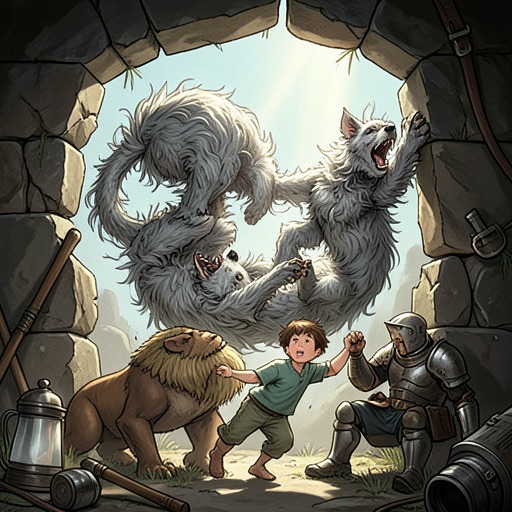
Baloo
The Jungle BookBaloo is the old brown bear who teaches the wolf cubs the Law of the Jungle, yet his importance reaches beyond instruction. He is the first non-parent to speak decisively for Mowgli at the Pack Council, and he treats the man-cub’s education as a matter of survival rather than ornament. His lessons place Mowgli within the ordered society of the jungle while also preparing him to move among beings who do not share his species or his upbringing.
Identity and Authority
Baloo is the only creature besides the wolves who is explicitly permitted to attend the Pack Council. His exceptional status rests on his office as teacher and on the trust attached to that office. He is described as a sleepy brown bear who eats only nuts, roots, and honey, and therefore can come and go where he pleases without being treated as a rival predator. His authority is not based on physical dominance or political leadership. It comes from knowledge of the Law and from his responsibility for the young.
That authority becomes decisive when Mowgli’s right to enter the Pack is disputed. The Law of the Jungle requires that, when a cub’s acceptance is challenged, at least two members other than the cub’s parents must speak for him. After Shere Khan’s demand has left the Council silent, Baloo rises on his hind legs and accepts the burden. He says, "The man's cub—the man's cub?" and then declares, "I speak for the man's cub. There is no harm in a man's cub. I have no gift of words, but I speak the truth. Let him run with the Pack, and be entered with the others. I myself will teach him." His intervention converts teaching into legal and social protection: Mowgli is not merely tolerated but entered with the other cubs.
Teacher of the Jungle Law
Baloo’s instruction is unusually broad because Mowgli must learn more than a wolf cub would. The young wolves generally learn only the parts of the Law that apply to their own pack and tribe, but Mowgli, as a human child living among animals, must understand a far wider system of relations. Baloo teaches him the Hunting Verse and the Wood and Water Laws, including how to distinguish a rotten branch from a sound one, how to address wild bees when approaching a hive high above the ground, how to speak to Mang the Bat when disturbing him at midday, and how to warn the water-snakes before entering their pools.
The lessons are practical, formal, and reciprocal. Mowgli must know not only how to hunt but how to ask permission when hunting outside his own grounds. Baloo teaches him the Strangers' Hunting Call, which means that he is hungry and requests leave to hunt, together with the answer permitting him to hunt for food but not for pleasure. The jungle therefore appears not as a lawless wilderness but as a society of territories, permissions, recognized dangers, and obligations. Baloo’s education gives Mowgli a language with which to negotiate that society.
His teaching also includes the Master Words of the Jungle. Baloo explains that these words can secure protection from birds, the Snake People, and all four-footed hunters except Mowgli’s own pack. The words function as a portable safeguard, allowing Mowgli to claim recognition across boundaries that would otherwise separate species. In this sense, Baloo teaches both ecological knowledge and political membership: Mowgli learns what the jungle is made of, who may be approached, and what forms of speech can suspend hostility.
Discipline and Care
Baloo’s affection is expressed through severity. When Bagheera objects that Mowgli’s face is bruised from the lessons, Baloo does not deny striking him; instead, he argues that a child is safer when corrected by someone who loves him than when ignorance exposes him to genuine danger. His position is summed up in the claim, "Better he should be bruised from head to foot by me who love him than that he should come to harm through ignorance." The statement reveals a stern ethic of care: pain inflicted within instruction is presented as preferable to unpreparedness outside it.
This discipline is not arbitrary punishment. Baloo insists that every creature in the jungle may become dangerous when disturbed, and that nothing in the jungle is too small to kill. The bruises therefore mark the cost of learning a code whose failures can have fatal consequences. His method joins tenderness to regulation, making care inseparable from the demand that Mowgli remember words, boundaries, and duties.
The relationship is consequently more than that of a lecturer and pupil. Baloo’s repeated lessons create a durable bond, while Bagheera’s visits make the instruction a shared guardianship. Bagheera watches Mowgli recite the day’s work, and Baloo remains the central authority who determines what the boy must know. The two protectors differ in manner—Bagheera is alert and dangerous, while Baloo is serious and methodical—but both treat Mowgli’s competence as essential to his continued life among the Jungle People.
Friendship and Rescue
Baloo’s role as teacher develops into active companionship and dependence. During the rescue at the Cold Lairs, after the struggle with the Bandar-log, he admits that he and Bagheera may owe their lives to Kaa. His grave humor—he imagines that the monkeys have pulled him into a hundred little bear cubs—does not conceal the physical cost of the battle. When Kaa asks where the manling is, Mowgli answers from inside a trap that he cannot climb out. Baloo is thus present not only as the instructor who prepared Mowgli for danger but as one of the allies caught in the danger alongside him.
The episode clarifies the practical value of Baloo’s network of relationships. His authority at the Pack Council, his teaching of the Master Words, and his partnership with Bagheera all help form the protective world around Mowgli. Yet Baloo is not an all-powerful guardian. He can be hurt, trapped, and rescued, and the scene places him within the same precarious jungle order he teaches. His wisdom matters because it enables cooperation rather than because it abolishes danger.
Law, Belonging, and Narrative Significance
Baloo embodies a system in which rules are sustained by communal recognition. The Pack Council inspects wolf cubs under the full moon; an unprotected cub may be killed only at the cost of the murderer’s life; and a disputed cub requires advocates. Baloo’s intervention demonstrates that the Law of the Jungle is not merely an abstract code. It depends on interpreters, witnesses, teachers, and speakers who can apply it when a vulnerable individual is challenged.
His role also exposes the tension between law and power. Akela’s authority rests on years of successful leadership, while Shere Khan tries to turn the Council into an instrument of appetite and hostility toward Mowgli. Baloo answers that pressure not with a threat but with a truthful claim of responsibility. He speaks because he teaches, and he teaches because Mowgli has been admitted. The two functions reinforce each other: education makes belonging possible, while belonging gives education a protected social purpose.
Baloo therefore stands for a demanding form of inclusion. He does not make Mowgli safe by pretending that species differences do not matter. Instead, he gives Mowgli the knowledge required to cross those differences without treating the jungle as a place available for pleasure or careless intrusion. His legacy is a vocabulary of restraint, permission, and mutual recognition. Through Baloo, the Law of the Jungle becomes not simply a rule of survival but a learned practice by which an outsider can become accountable to a community.