Big Toomai
The Jungle BookBig Toomai is a veteran mahout whose authority rests on hereditary knowledge, daily care, and an unusually deep command of Kala Nag. He is both the practical guardian of his family and the representative of an older professional order, one that respects elephants while seeking to contain their danger. His conflict with Little Toomai is therefore not simple hostility: it is the clash between a father who has survived elephant work by discipline and a son who experiences the same world as a summons to adventure.
Identity and Inheritance
Big Toomai is Kala Nag's driver and the son of Black Toomai, who took the elephant to Abyssinia; he is also the grandson of Toomai of the Elephants, who saw Kala Nag captured. Three generations of the family have fed and groomed the animal, and Big Toomai expects the chain of service to continue through his own son. He states that Kala Nag fears nothing except him, a claim grounded not in theatrical bravado but in forty years of accumulated familiarity between the elephant and the Toomai family.
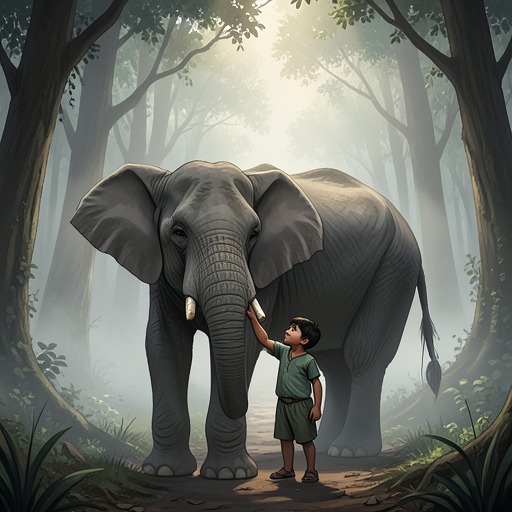
That inheritance is material as well as symbolic. Big Toomai's family possesses the knowledge by which a massive, dangerous animal can be handled, washed, inspected, and directed. The smooth-worn iron ankus has passed through his father and grandfather before reaching the expected future hands of Little Toomai. The boy has been raised beneath Kala Nag's shadow, and Big Toomai's authority is reinforced by a domestic history in which the elephant has learned to recognize the family's generations as a continuous human presence.
Work and Attitude Toward the Jungle
Big Toomai is not an inexperienced or timid handler. Kala Nag stands ten feet at the shoulder and is used in the Keddah operations, where scattered wild elephants are driven into stockades. In the final turmoil, Kala Nag enters the flaring mass of trumpeting animals, selects the largest and wildest tusker, and forces him into submission while other men rope the smaller elephants. Big Toomai is the driver who can direct this fighting elephant in circumstances where a mistake may mean death.
Yet experience has made Big Toomai wary of the jungle rather than romantic about it. He prefers brick elephant lines, one stall for each elephant, heavy stumps for secure tethering, and broad level roads. He remembers the Cawnpore barracks approvingly because a bazaar was nearby and the daily work lasted only three hours. To him, orderly infrastructure means safety, status, and a pension at the end of service; the roaming camp and the wild elephant drive represent exhausting work that belongs to less protected hunters.
His resistance becomes explicit after Little Toomai slips into the Keddah to help with a rope. Big Toomai scolds him for treating elephant catching as his own business and warns that Petersen Sahib may turn the boy into a full elephant catcher, forcing him to sleep in fever-filled jungles and exposing him to being trampled. Big Toomai insists that the family should not be brought down into the dirt of the Keddah. He sends the boy back to washing Kala Nag, attending to his ears, and checking for thorns: care is expressed through reprimand, routine, and an attempt to preserve the child from the danger that has shaped his own life.
Father, Son, and Kala Nag
Big Toomai's relationship with Little Toomai is severe in language but protective in purpose. He calls the boy worthless and foolish, yet the rebuke follows a moment in which the child has risked himself among kicking elephants. Big Toomai's fear is sharpened by his knowledge of the work's exact hazards: the boy could be recruited by Petersen Sahib, could follow tracks through unhealthy jungle, or could be crushed in the Keddah. His anger is thus a form of attempted restraint, meant to keep inherited skill from becoming premature exposure.
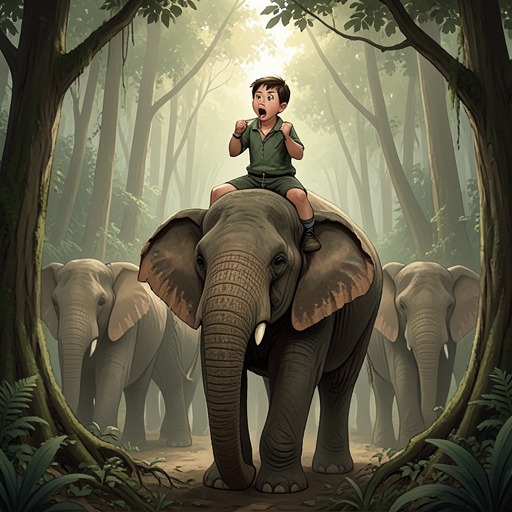
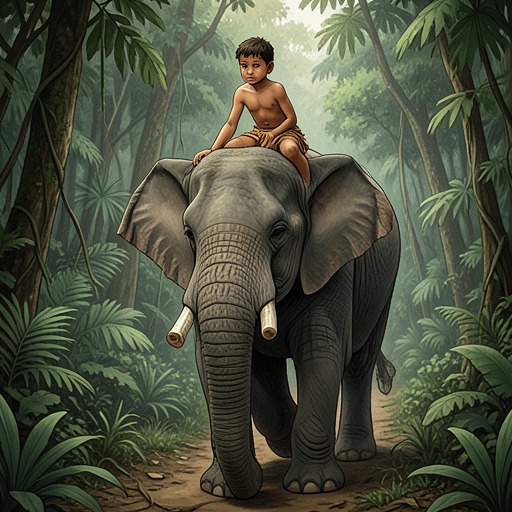
Kala Nag complicates that restraint. Big Toomai says that the elephant obeys no one but him, and he is sufficiently confident in that control to remove Kala Nag's leg chain when another elephant becomes dangerous, leaving only a loop of grass string and an instruction to remember that he is tied. The arrangement repeats an old family practice, but this time Kala Nag does not answer with his customary gurgle. When the grass string snaps, the elephant leaves silently, returns for Little Toomai, lifts him onto his neck, and carries him into the forest.
Big Toomai is absent from that decisive departure, but his earlier confidence is tested by it. The elephant he believes secured by command responds instead to a bond with the boy and to an impulse that lies beyond the camp's regulations. Big Toomai's expertise remains real; it simply proves insufficient to explain every form of elephant loyalty or every direction in which his son's life may move.
Recognition and Transformation
After the night journey, Big Toomai comes hotfoot from the plains in search of his missing son and elephant. He finds both alive and looks at them as though he is afraid of them, a reversal that exposes the limits of his former certainty. The boy has not merely disobeyed a command; he has returned from a hidden region of elephant life that no ordinary human observer is said to have witnessed.
The camp responds with a feast. The elephant catchers, trackers, drivers, and ropers pass Little Toomai from one to another, mark his forehead with blood from a jungle-cock, and declare him a forester initiated into the jungles. Big Toomai's private fear is therefore absorbed into a public ceremony of recognition. The vocation he tried to postpone becomes the identity conferred on his son.
Machua Appa then gives the boy the new name Toomai of the Elephants, honoring the ancestor who bore it and proclaiming that the favor of the elephant-folk and the Gods of the Jungles rests upon him. Big Toomai does not make the declaration, but his reaction at the feast is crucial: he has come searching in alarm, and he remains present when the community turns the act he condemned into an initiation. His son is no longer merely Little Toomai, the child to be kept from the Keddah, but a successor whose future is imagined in tracking, roping wild tuskers, and moving safely among charging elephants.
Narrative Significance
Big Toomai embodies the settled, regulated side of elephant work: inherited command, safe lines, smooth roads, and the expectation that expertise should reduce uncertainty. Little Toomai embodies the opposite impulse, preferring misty camps, hidden trails, wild drives, and the unknown movements of elephants. Their disagreement gives the story its human shape, while Kala Nag supplies the nonhuman force that decides the argument through action rather than explanation.
The contrast also distinguishes mastery from possession. Big Toomai can command Kala Nag in the Keddah and has devoted his life to maintaining that obedience, but the elephant's midnight escape and deliberate choice to carry Little Toomai show that the animal is not merely equipment within a government operation. The narrative grants Kala Nag memory, judgment, and relational loyalty, while Big Toomai's response marks the point at which human authority must acknowledge an elephant world it cannot fully supervise. His significance lies in that recognition: the experienced father begins by defending safety from the jungle and ends by witnessing the jungle claim his son.