Billy
The Jungle BookBilly is an experienced mule attached to a screw-gun battery, and his importance lies in the contrast between his unglamorous appearance and the highly specialized work he performs. He moves through the night camp as a veteran campaigner, understands military equipment and discipline, and treats fear as a correctable failure of training rather than an unavoidable condition. Through Billy, the narrative gives a working animal an independent professional voice while also showing how bodies, harness, guns, and command are assembled into a military system.
Identity and Military Function
Billy belongs to a screw-gun battery, whose small cannons are carried in two pieces and assembled when required. The guns can be taken into mountains wherever a mule can find a road, making the animals essential to artillery operations in rocky country. Billy therefore serves neither as ornamental transport nor as a generic beast of burden: his value depends on endurance, balance, obedience, and the practiced movement of a trained military specialist.
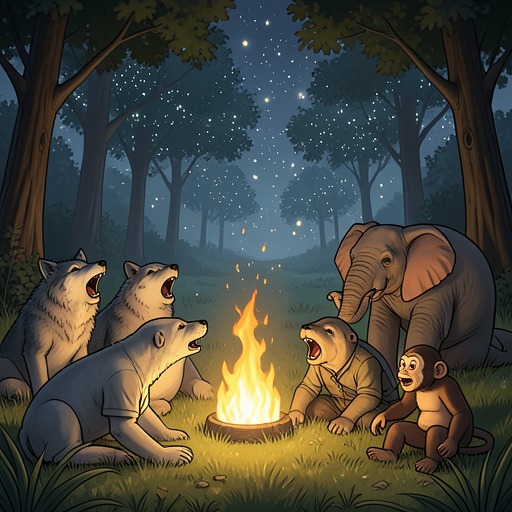
His conversation with the troop horse establishes the authority of long experience. When a young mule calls wildly for Billy after the camp has been disturbed, Billy answers as an old hand who knows that confusion is not a crisis. He threatens the youngster with a “number-one kicking” for disgracing the battery, and objects not merely to fear itself but to the public shame of displaying it before an outsider. Discipline, in Billy’s world, is both practical protection and professional dignity.
Knowledge of Mountain Warfare
Billy describes mule work as a technical science learned slowly. The proper task is to climb a mountain with a well-balanced saddle, maintain footing with all four feet and the ears, and creep along narrow ledges far above the ground. At the halt, the mule must remain still while the guns are assembled, then watch the small shells fall into distant tree-tops. His account turns apparently instinctive animal movement into acquired expertise: the mule must understand terrain, weight, concealment, timing, and the dangers created by human fire.
The central rule of Billy’s craft is to avoid appearing against the skyline, even when concealment requires a detour of a mile. That detail makes his military intelligence concrete. He is not simply commanded through difficult country; he has learned how tactical visibility governs survival and why a slower, hidden route is preferable to a direct exposure. His pride comes from knowing what the soldiers are trying to accomplish and from carrying out the work without theatrical display.
Relationships and Camp Authority
Billy corrects the frightened young mule, but his sternness is balanced by a broader understanding of fear. The troop horse recalls that he once ran for half a day after seeing a man for the first time, and Billy does not dispute the lesson that unfamiliar creatures may initially terrify even a trained animal. What matters is the transition from startled reaction to dependable service. Billy’s authority thus rests on experience rather than abstract superiority.
He is also wary of human beings. When the troop horse goes to inspect the stranded narrator, Billy says that he is not fond of white men and prefers returning to the battery because he carries Government property. His caution links personal judgment to institutional responsibility: the harness and equipment on his back are not merely possessions but part of the work entrusted to him. He leaves with the young mule, while giving formal good-nights to the troop horse, the camel, and Two Tails, mixing military courtesy with comic impatience.
Discipline, Labor, and Material Order
Billy’s character emerges through the objects surrounding him. Saddles, straps, chains, guns, and battery lines organize the animals’ movements, while the animal’s body makes the artillery system mobile. His knowledge cannot be separated from material practice: the balance of the saddle, the placement of the gun parts, the avoidance of the skyline, and the controlled climb all convert physical labor into military capability.
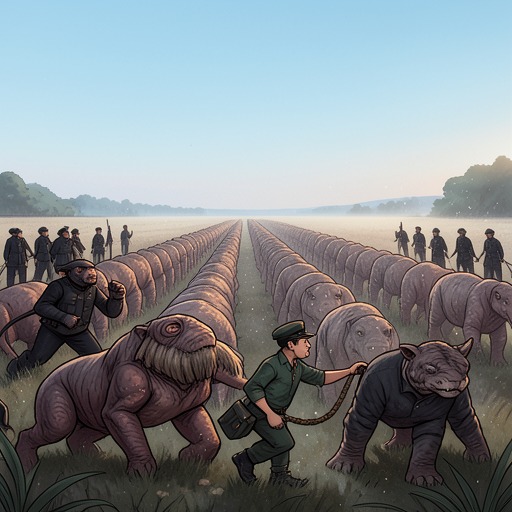
The wider camp makes this structure visible. Gun bullocks drag heavy siege guns when elephants cannot approach the firing line, while elephants and mules occupy different but connected positions in the transport hierarchy. Billy’s work is therefore specialized rather than solitary. He belongs to a chain in which animals are trained, harnessed, corrected, and synchronized, yet the story preserves distinctions among their skills and temperaments. Billy’s pride comes from mastery within that system, even as his reluctance toward white men hints at an animal perspective that does not reduce loyalty to blind submission.
The Review and Narrative Significance
At the Rawal Pindi review, Billy’s private competence becomes public spectacle. The parade includes thirty thousand men, cavalry, guns, elephants, oxen, and the screw guns. Billy appears last among these artillery units, carrying himself as though he commanded all the troops, with his harness oiled and polished. His bearing confirms that military display depends on countless disciplined bodies whose individual histories are normally hidden beneath formation and ceremony.
The review also provides a sharp contrast between Billy’s practical knowledge and the grandeur of imperial pageantry. Earlier, he explains how a mule survives on a mountain by avoiding exposure and keeping quiet; later, he passes through a vast public formation in which every animal and soldier is made visible as part of a unified spectacle. The narrator cheers for Billy, but Billy never looks right or left. His refusal to acknowledge the audience is not indifference alone. It is the final expression of professional concentration: the veteran mule performs his duty as though the parade were another operation, governed by discipline rather than applause.