Camel
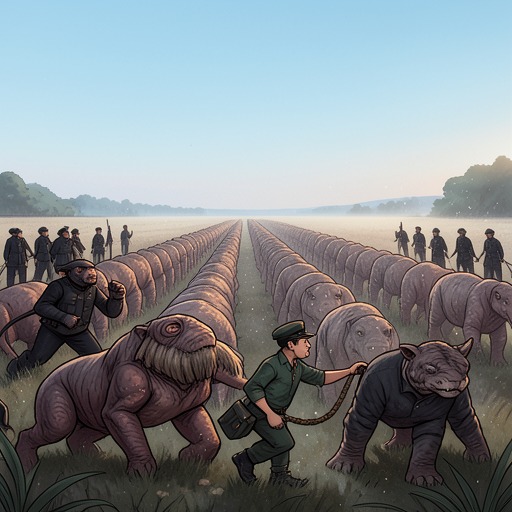
The Jungle BookThe Camel appears in the book most memorably as a baggage animal in the vast military encampment at Rawal Pindi. Alongside men, horses, elephants, bullocks, and mules, Camels belong to the infrastructure of a review for the Viceroy of India, yet their own fear and confusion expose the strain beneath the spectacle of military order. The baggage Camel is not merely transport equipment: through its speech, hesitation, and memories of the night, it becomes an animal witness to a human institution that classifies bodies by usefulness while demanding obedience from them.
Setting and Working Function
The Camel’s principal setting is the Rawal Pindi camp, where thirty thousand men and thousands of working animals have gathered during a month of heavy rain. The camp is not a stable home but a saturated logistical machine: tents stand in mud, ropes bind animals to their lines, guns are stacked at night, and the movement of transport animals sustains the military community. The Camels are attached to the 39th Native Infantry as baggage animals, giving them a defined place in the chain of supply rather than in the fighting line.
The surrounding military system distinguishes animals according to their tasks. The mule belongs to a screw-gun battery and understands itself through climbing, hauling, and artillery work; the troop-horse imagines the charge and the direct encounter of battle; the Camel carries baggage. This division of labor gives the camp its efficiency, but it also turns each animal into a specialized instrument. The Camel’s own description of its position is modest and apologetic: it identifies itself as only a baggage Camel and contrasts its role with the apparent bravery of the other animals.
The Night of the Stampede
The Camel enters the foreground during a night when the camp’s order breaks down. The Amir of Afghanistan has brought eight hundred men and horses unfamiliar with both camps and locomotives, and the horses repeatedly break their heel ropes and stampede through the mud. The Camels also break loose, run among the tents, and fall over the ropes. Their escape is therefore part of a larger chain of instability rather than an isolated act of disobedience.
The human narrator encounters the Camel after fleeing a collapsing tent. A Camel has blundered into the tent, snapping its pole and making the structure dance like a “mad ghost”; the narrator laughs despite the wet darkness before retreating toward the artillery lines. Later, a Camel passes with its soft feet squelching in the mud and its neck bobbing from side to side. Because the narrator knows camp-animal language, the Camel’s movement becomes intelligible as speech rather than mere panic.
The Camel asks where it should go and recounts its struggle with a white thing that waved and struck it on the neck. The white thing is the broken tent pole, so the animal has interpreted the accidental collision through the immediate logic of fear and pain. Its question about whether the animals should keep running shows that the stampede is not presented as a calculated revolt. It is an attempt to escape a confusing environment in which rain, darkness, ropes, tents, and human objects have become threats.
Fear, Memory, and Animal Testimony
The Camel later explains its conduct by saying that the Camels dreamed bad dreams and became very afraid. This explanation is comic in its self-conscious humility, but it also grants the animal a psychological life. Fear is not reduced to a mechanical defect: it becomes the Camel’s account of what happened, offered before the assembled military animals and answered by the mule’s practical insistence that the Camels should have remained with the 39th Native Infantry.
The Camel’s testimony is shaped by unequal knowledge. It knows the night as bodily confusion—mud underfoot, darkness, pursuit, and the shock of being struck—while the mule interprets the same events through military discipline and responsibility. The contrast makes the camp’s organization visible from below. Human command requires animals to stay in assigned lines and perform assigned work; the Camel experiences the breakdown of that command as an environment of frightening, incomprehensible objects.
Yet the Camel is not portrayed as incapable or wholly passive. It has fought, though not in the climbing or running manner admired by the other animals, and it tries repeatedly to speak in a conversation dominated by more confident voices. Its stammering entrance into the discussion—an admission that it has fought “a little”—marks both social embarrassment and a suppressed history of labor. The animal’s body is unsuited to the heroic forms recognized by the mule and troop-horse, but that does not mean it has no experience of danger.
Discipline and the Return of Order
The Camel’s fear is finally contained by the military system rather than solved through persuasion. The camp’s animals are gathered into a command structure in which an order is given and obeyed. The stark formulation offered by a native officer—“An order was given, and they obeyed.”—presents obedience as the principle that converts scattered animals and men into an organized force.
This restoration produces a sharp contrast with the earlier night. In darkness and rain, the Camel is a frightened individual moving without orientation; in the formal camp, it is one component of a mass capable of synchronized action. The same animal body can therefore appear as a nuisance when loose, a laboring resource when harnessed, and part of a disciplined spectacle when placed within the military line. The Camel helps reveal that order is not natural or automatic: it is imposed through ropes, roles, commands, and collective training.
The comic animal dialogue also complicates the triumph of discipline. The Camel does not deny having run away, but its account preserves the costs hidden by the final display of control. Behind the command stands a night of exhaustion, fear, wet ground, broken tents, and animals whose responses are interpreted by their handlers as misconduct. The camp’s efficiency depends upon suppressing those experiences, while the narrative briefly restores them through animal speech.
Narrative and Thematic Significance
The Camel belongs to the book’s wider practice of making animals bearers of knowledge. In other stories, animal voices transmit the experience of killing grounds, jungle law, rescue, or ritual; here, the Camel’s testimony makes military logistics and discipline available from an animal perspective. Its speech does not overturn the hierarchy of the camp, but it prevents the hierarchy from appearing complete. The military review may be designed for human authority, yet the animals reveal how much labor and fear support its polished surface.
The Camel also occupies an important middle position between wild animal and fully controlled instrument. It is a working creature attached to an army, but it retains memory, apprehension, judgment, and the capacity to describe what happened. Its identity as a baggage Camel is imposed by military classification, while its narrative presence gives that category a personal and bodily dimension. The result is an understated critique of systems that value animals primarily through transport, supply, and obedience: the Camel carries burdens for the camp, but it also carries a perspective the camp itself cannot express.