Council Rock
The Jungle BookCouncil Rock is the hilltop meeting place where the Seeonee Wolf Pack makes its most consequential collective decisions. A circle of stones and boulders large enough for a hundred wolves to hide among, it is governed by ritual inspection, the repeated command to “Look well, O Wolves!”, and the authority of the leader seated upon its rock. Across Mowgli’s story, the site changes from a place of adoption into a courtroom of exclusion and then into a memorial stage where Shere Khan’s defeat is publicly confirmed.
Setting and Law
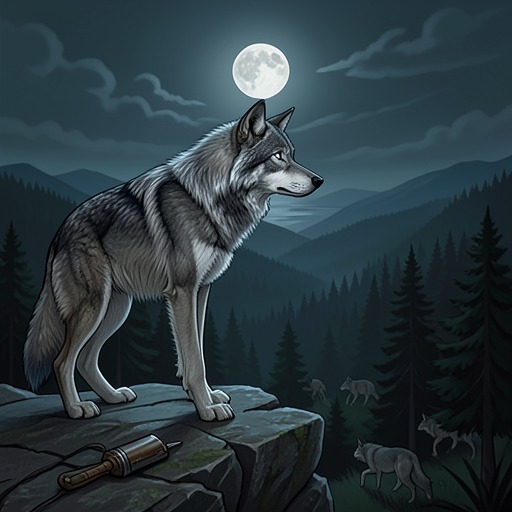
Council Rock stands on a hilltop covered with stones and boulders, arranged so that a large gathering of wolves can assemble while remaining partly concealed. The meeting is held at full moon, when the Pack Council identifies its cubs. The setting is therefore not merely a natural landmark: its elevated, open circle makes membership visible, while its surrounding rocks provide the physical form of a collective court.
The Law of the Jungle determines what happens there. Wolf cubs must be brought before the Pack when they are old enough to stand and run; senior wolves examine them one by one, and mothers may push them into the moonlight so that none is overlooked. Akela, the great gray Lone Wolf, presides from his rock and calls for careful scrutiny. The repeated response from the mothers and the Pack turns inspection into a shared ceremony rather than a private decision.
Council Rock also provides the formal setting for disputes over belonging. When Mowgli’s right to enter the Pack is challenged, the Law requires at least two members who are neither his father nor mother to speak for him. Baloo defends the naked man-cub, and Bagheera adds the price of a freshly killed bull. The Pack accepts this arrangement, and the voices around the Rock transform Mowgli from Shere Khan’s quarry into a recognized member of the Free People.
Mowgli’s Adoption
Mowgli first appears at Council Rock as “Mowgli the Frog,” pushed by Father Wolf into the center of the circle while he laughs and plays with moonlit pebbles. His calmness contrasts with the danger surrounding him. Shere Khan calls from behind the rocks that the cub belongs to him and demands that the Free People surrender him, but Akela refuses to let a tiger dictate the Pack’s law.
The scene establishes Council Rock as a contested boundary between predation and community. Shere Khan sees Mowgli as prey and asserts ownership through force; the Pack, at least for this meeting, subjects the question to custom. Baloo’s appeal against killing a naked cub and Bagheera’s offered bull give the wolves both a moral and material reason to accept him. The decision is accompanied by the old inspection cry, so Mowgli’s admission becomes a public act witnessed by the Pack rather than an informal favor from his adoptive parents.
The place also foreshadows the conflict that will later return there. Shere Khan remains outside the circle, roaring in anger, while Mowgli sits within it. The arrangement gives visual form to the difference between lawful membership and hostile claim: the tiger can threaten the assembly, but he cannot yet control its decision.
The Council of Expulsion
Years later, Council Rock becomes the scene of Mowgli’s rejection. Akela lies beside his rock, signaling that Pack leadership is open, while Shere Khan and the scrap-fed wolves who flatter him move openly through the assembly. The old order has weakened, and the same location that once protected Mowgli now exposes the instability of the community that accepted him.
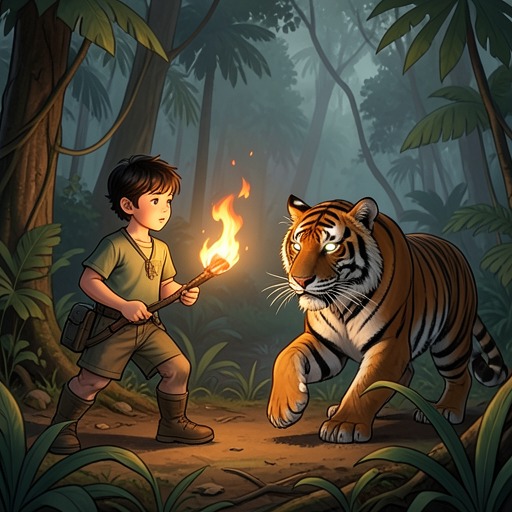
Bagheera places the fire pot between Mowgli’s knees, and Mowgli brings the Red Flower into the council as a material sign of human power. When the wolves insist that he is a man, he accepts the consequence: he says that he will no longer call them his brothers and identifies himself as a man among those who have called him one. He throws down the pot, lights a branch, and drives the frightened wolves from the circle while Shere Khan recoils from the flame.
The action reverses the original arrangement at Council Rock. At Mowgli’s adoption, the Pack’s law grants him protection from the tiger; at his expulsion, the Pack’s fear and faction allow the tiger to press against that law. Mowgli does not simply wait to be removed. He uses the Red Flower to seize the immediate power of the place, spares Akela by declaring that the former leader will not be killed, and orders the wolves away. Yet victory cannot restore his membership. When tears come to him for the first time, Bagheera explains that they are human tears and that the jungle is closed to him thereafter.
Return with the Hide
Council Rock later becomes the place where Mowgli returns after the Man-Pack has cast him out. He arrives with Akela and another wolf, carrying Shere Khan’s hide, and announces to Mother Wolf that he has come to keep his word. The return joins two apparently separate expulsions: rejected by the human village, Mowgli comes back to the wolves with the proof of the promise made during his earlier confrontation there.
Mother Wolf recognizes the hide as the fulfillment of her prophecy that the hunter would become the hunted. Bagheera greets Mowgli as Little Brother, and together they climb the Rock. Mowgli spreads the striped skin across the flat stone where Akela once sat and fixes it down with four slivers of bamboo. Akela then lies upon the hide and calls the old assembly cry exactly as he did when Mowgli was first brought before the Pack.
This repetition gives the place a ceremonial memory. The first meeting displayed a vulnerable child awaiting judgment; the later meeting displays the conquered enemy whose hide proves the child’s transformation. The old wolves answer the call from habit, but their condition reveals what has happened since Akela’s deposition: some are lame from traps, some bear shot wounds, some are mangy from poor food, and many are missing. Council Rock therefore records not only Mowgli’s triumph but the Pack’s deterioration under lawlessness.
Meaning and Narrative Role
At Council Rock, space produces identity through visibility and collective recognition. A cub is placed in the center, examined, spoken for, accepted, or rejected; the surrounding wolves turn the natural hilltop into an institution. The Rock is thus a threshold between private life and public status, linking the cave where Mowgli is loved by Father Wolf and Mother Wolf with the wider society whose judgment determines whether he belongs.
Its repeated ceremonies also structure Mowgli’s movement through separation, ordeal, and return. He enters the Pack as an unprecedented man-cub, is forced out when his human nature can no longer be contained by wolf custom, and returns with Shere Khan’s hide only to declare that both the Man-Pack and Wolf-Pack have cast him out. The return is therefore not a restoration of the old order. Mowgli says that he will hunt alone, while the four wolf cubs choose to hunt with him; Council Rock confirms his achievement, but it cannot give him back a single community.
The final image combines public proof with permanent displacement. Shere Khan’s hide lies where Akela once led, and the command to look well summons the Pack to witness the reversal. Yet Mowgli does not resume leadership. The Rock has witnessed his adoption, his repudiation, and his vindication, making it the central political and symbolic location of his divided identity: human by nature, wolf by upbringing, and finally unable to belong wholly to either society.