Darzee's Chant
The Jungle BookDarzee's Chant is the Tailorbird's song of thanksgiving for Rikki-tikki-tavi, the mongoose who protects the bungalow garden from Nag, Nagaina, and the danger represented by their cobra brood. Its decisive significance lies in its change of scale: the fight is carried out by one small animal, but the chant recasts the result as a public liberation for the birds and the wider garden community.
Occasion and Setting
Darzee's Chant appears after the final pursuit of Nagaina. Rikki-tikki-tavi follows her into the rat-hole, gripping her tail even though a cobra's underground lair gives her every advantage. While the grass at the entrance stops moving, Darzee assumes that the mongoose has been killed and begins composing a death song. The apparent funeral reverses itself when Rikki-tikki-tavi emerges alive, covered with dirt, licking his whiskers, and declares that the widow will never come out again.
The song therefore rises directly from a moment of uncertainty and mistaken mourning. Darzee's first response is shaped by what he can see—or cannot see—at the hole's mouth; Rikki-tikki-tavi's return converts the death song into a victory hymn. That abrupt turn gives the chant its dramatic force. It does not merely praise an established hero; it records the instant when fear is replaced by confirmed safety.
Voice and Form
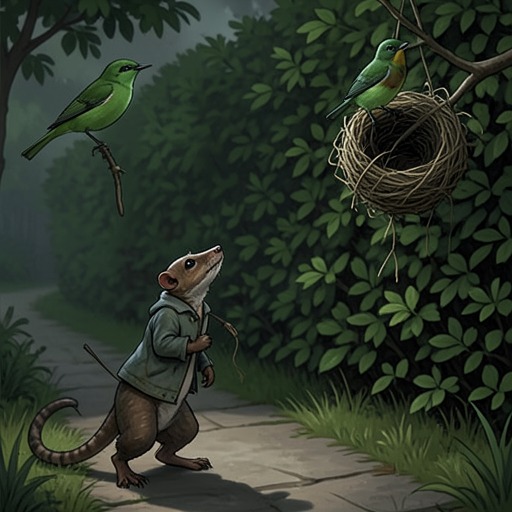
Darzee sings as a bird and as a tailor. The opening identifies him through the craftsman image, “Singer and tailor am I—,” joining music with the making of a nest. His art is presented as constructive: while he weaves a house, he also weaves music. The chant's repeated appeals to mothers and fledglings extend the victory into domestic life, asking the birds to lift their heads because the evil that once threatened them has been slain.
The song uses repetition, direct address, and ceremonial praise rather than a detached account of events. Its questions—“Who has delivered us, who?”—create a call for communal recognition, and the answer names Rikki-tikki-tavi as “the valiant, the true,” “the ivory-fanged,” and “the hunter with eyeballs of flame.” These epithets enlarge the small mongoose into a legendary protector without removing the concrete features that make him recognizable: teeth, eyes, hunting, and courage.
The Hero Celebrated
The chant presents Rikki-tikki-tavi's victory as deliverance from a terror that had been concealed within the garden's roses. Its language contrasts hidden menace with exposed defeat: the evil that plagued the birds is “impotent—flung on the dung-hill and dead!” The movement is from concealment to public visibility, from paralysis to song. The cobra threat is no longer an unseen presence in the flowers but a defeated power placed outside the living community.
Darzee's praise also emphasizes truthfulness and moral reliability. Rikki-tikki-tavi is not celebrated merely as a strong killer; he is “the valiant, the true.” That formulation answers the uncertainty surrounding the underground pursuit. Darzee cannot witness the whole struggle, and his first song mistakes silence for death, but the mongoose's reappearance supplies the fact on which the final praise rests. The chant converts incomplete observation into communal knowledge once the result is confirmed.
Communal Consequences
Rikki-tikki-tavi's action has consequences beyond the destruction of two individual cobras. Nag and Nagaina had made the garden a place of continuing danger, and the chant speaks for the birds whose nests and young were endangered by that terror. The repeated instruction to mothers to raise their heads presents the victory as a restoration of ordinary life: fledglings can again be protected, houses can again be woven, and song can replace alarm.
The closing blessing asks the birds to give Rikki-tikki-tavi “the Thanks of the Birds,” bowing with tail feathers spread and praising him with nightingale words. The imagery creates a miniature ceremony of honor. Bird society collectively acknowledges a defender who does not belong to it, so the chant also marks an alliance across species. Rikki-tikki-tavi's protection earns him a place in the birds' memory even though his method is tooth, jump, spring, and bite rather than song or nest-building.
Narrative and Thematic Significance
Darzee's Chant is both aftermath and interpretation. The surrounding action establishes Rikki-tikki-tavi as the actual fighter, while the chant supplies the community's emotional and symbolic response. It gives language to those who benefit from his courage and makes the garden's restored security audible. In that sense, the song functions as a communal record of survival: the danger is over, the supposed dead hero has returned, and the birds can name what has happened.
Its celebratory structure also balances the violence of the mongoose's work. The story's conflict is resolved through direct combat and death, but Darzee's song does not dwell on the mechanics of killing. Instead, it translates violence into protection, thanksgiving, and renewed domestic life. The final image is not the hole, the cobra, or the bloodshed, but birds bowing in praise to the small hunter who has made their world inhabitable again.