Dick Cunliffe's horse
The Jungle BookDick Cunliffe's horse, identified as Number Fifteen of E troop of the Ninth Lancers, is a veteran cavalry animal whose self-command and practical knowledge give the military world of the story an animal voice. He is neither a decorative mount nor a silent instrument: he remembers fear, explains training, judges danger, and understands service as a partnership in which his own life is bound to Dick Cunliffe's. His polished performance at the Rawal Pindi review is therefore the visible result of discipline learned through fear, trust, and repeated work.
Identity and Introduction
Dick Cunliffe's horse appears during the night disturbance at the Rawal Pindi camp, where thirty thousand men and large numbers of camels, elephants, horses, bullocks, and mules have gathered for the Viceroy's review and the visit of the Amir of Afghanistan. After frightened camels break loose and blunder through the camp, the horse canters steadily through the darkness, jumps a gun tail, and comes up beside Billy the Mule. He introduces himself formally as Number Fifteen of E troop of the Ninth Lancers and asks the others to make room.
His composure contrasts with the camel's panic and with the mule's irritation. Yet the horse does not present himself as naturally fearless. He explains that the first time he saw a man, in Australia when he was three years old, he ran for half a day; had he seen a camel then, he would have run still farther. The recollection establishes him as a trained animal rather than an inhumanly brave one. Courage, in his account, is fear brought under control by experience.
Training and Military Knowledge
The horse distinguishes sharply between a camp stampede and active service. In camp he may break out of his picket, and he recalls that four hundred and fifty horses once stampeded because a new recruit frightened them with stories of whip snakes and the loose ends of head-ropes. On campaign, however, Dick Cunliffe rides him, drives his knees into him, and demands that he watch every step, keep his hind legs beneath him, and remain bridle-wise.
For the horse, being bridle-wise means turning instantly when the rein presses against the neck. If there is no room to swing, he must rear slightly and pivot on his hind legs. The maneuver is not ornamental horsemanship: he calls it a matter of life or death for the rider and therefore for the horse as well. His definition shows how military obedience has become bodily intelligence. The command is received through pressure, translated into movement, and carried out before deliberation can endanger either partner.
He also describes the physical closeness required in a cavalry charge. He rides among yelling, knife-bearing men while keeping Dick's boot just touching the next man's boot without crushing it. He can see Dick's lance beside his right eye and takes that position as a sign of safety. The horse has once been cut across the chest when he stretched himself to avoid stepping on a fallen man, but he attributes the wound to the enemy rather than to Dick. His conclusion is severe and revealing: without trust in the rider, a horse may as well run away at once.
Relationship with Dick Cunliffe
Dick Cunliffe's horse defines his identity through his rider. Dick is not merely the man who sits on his back; he is the source of battlefield direction, the pressure that makes rapid turning possible, and the trusted companion whose movements the horse anticipates. Their relationship is reciprocal even within a military hierarchy. Dick gives commands and imposes discipline, while the horse supplies judgment about footing, spacing, balance, and immediate danger.
The horse's confidence never erases the possibility of injury. He has been cut in combat and knows that the rider cannot prevent every blow. Nevertheless, he preserves the distinction between a trusted human partner and an enemy who attacks from the ground. This judgment makes his service more than mechanical submission. He accepts danger because the shared task has a structure, and because Dick's presence gives that structure meaning.
Parade and Public Performance
Before the review, the horse tells Vixen that he will stand on the left of the second squadron and set the time for the entire troop. The statement becomes visible during the parade. As the cavalry passes to the music of "Bonnie Dundee," he moves with his head drawn toward his breast, one ear forward and one back, his tail like spun silk, and his legs flowing as smoothly as waltz music. He neither looks right nor left; concentration replaces the disorder of the night.
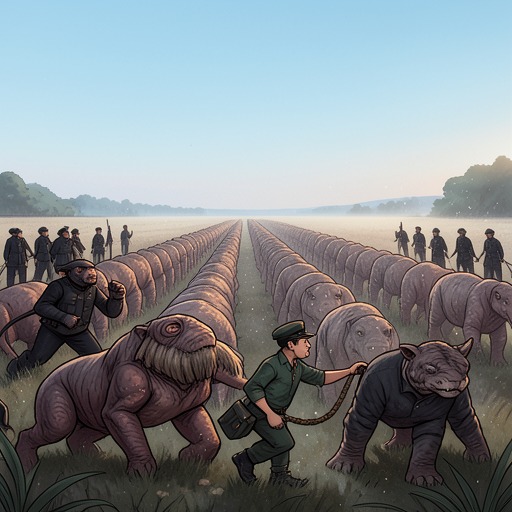
The review gathers the separate skills of the camp animals into a single military image. The horse leads the second squadron in its measured movement; Two Tails and two other elephants draw a forty-pounder siege gun while twenty yoke of oxen follow; Billy the Mule carries the screw guns with polished harness and an air of command. The parade's final formation becomes a wall three-quarters of a mile long, and the advancing mass shakes the ground. Dick Cunliffe's horse is a small but essential unit within that immense mechanism: his individual discipline is what allows collective precision to appear effortless.
Narrative Significance
The horse's conversation gives the animals of the military camp knowledge that human observers usually overlook. The officer later explains the spectacle to a Central Asian chief in the simplest possible terms: an order was given, and it was obeyed. The horse's account complicates that official formula. Obedience depends on training, memory, trust, bodily technique, and the ability to control fear. The parade displays the result, while the nighttime conversation exposes the labor beneath it.
His perspective also places cavalry service beside other forms of animal labor without treating them as identical. Billy the Mule takes pride in climbing mountains with guns, remaining below the skyline, and watching shells fall into distant treetops; the horse takes pride in rapid maneuver, close formation, and the rider's lance. Both animals possess specialized knowledge, but each knows the danger of the other's work. Through this contrast, the story grants military animals professional competence and a shared interpretive authority over the human systems that train and use them.
Dick Cunliffe's horse therefore represents disciplined animal subjectivity within an imperial army. He is shaped by military command, yet he speaks as an experienced worker who understands technique and risk. His final public image is one of seamless order, but his remembered fear and insistence on trust prevent that order from appearing natural. The horse's achievement lies not in never being afraid, but in converting fear into exact movement when the rein, the rider, and the regiment demand it.