Elephants
The Jungle BookElephants are among the book’s most powerful figures of animal agency and human control. They appear as wild, organized communities moving through forests and rivers; as trained workers carrying tents, guns, and timber; as instruments of military ceremony; and as beings whose collective life remains partly inaccessible to human knowledge. Their history is carried by memory, bodily skill, obedience, fear, and resistance. The central elephant, Kala Nag, embodies this tension most fully: he has served the Government of India for decades, yet his deepest allegiance is revealed when he leaves the camp with Little Toomai to join the elephants’ night dance.
Identity and Social Life
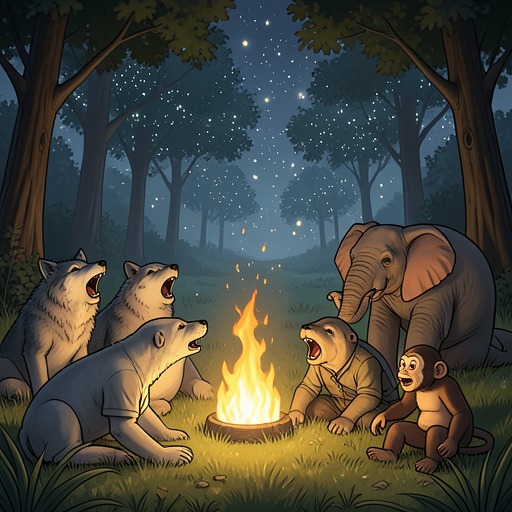
Elephants are presented as a people with their own routes, gatherings, signals, and forms of collective action. In the Garo Hills, wild elephants create paths through dense forest and assemble in a clearing whose ground has been stamped hard by repeated gatherings. The clearing is not an accidental patch of earth: the elephants themselves enlarge it by crushing grass, cane, trash, and fibers into solid ground. Their movements therefore shape the environment, leaving behind a durable communal space. The night assembly includes many kinds of elephants: white-tusked males, fat females with calves beneath them, young animals displaying newly emerging tusks, scarred old bulls, and an elephant bearing the marks of a tiger’s attack. This range of ages, sexes, histories, and bodily conditions gives the gathering the character of a whole society rather than a herd assembled only for spectacle. Once inside the clearing, animals that had crashed through the undergrowth move almost like ghosts, suggesting a practiced ritual known to them but hidden from ordinary human observers. The dance is carried by sound and synchronized weight. Trumpeting spreads through the assembly, then hundreds of feet begin stamping together until the ground rocks and the noise becomes a vast drumbeat. The movement alternates between trampling hard earth and crushing green growth. It lasts for roughly two hours and ends at dawn, when the light seems to command its cessation. The elephants then vanish so completely that only Kala Nag, Pudmini, and the elephant with rope-galls remain visible. Their disappearance emphasizes that the event belongs to elephant society, while Little Toomai is an accidental and privileged witness.
Kala Nag and a Life of Service
Kala Nag, whose name means Black Snake, has served the Government of India in nearly every capacity available to an elephant. He was already about twenty when he was captured and has served for forty-seven years, making him nearly seventy. His memory reaches back to work before the Afghan War of 1842, when he helped push a gun out of deep mud before he had reached full strength. His long life is therefore also an archive of imperial labor and warfare. His mother, Radha Pyari, taught him that frightened elephants were likely to be injured. He learned the lesson through experience: when a shell burst near him, fear drove him backward into piled rifles, where bayonets wounded him in vulnerable places. By the time he was twenty-five, he had abandoned fear and become one of the best loved and best cared-for elephants in government service. His career included carrying twelve hundred pounds of tents across Upper India, being lifted by steam crane onto a ship, transporting a mortar through rocky country far from India, and witnessing the dead Emperor Theodore at Magdala during the Abyssinian War. Kala Nag also endured the costs of military and industrial service. He saw fellow elephants die from cold, epilepsy, starvation, and sunstroke at Ali Musjid, then was sent thousands of miles south to haul and stack teak in the timberyards at Moulmein. There he nearly killed an insubordinate young elephant that shirked its share of work. Later, he was transferred from timber hauling to the capture of wild elephants in the Garo Hills, joining a specialized government force responsible for hunting, trapping, breaking, and distributing elephants for work throughout the country. His body is marked by this history. He stands ten feet at the shoulders, with tusks cut down to five feet and their ends bound in copper bands to prevent splitting. These shortened tusks are still more useful in a fight than the full tusks of an untrained elephant. During captures, he enters a stockade filled with forty or fifty wild elephants, selects the largest and fiercest tusker, and hammers and hustles him into submission while men on other elephants rope the smaller animals. He also knows how to meet a wounded tiger, striking a leaping animal sideways with a swift movement of his head and pinning it beneath his knees. His expertise is thus both magnificent and unsettling: the same intelligence and strength that sustain his survival make him an effective instrument of human administration.
Little Toomai and the Night Dance
The relationship between Kala Nag and Little Toomai reveals that obedience does not exhaust an elephant’s character. After the elephants in camp are chained by their hind legs and secured with ropes, a wild elephant’s distant call awakens the lines. Kala Nag raises his head toward the Garo Hills and does not respond as usual. When the grass string around his leg snaps, he slips quietly out of the pickets. Little Toomai follows barefoot through the moonlit camp, calling to Kala Nag and asking to be taken along. The elephant turns back, lowers his trunk, lifts the boy onto his neck, and enters the forest. He moves uphill with extraordinary silence, brushing through grass, pepper vines, and bamboo as though the forest were smoke. The journey passes through a living night landscape of bats, porcupines, and a digging hog-bear, while the boy gradually realizes that the elephant-folk are traveling toward their dance. At the clearing, Little Toomai sees wild males, mothers, calves, young elephants, old females, scarred bulls, and animals carrying the marks of combat. Kala Nag joins the synchronized stamping. Little Toomai cannot identify his own position as the dance proceeds, and the sound enters his whole body. When dawn comes, the elephants have gone, leaving behind a larger clearing and the evidence of their labor. Little Toomai has seen what no human had seen before: the elephants’ dance at night, alone in the heart of the Garo Hills. This experience changes his status, because his knowledge is not acquired from a manual or a human instructor but through trust from Kala Nag and access to an animal world normally closed to people.
Elephants Under Human Institutions
The book repeatedly contrasts elephant self-organization with human systems that classify, train, measure, and deploy animal bodies. The Government of India preserves elephants through a department devoted to hunting, capture, breaking, and redistribution, but preservation here is inseparable from possession. Elephants are protected as a resource precisely so that they can be made available for transport, construction, warfare, and state ceremony. The military camp at Rawal Pindi extends this organization across a vast human and animal population. Thirty thousand men and thousands of camels, elephants, horses, bullocks, and mules gather for a review by the Viceroy of India. The camp’s order is repeatedly threatened by animals whose movements do not fit military schedules: horses break their heel ropes, camels stampede through mud, and one camel collapses a tent. The scene exposes the fragile boundary between disciplined display and uncontrolled animal force. Yet the same animals can be incorporated into a chain of command. An old Central Asian chief asks how the remarkable order of the camp was achieved, and a native officer explains that an order was given and obeyed. The statement reduces a complicated hierarchy to its visible principle, but the surrounding narrative shows what that obedience requires: ropes, pickets, training, specialized handlers, bodily memory, and the long history represented by Kala Nag. Elephants can perform submission with spectacular precision, but their secret gathering demonstrates that institutional obedience is only one part of their existence.
Narrative and Thematic Significance
Elephants also organize the book’s broader attention to animal knowledge. Other creatures are introduced through songs, warnings, and stories: Baloo teaches Mowgli the Law of the Jungle; Matkah sings a mother seal’s lullaby; Darzee sings during the mongoose’s struggle with Nagaina; and Rikki-tikki-tavi’s battle is framed as a conflict in which animals perceive danger and responsibility. The elephant material enlarges this pattern by giving animal society a ceremony that humans may witness but cannot command or fully interpret. Songs associated with elephants place them within cultural memory. Little Toomai’s mother sings of Shiv, who poured the harvest and made the winds blow, while the section devoted to the boy’s experience is titled “Shiv and the Grasshopper.” The song links domestic human life, religious imagination, and the larger world of animal movement, but the night dance remains materially grounded in feet, trampled earth, trumpet calls, and the changing forest. Myth and physical labor meet without reducing the elephants to either symbol. The elephants’ significance finally lies in their doubleness. They are powerful enough to carry twelve hundred pounds of tents, transport mortars, break wild captives into obedience, fight tigers, and produce a military salute heard by the highest imperial authority. They are also capable of moving silently beyond the camp, following routes known to themselves, enlarging a hidden clearing, and disappearing at dawn. The narrative therefore refuses to treat them as mere machines of empire or as distant emblems of the wild. Their bodies bear the marks of human use, while their collective life preserves a domain that human power can approach but does not own.