Garo Hills
The Jungle BookGaro Hills is the mountainous forest country that surrounds the elephant-catching camps and conceals the wild elephants' nocturnal dance ground. In this setting, human administration, trained working elephants, and the autonomy of the wild herds meet uneasily. The hills are therefore both a workplace shaped by the Government of India and a largely inaccessible animal domain whose deepest customs remain beyond human explanation.
Setting and Human Use
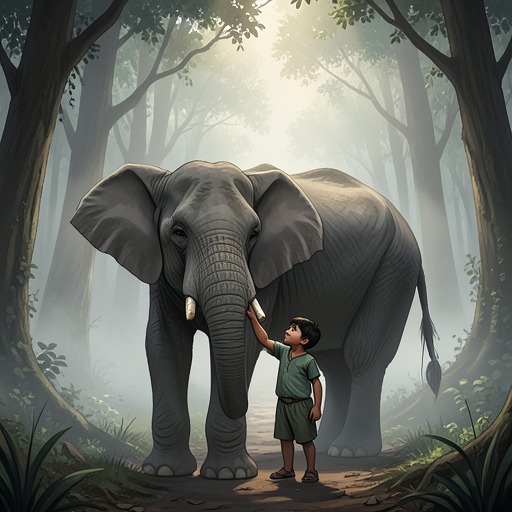
The Garo Hills are presented as difficult country through which trained crews drive wild elephants toward a Keddah, or stockade. The Government of India maintains a department devoted to hunting, catching, breaking in, and distributing elephants for work, and the hill operations form part of that organized system. Little Toomai prefers this mobile life to the ordered elephant lines: he enjoys the bridle paths that only an elephant can take, distant glimpses of wild herds, sudden weather, and the hazardous progress of a drive through valleys and forest.
The terrain makes the operation both spectacular and dangerous. During the final drive, wild elephants rush into the stockade like boulders in a landslide, while men answer their force with posts, ropes, torches, yells, and blank cartridges. The hills thus carry the marks of human control, but they also expose its limits. Even the mahouts, experienced in managing captured elephants, must work amid noise, darkness, shifting animals, and ground whose scale and complexity favor the herds.
The Night Journey
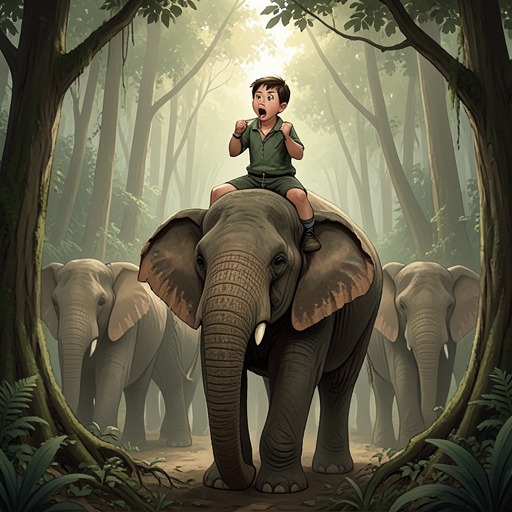
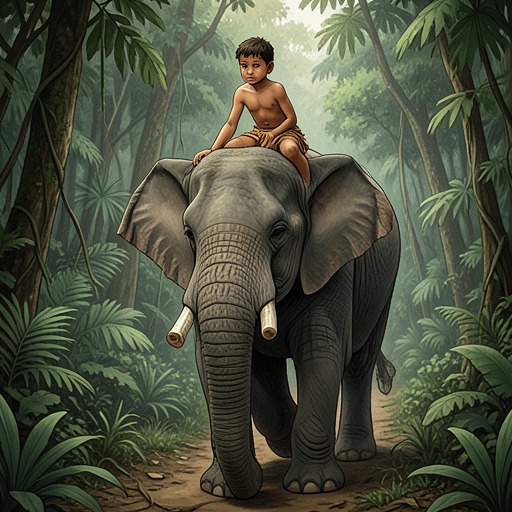
The hills become a different world after Kala Nag leaves the camp. A distant wild-elephant call rouses the elephants in the lines, and Kala Nag silently slips away after his grass tether snaps. Little Toomai follows barefoot and is lifted onto the elephant's neck. At first Kala Nag moves so quietly that the forest seems to absorb him; then he plunges downhill with the force of a runaway gun, tearing through creepers, bamboo, and saplings.
The journey reveals the hills as a living network rather than an empty wilderness. Little Toomai sees mist over the river and hears bats, porcupines, and a hog-bear in the darkness. After crossing the water, Kala Nag joins a path recently made by many elephants. A wild tusker rises behind them, and trumpetings and breaking branches surround the travelers as the herd climbs toward a hidden destination. The route is legible to the elephants even when its direction remains uncertain to the boy.
The Hidden Dance Ground
At the hilltop, Kala Nag reaches a circle of trees enclosing an irregular clearing of three or four acres. The ground has been trampled hard as brick, with no green blade remaining; the central trees are polished where elephants have rubbed their bark away. Moonlight turns the clearing iron gray and the elephants' shadows black. More animals emerge from between the trees, entering the open space almost like ghosts after crashing through the surrounding undergrowth.
The gathering includes white-tusked males, mothers with tiny calves, young elephants beginning to grow tusks, old females, scarred bulls, and an animal marked by a tiger's claws and a broken tusk. The range of bodies makes the clearing appear not like a random meeting place but like a gathering of the whole elephant community. Little Toomai cannot keep count of the arrivals; he repeatedly reaches ten and loses track as more elephants come up the hillside.
Witness and Recognition
Little Toomai's presence gives the Garo Hills their decisive narrative significance. He is the first human to see the elephants' night dance alone in the heart of the hills, while Kala Nag serves as the bridge between the managed camp and the wild herd. The experience changes his position among the elephant catchers: what adults dismiss as a child's wild story becomes verifiable knowledge when Petersen Sahib and Machua Appa follow the track for fifteen miles.
The clearing confirms the child's account. Machua Appa counts seventy elephant tracks crossing the river and identifies the mark made by Pudmini's leg iron on a tree. Petersen Sahib, despite eighteen years of experience catching elephants, has found such a dance place only once before. Yet the discovery does not turn the dance into a humanly mastered custom. The observers can read the physical evidence, but they still admit that the ways of elephants are beyond the understanding of both black and white men.
Narrative Significance
Garo Hills contrasts institutional knowledge with direct encounter. The camp knows how to drive, tether, and discipline elephants; Little Toomai knows what he has seen because Kala Nag carries him into a space inaccessible to ordinary human observation. The hills preserve an animal order that is older and more mysterious than the government machinery operating at their margins.
This contrast belongs to the book's wider habit of treating animal communities as governed by their own customs, songs, and territories. Baloo teaches Mowgli that the jungle has laws and permissions, while the seals and the mongoose stories likewise place animal life within social systems rather than reducing it to scenery. In the Garo Hills, however, the hidden dance ground makes that principle spatially concrete: the elephants possess a place humans can discover only through an animal's decision to carry a child there. The hills remain significant because they allow the story to end not with human conquest of nature, but with a moment of recognition before a mystery that human observers can document without explaining.