Government of India
The Jungle BookThe Government of India is presented not merely as a distant political authority but as an institution that organizes animal bodies, military logistics, and imperial movement. Its reach is visible in the long service of Kala Nag, in the specialized administration of elephant capture, and in the command structure that binds animals and soldiers into a single chain of obedience.
Nature and Administrative Reach
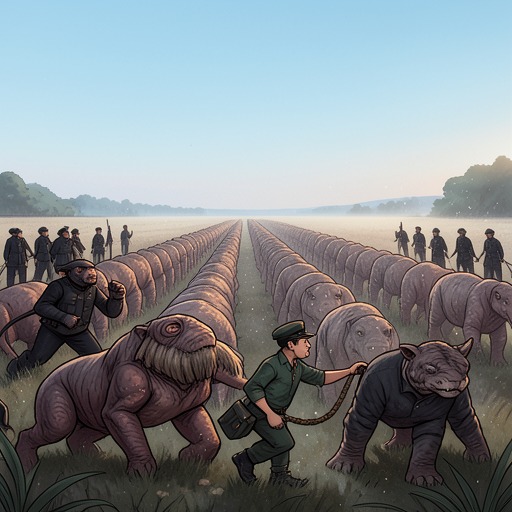
The Government of India maintains a dedicated department responsible for hunting, capturing, breaking in, and distributing elephants for work as required. Elephant preservation in this context does not mean freedom from human control; it means systematic state management of a valuable labor force. Elephants are caught, trained, moved across the country, and assigned to tasks according to administrative need.
This system places animal life within a durable bureaucratic structure. Kala Nag served the Government of India for forty-seven years after being captured at about twenty years of age, making him nearly seventy by the time the narrative describes him. His individual history becomes a record of the government's changing demands: military transport, work with artillery, timber hauling, and the capture of wild elephants.
Kala Nag and State Service
Kala Nag's career demonstrates the breadth of the government's use of elephants. He carried tents weighing twelve hundred pounds on marches in Upper India, was lifted by a steam crane onto a ship, crossed the sea, and carried a mortar through a strange rocky country far from India. He witnessed the death of fellow elephants from cold, epilepsy, starvation, and sunstroke at Ali Musjid, and later was sent thousands of miles south to haul and stack large teak timbers in the timberyards at Moulmein.
His service also connects government work to imperial warfare. Kala Nag remembered pushing a gun from deep mud before the Afghan War of 1842, and he later returned from an overseas campaign associated by the soldiers with the Abyssinian War medal. The elephant's memory therefore preserves a history of military expansion that official records would normally tell through campaigns and medals rather than through the bodily endurance of an animal.
The government's system depends on trained skill as well as coercion. Kala Nag stands ten feet at the shoulder, with tusks cut down to five feet and bound at their ends with copper bands to prevent splitting. In the capture of wild elephants, he enters a stockade filled with forty or fifty frightened, trumpeting animals, selects the largest and wildest tusker, and hammers and hustles him into submission while men on other elephants rope the smaller animals. His expertise makes him an instrument of state power, but it is also a form of specialized knowledge acquired through decades of dangerous labor.
Departments, Capture, and Discipline
The elephant department converts difficult landscapes into organized operations. After weeks of cautiously driving scattered elephants across the Garo Hills, the workers force the animals into a final stockade, where a drop gate made of lashed tree trunks closes behind them. The operation joins terrain, architecture, ropes, trained elephants, human commands, and administrative planning. Kala Nag's controlled violence is essential to turning a wild herd into a manageable supply of working animals.
The same institutional order appears in the treatment of Little Toomai. Petersen Sahib acknowledges that a boy who can face a full Keddah at his age possesses unusual courage, yet warns him that Keddahs are not places for children to play. The government's authority thus regulates not only elephants but also the human labor surrounding them, distinguishing recognized skill from unauthorized risk. Little Toomai's access to the Keddahs is made conditional upon witnessing the elephants dance, an event represented as the threshold of genuine understanding.
Imperial Logistics and the Chain of Command
The Government of India also appears through the enormous military camp assembled at Rawal Pindi for a review by the Viceroy of India and a visit from the Amir of Afghanistan. Thirty thousand men and thousands of camels, elephants, horses, bullocks, and mules gather in rain and mud. The camp's instability is exposed by stampeding horses and wandering camels, yet its scale shows the logistical capacity of the imperial system: people, animals, transport, tents, weapons, and ceremony are gathered into one deployable formation.
The governing principle of this formation is obedience transmitted through ranks. A native officer explains that a mule, horse, elephant, or bullock obeys its driver; the driver obeys the sergeant; the sergeant obeys the lieutenant; and authority continues through captain, major, colonel, brigadier, and general to the Viceroy, who serves the Empress. The statement presents the military hierarchy as a continuous mechanism in which animal obedience and human obedience are structurally comparable. The Amir's contrasting claim that his people obey only their own wills makes the imperial chain appear, from the officer's perspective, as the source of order and political superiority.
Meaning Within the Wider Narrative
The Government of India stands in sharp contrast to the self-regulating societies of the jungle and the sea. The Law of the Jungle restricts man-killing because human violence brings armed expeditions, elephants, guns, gongs, rockets, and torches that make the whole jungle suffer. In that animal reasoning, government is experienced as an external force whose arrival follows disturbance and magnifies its consequences.
Elsewhere, abandoned human places such as the Cold Lairs are avoided by most hunting animals because they are reminders of former human occupation. The seals at Novastoshnah gather according to seasonal movement and the suitability of the beach, while Kotick's search for a safe rookery reveals the danger created when human exploitation reaches animal habitats. Against these forms of animal adaptation, the Government of India represents planned occupation: it turns elephants into transport, labor, military equipment, and instruments for capturing more elephants.
The institution is therefore both protective and exploitative in its treatment of animals. Elephants are described as strictly preserved, yet that preservation sustains their capture, breaking in, circulation, and work. Kala Nag is cared for, groomed, and valued, but he is also subjected to war, transport, timber labor, and violent capture operations. The narrative's force lies in holding these facts together: state care does not remove domination, and disciplined service does not erase the animal's own memory, danger, or physical cost.