Gray Brother
The Jungle BookGray Brother is the eldest of Mother Wolf’s cubs and one of Mowgli’s most steadfast allies. His importance lies in the way he turns brotherhood into practical protection: even after Mowgli has entered the village and taken up the work of a buffalo herder, Gray Brother crosses the distance between the human settlement and the jungle to keep him informed, guard him from Shere Khan, and stand beside him in the final hunt. He is not merely a remembered companion from Mowgli’s childhood; he remains an active representative of the wolf world and a decisive participant in the tiger’s defeat.
Identity and Introduction
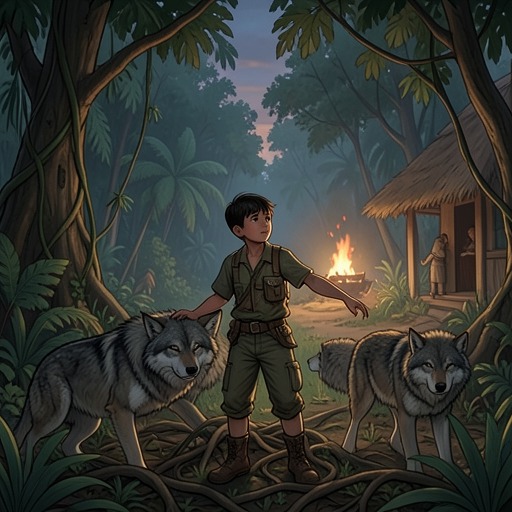
Gray Brother first appears at the edge of the village fields, where Mowgli has stretched himself in clean grass after a day of learning human speech and customs. The visit immediately exposes the tension in Mowgli’s new life. Mowgli smells of wood smoke and cattle, and Gray Brother notices that he is already beginning to resemble a man; yet the wolf addresses him as “Little Brother,” preserving the intimate language of the den. Gray Brother has followed him for twenty miles simply to bring news, a journey that establishes both his endurance and the seriousness of his attachment.
His arrival also confirms that Mowgli’s connection with the jungle has not been erased by his adoption into human society. Mowgli embraces him and asks whether all is well in the jungle, while Gray Brother worries that men may make him forget that he is a wolf. The exchange gives their relationship a double character: Gray Brother is a literal sibling through Mother Wolf’s family, but he is also the living reminder of an identity Mowgli is being forced to negotiate between the wolf pack and the village.
Guardian Between Two Worlds
Gray Brother becomes Mowgli’s regular watcher after the move into village life. Day after day, while Mowgli leads the buffaloes to their wallows, he sees Gray Brother’s back a mile and a half away across the plain. The distant figure functions as a signal that Shere Khan has not yet returned. Gray Brother does not intrude into Mowgli’s daily work, but his repeated presence gives the open grassland a hidden structure of vigilance: Mowgli appears to be a village herder, while the wolf silently maintains the jungle’s watch over him.
That watch is especially significant because Gray Brother understands that Shere Khan’s threat has not ended. Earlier, he reports that the tiger has gone away to hunt while his singed coat grows again and has sworn to lay Mowgli’s bones in the Waingunga. The warning preserves the continuity of the old conflict even while Mowgli is learning the names of household objects and adapting to human routines. Gray Brother therefore carries not only information but the memory of the unresolved enmity between Mowgli and Shere Khan.
Intelligence and the Approach of Conflict
When Gray Brother is absent from the usual signal place, Mowgli initially laughs and assumes that Shere Khan has still not returned. The apparent absence is revealed as a deception: Gray Brother has hidden for a month so that the tiger would believe Mowgli had been thrown off his guard. He then crosses the ranges and returns with precise information that Shere Khan has come back with Tabaqui, following Mowgli’s trail.
Gray Brother’s report is more than a general warning. He has personally met Tabaqui at dawn and killed him after forcing him to disclose the plan. Tabaqui’s cunning makes him dangerous as a scout and informer, but Gray Brother removes that danger before the main confrontation. He tells Mowgli that Shere Khan intends to wait at the village gate specifically for him and is lying in the large dry ravine of the Waingunga. The enemy’s ambush is thus transformed into a vulnerability: because Gray Brother has discovered the location and intention, Mowgli can choose the ground and prepare the buffaloes.
Role in Shere Khan’s Defeat
Gray Brother’s most consequential action comes during the buffalo drive. Mowgli mounts Rama and assigns Gray Brother a precise task: after the bulls have been driven away, Gray Brother must hold the cows together and force them toward the foot of the ravine. The cows are the more dangerous half of the herd because their calves are in the center and they are ready to charge anything that remains in their path. Gray Brother nevertheless runs directly before them, keeping them moving until the ravine walls are higher than Shere Khan can jump.
The command turns the herd into a weapon and depends on disciplined cooperation among Mowgli, Akela, and Gray Brother. Akela drives the bulls to the left, while Gray Brother separates and controls the cow-buffaloes. His work is physically perilous because the cows charge him as he leads them toward the ravine, but he maintains the division that makes the trap possible. Gray Brother’s loyalty therefore has a tactical form: he does not simply encourage Mowgli or accompany him; he executes the dangerous maneuver on which the plan depends.
Relationship with Mowgli and Narrative Significance
Gray Brother’s bond with Mowgli is marked by affection, anxiety, and trust. He calls Mowgli “Little Brother,” follows him over a great distance, and repeatedly checks whether human life is changing his sense of belonging. Mowgli answers this concern not by abandoning the village or denying his new circumstances, but by asking Gray Brother to continue bringing news. Their relationship thus allows Mowgli to remain connected to the wolves without pretending that his human experience has not altered him.
Within the larger narrative, Gray Brother occupies the role of an ally who carries the jungle across a social boundary. He is a witness to Mowgli’s separation from the wolves, a messenger who keeps the old danger visible, and a combatant whose knowledge and strength help bring the conflict with Shere Khan to its decisive end. The contrast between Gray Brother’s quiet surveillance across the plain and his ferocious encounter with Tabaqui captures his function precisely: he is patient when protection requires waiting, and violent when delay would endanger his brother. Through him, the wolf pack’s claim on Mowgli persists not as sentiment alone, but as an organized, watchful, and ultimately effective form of loyalty.