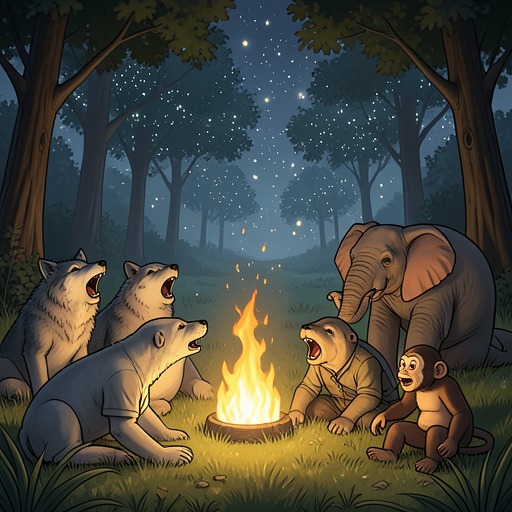
Hunting-Song of the Seeonee Pack
The Jungle BookThe Hunting-Song of the Seeonee Pack is a ritual hunting chant that gives the Seeonee Wolf Pack a shared voice and a shared method of reading the jungle. Its repeated cries follow the movement of a hunt from first light and startled prey to the discovery of a trail, the baying pursuit, and the pack’s collective command to make itself heard. The song is therefore both poetry and practical knowledge: it celebrates the senses that make wolves effective hunters while binding individual movement to communal action.
Form and Hunting Imagery
The song is organized around recurrence. The phrase “Once, twice and again!” returns after the dawn image and after the pack’s cry, making repetition sound like the measured continuation of a pursuit rather than ornamental singing. The opening places the hunt at daybreak, when the Sambhur gives its warning call and a doe leaps up. The song thus begins not with the hunters’ triumph but with the instant in which prey and predator enter the same field of attention.
Its central images define the wolf through signs of controlled physical power. The pack follows a track that leaves no mark, sees in darkness, and gives tongue when the pursuit requires a cry. “Feet in the jungle that leave no mark!” presents silence as an achievement; “Eyes that can see in the dark—the dark!” expands sight into an ability to inhabit conditions that conceal other creatures. The final command, “Tongue—give tongue to it! Hark! O hark!”, turns sound into a collective instrument. The wolf must be silent while tracking, yet audible when the pack’s knowledge has to be announced and shared.
Instruction and the Law of the Pack
The song is not merely a performance heard from outside the pack. In the period when Baloo teaches Mowgli the Law of the Jungle, the young wolves learn only the portion of the law applicable to their own pack and tribe; they run away as soon as they can repeat the Hunting Verse. Mowgli, because he is a man-cub, must learn much more. The Hunting-Song therefore marks the threshold between basic membership and the wider education required by an outsider who is being trained to move safely among many kinds of Jungle People.
The verse that the young wolves repeat identifies noiseless feet, dark-seeing eyes, wind-hearing ears, and sharp white teeth as marks of brotherhood, while excluding Tabaqui and the hyena from that fellowship. In this instructional setting, hunting skill becomes a system of classification. The song teaches what a brother is expected to possess, but the surrounding lesson also shows that the jungle contains boundaries, permissions, and obligations beyond the wolf pack’s immediate practice.
Baloo’s teaching extends from the Hunting-Song into the Wood and Water Laws. Mowgli learns to distinguish a rotten branch from a sound one, to speak politely to wild bees high above the ground, to address Mang the Bat when he disturbs him at midday, and to warn water-snakes before entering their pools. He also learns the Strangers’ Hunting Call, which must be repeated aloud until answered when a member of the Jungle People hunts outside its own grounds. The call asks permission to hunt because of hunger, and the answer permits food-hunting but forbids hunting for pleasure. Against this wider code, the Hunting-Song appears as the pack’s concentrated sensory grammar: it teaches how to pursue, while the Law teaches when and where pursuit is legitimate.
Collective Voice and Narrative Function
The chant changes private perception into public action. A Sambhur’s cry, a doe’s leap, an invisible trail, and the pack’s ability to see in darkness are separate discoveries until the song gathers them into one sequence. Its repeated “Once, twice and again!” gives the hunt a pulse and makes the pack’s memory reproducible: what one wolf knows can be voiced, answered, and taken up by all.
The song also establishes a contrast between disciplined animal society and the disorder associated with outsiders. The wolves’ noises are not random; even the command to give tongue belongs to a recognized pattern of tracking and response. In the same book, other songs carry different communal functions: a mother seal sings to protect a young seal from swimming too early, Shiv and the Grasshopper accompanies a human household lullaby, and the tale of Rikki-tikki-tavi opens by defining a war fought through the bath-rooms of a bungalow. The Hunting-Song belongs specifically to a social world in which knowledge is transmitted orally and survival depends upon coordinated relations among species and territories.
Its presence near Mowgli’s departure also gives the song a retrospective force. As dawn breaks, Mowgli leaves the hillside alone to meet human beings, while the pack’s hunting language remains associated with the jungle community from which his path is beginning to separate. The chant consequently stands for more than the mechanics of a chase: it is one of the audible forms of belonging that Mowgli carries from wolf education into the uncertain world of men.
Significance
The Hunting-Song presents the Seeonee Wolf Pack as a culture of attention. Its members are defined by what they can notice, what they can pursue without leaving a trace, and how they know when to remain silent or raise the alarm. The song’s compact structure makes those abilities memorable, but its repeated communal voice prevents them from becoming merely individual talents.
At the same time, the song helps distinguish local custom from the larger Law of the Jungle. The young wolves can recite its Hunting Verse and consider their lesson finished, whereas Mowgli must learn a more extensive body of knowledge governing branches, bees, bats, snakes, territory, hunger, and restraint. The chant is thus both complete within the pack and incomplete as a total education. Its deepest importance lies in that double role: it is the Seeonee Wolf Pack’s emblem of mastery, and the first clear measure of how much more Mowgli must learn to survive as a being who belongs partly to the pack and partly beyond it.