Kaa's Hunger Dance
The Jungle BookKaa's Hunger Dance is the climactic display of Kaa's power after the rescue of Mowgli from the Bandar-log. Performed at night among the ruins where the monkeys have been defeated, it turns a chaotic crowd into a helpless audience and reveals why Kaa is both an ally and a danger to the animals who stand near him.
Setting and Immediate Circumstances
The dance begins as the moon sinks behind the hills. The monkeys are gathered in trembling lines along the walls and battlements, while Baloo goes down to the tank for a drink and Bagheera puts his fur in order. Kaa glides into the center of the terrace and snaps his jaws together with a ringing sound that draws every monkey's eyes toward him. The setting therefore changes from the noisy aftermath of the rescue to a confined stage: walls, darkness, and the python's position at the center concentrate attention upon Kaa.
Kaa asks whether there is still enough light to see, and the monkeys answer that they can see him. He then announces the beginning of the Dance of the Hunger of Kaa and orders the Bandar-log to sit still and watch. The command is deceptively simple. The monkeys, who have been characterized by restless movement and disorder, are required to surrender movement itself before the dance has fully begun.
The Movement of the Dance
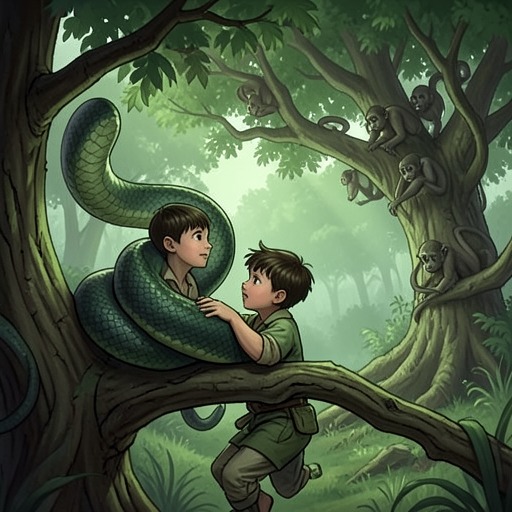
Kaa turns two or three times in a large circle, weaving his head from side to side. His body then forms loops and figures of eight, followed by soft, fluid triangles that dissolve into squares and five-sided figures, coiled mounds, and other constantly changing shapes. The movement is neither hurried nor interrupted. Kaa never rests, yet he does not rush; he maintains an unbroken motion accompanied by a low humming song.
The visual pattern gradually overtakes the scene. As the darkness deepens, the shifting coils disappear from sight, but the rustle of Kaa's scales remains audible. This withdrawal of visible form intensifies rather than diminishes his presence. The monkeys no longer need a fully seen body to remain fixed upon him: sound, rhythm, and the memory of the movement continue the dance after darkness has hidden its shape.
Enchantment and Command
Kaa finally addresses the Bandar-log and asks whether they can move a foot or hand without his order. They reply that they cannot. He commands them to come one pace nearer, and the lines of monkeys sway forward helplessly. Baloo and Bagheera take one stiff step with them, showing that the dance's influence extends beyond the intended victims and can reach powerful, experienced animals as well.
Kaa repeats the command to come nearer, and the whole group moves again. The episode presents fascination as a bodily submission rather than a reasoned agreement. The monkeys speak, but their answer merely confirms the loss of independent action; their bodies have already become responsive to Kaa's rhythm. The dance thus converts observation into obedience and turns a crowd into a single advancing formation.
Mowgli's Intervention and Escape
Mowgli recognizes the danger before Baloo and Bagheera can free themselves. He places his hands on both of them and pulls them away, causing the two great animals to start as though awakened from a dream. Bagheera tells Mowgli to keep a hand on her shoulder, warning that otherwise she will have to return to Kaa. Her words make clear that the spell has not ended simply because the animals have begun to retreat; physical contact with Mowgli provides the restraint that keeps her from being drawn back.
Mowgli, who does not understand the python's powers of fascination, reduces what he has seen to the sight of a large snake making circles in the dust. He leads Baloo and Bagheera through a gap in the walls and back into the jungle. Once safely beneath the trees, Baloo shakes himself and declares that he will never again make Kaa an ally. Bagheera remains more deeply affected, admitting that if she had stayed a little longer she would have walked down Kaa's throat. The escape therefore carries a double consequence: Kaa has saved Mowgli's companions from the Bandar-log, but his own predatory power has nearly made them victims.
Narrative Significance
The dance reverses the relationship between hunter and audience. The Bandar-log had been numerous, noisy, and difficult to control, yet Kaa's solitary body imposes silence, stillness, and direction upon them. His authority does not come from an announced law or a visible weapon. It emerges through repetition, darkness, bodily scale, and the gradual replacement of voluntary movement with compelled motion.
The scene also complicates Kaa's role as an ally. His knowledge and strength are indispensable to the rescue, but the same capacity that defeats the monkeys threatens Baloo and Bagheera. Mowgli's intervention preserves the distinction between assistance and surrender: Kaa can be used as an ally, but he cannot be approached without acknowledging that his help carries its own form of danger. The Dance of the Hunger of Kaa is consequently both a victory over the Bandar-log and a demonstration of the immense, morally neutral power that Mowgli's companions must learn to survive.