Kotick
The Jungle BookKotick is the White Seal, born into the immense colony at Novastoshnah with an appearance that immediately marks him as exceptional and eventually makes him the leader of a migration. His decisive significance lies in the way he turns difference into responsibility: after seeing what other seals have not seen, he refuses to accept slaughter as an ordinary part of seal life, searches for a refuge, and returns with a practical answer to a danger his elders regard as unavoidable.
Identity and Introduction
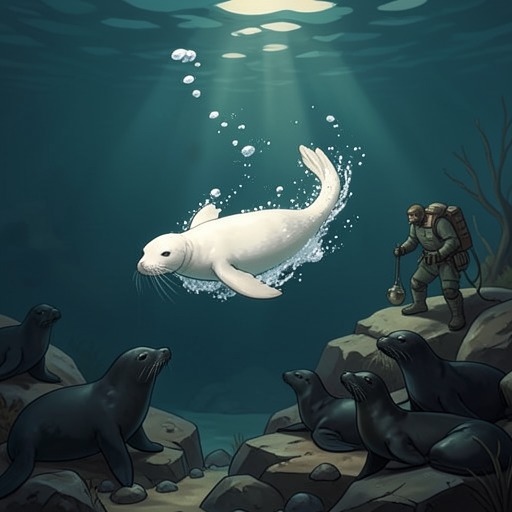
Kotick is born to Matkah in the middle of the crowded breeding season at Novastoshnah, where more than a million seals cover the beach amid fog, noise, fighting, play, and constant movement between land and sea. He is described as unusually large-headed and shouldered for a newborn, with pale, watery blue eyes, but it is his coat that makes Matkah examine him closely. She recognizes at once that the baby will be white, a condition Sea Catch rejects as impossible because no white seal has previously been known. Matkah nevertheless accepts the fact without hesitation, and Kotick enters the story as a biological anomaly whose body distinguishes him from the colony before his actions do.
The white coat becomes more than a physical curiosity. Because Kotick is visibly unlike the seals around him, his experiences do not settle easily into the colony's inherited explanations. His parents initially imagine the conventional future for him: growth, strength, a nursery on the beach, and eventual protection through adulthood. Yet the very feature that separates him from the others also helps make him a witness whose perspective cannot be absorbed into ordinary custom.
Witnessing Danger and Rejecting Custom
Kotick's moral and practical purpose emerges after he encounters the seal-killing grounds. When he returns to Novastoshnah, the other seals do not sympathize with his attempt to find a quiet place for the colony. They explain that men have always driven the holluschickie and treat the violence as part of the day's work. Their judgment rests partly on ignorance: none of them has seen the killing. Kotick has, and that direct knowledge creates the difference between him and his companions. His whiteness reinforces his isolation, but the decisive separation is ethical and experiential.
Sea Catch advises Kotick to grow into a large seal, establish a nursery, and wait roughly five years until he is strong enough to fight for himself. Matkah, though gentler, tells him that he will never be able to stop the killing and urges him to play in the sea instead. Kotick obeys only outwardly. He goes off with a heavy heart, and the contrast between the expected life of ordinary sealhood and his private alarm establishes the central conflict: inherited adaptation offers survival for an individual, while Kotick seeks safety for the whole community.
The Search for a Refuge
In autumn, Kotick leaves the beach alone, driven by the notion that he must find Sea Cow and a quiet island with firm beaches where seals can live beyond human reach. His quest is extensive rather than symbolic in scale: he explores the North and South Pacific, at times swimming as much as three hundred miles in a day and a night. The journey exposes him to predators and to the wider, often dangerous society of the sea, including the Basking Shark, the Spotted Shark, and the Hammerhead, as well as creatures whose habits and appearances differ radically from those of seals.
His search repeatedly turns on the evidence of human exploitation. Whenever Kotick finds a beach that is hard, well sloped, and apparently suitable for seals, he sees the smoke of a whaler on the horizon and understands what it signifies. Elsewhere he finds signs that seals once occupied an island but were killed off; he concludes that wherever men have come once, they will come again. The pattern defeats the easy solution of merely finding an attractive beach. Safety must mean not only physical suitability but lasting inaccessibility to human hunters.
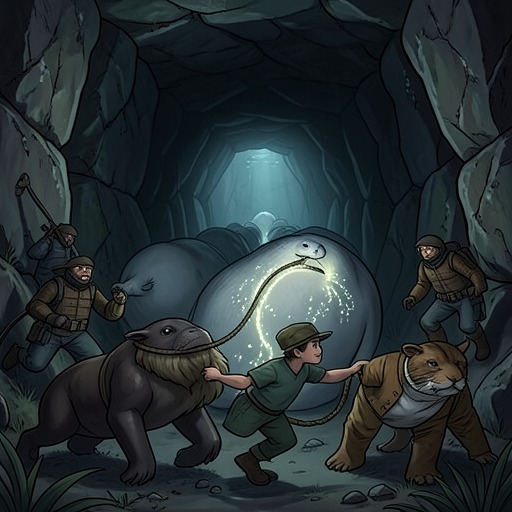
Kotick eventually recognizes Sea Cow after remembering the Burgomaster gull's earlier description of a creature said to be uglier and worse-mannered than Sea Vitch. The encounter initially appears absurd: the sea cows graze and bow in slow councils, cannot speak because Sea Cow has only six neck bones rather than seven, and communicate through the movement of an extra joint in the foreflipper. Yet their strange bodily limitation and silent code conceal the answer Kotick needs. Sea Cow leads him northward, and Kotick follows because he infers that creatures so slow and seemingly foolish could have survived only by discovering a safe island.
Leadership and Collective Migration
Kotick's discovery does not immediately persuade the seals. The decisive change comes when he returns and challenges them directly. After a violent struggle, Sea Catch, badly mauled, declares pride in his son and agrees to accompany him if the island exists. Kotick then calls upon the seals to follow him to the Sea Cow's tunnel. The response is first a murmur running along the beaches and then a collective commitment: thousands of tired voices agree to come with the White Seal.
A week later, Kotick leads nearly ten thousand holluschickie and old seals north to the tunnel. His authority is not inherited from age or established office; it is earned through experience, discovery, and physical courage. The seals who remain at Novastoshnah call the migrants idiots, showing that social recognition lags behind practical success. Kotick's leadership therefore requires both resistance to ridicule and willingness to act before the majority is convinced.
The migration unfolds gradually. The next spring, seals from Kotick's group meet the others off the fishing banks of the Pacific and describe the new beaches beyond the tunnel. More seals leave Novastoshnah, Lukannon, and other nurseries year after year. The movement is slow because the seals need time to reconsider familiar habits, but its persistence gives Kotick's discovery historical force: the refuge becomes not an individual escape but the basis of a broad relocation.
Change, Ending, and Narrative Significance
Kotick begins as Matkah's extraordinary baby and develops into a solitary explorer, then a returning challenger and finally the leader of a community. His transformation is measured not by abandoning his people but by refusing the limits they accept. Sea Catch and Matkah initially define adulthood as personal size and the ability to defend a nursery; Kotick expands that definition into the creation of conditions in which future nurseries can remain beyond human reach.
After the struggle that wins the seals' allegiance, Kotick is bloodied from head to tail, yet he proudly refuses to look at or touch his wounds. The image joins vulnerability and authority: the White Seal's body still bears the cost of leadership, but his injuries have become evidence that persuasion was backed by action. By the end, he sits throughout the summer on the quiet, sheltered beaches beyond the Sea Cow's tunnel, growing bigger, fatter, and stronger while the holluschickie play around him in waters where no man comes.
Kotick's ending is thus a collective deliverance rather than a private triumph. The seals do not all move at once, and the old nurseries are not erased in a single dramatic reversal. Instead, repeated testimony and repeated migration gradually alter the geography of seal life. Through Kotick, the narrative gives an animal community independent aims, memory, judgment, and political capacity: he sees, investigates, argues, fights, and reorganizes the conditions of survival. His white coat first isolates him as a curiosity, but the completed story makes it the emblem of a leader whose difference enables him to imagine a future his society has been taught not to seek.