Kotick discovers the Sea Cow's tunnel
The Jungle BookKotick discovers the Sea Cow's tunnel at the decisive turning point of his search for a safe home for the seals. After witnessing the killing grounds and finding that every promising island had either been visited by men or bore the evidence of an earlier exterminated nursery, he follows the Sea Cow northward and passes through a submerged passage into a hidden coast that appears secure from ships and hunters.
Causes and the Search for Safety
The discovery grows out of Kotick's refusal to accept the slaughter as an unavoidable part of seal life. When he returns to Novastoshnah after seeing the killing grounds, the other seals dismiss his concern: men have always driven the holluschickie, they say, and anyone unwilling to see ugly things should stay away from the killing grounds. Sea Catch advises Kotick to grow into a large adult seal, establish a nursery, and wait until men leave him alone; Matkah likewise tells him that he cannot stop the killing. Their practical resignation leaves Kotick isolated, and his being a white seal makes his experience still more singular among his companions.
That autumn Kotick sets out alone to find Sea Cow, if Sea Cow exists, and to locate a firm, quiet island where men cannot reach the seals. His search is physically immense: he explores from the North Pacific to the South Pacific and can swim as much as three hundred miles in a day and a night. He narrowly escapes the Basking Shark, the Spotted Shark, and the Hammerhead, encounters many other creatures, and repeatedly tests possible islands. Hard beaches are disqualified when a whaler's smoke appears on the horizon; other islands reveal that seals once bred there and were killed off, proving to Kotick that human arrival is likely to recur wherever it has happened once.
Meeting the Sea Cow
Kotick's second exploration begins after he has grown into a full-sized sea catch, with a curly white mane and the strength and fierceness of Sea Catch. He delays settling down despite Matkah's urging, saying that the seventh wave reaches farthest up the beach. After following a great shoal of halibut westward and sleeping on the ground swell toward Copper Island, he is awakened when his body bumps against a weed-bed. In the shoal water he sees enormous browsing creatures unlike any animal he knows: they are twenty to thirty feet long, lack hind flippers, possess shovel-like tails, and balance in deep water while solemnly bowing to one another.
At first Kotick treats the creatures as absurdly mannered strangers. They do not answer his questions, even when he addresses them in the languages learned during his travels. Then he suddenly remembers what the Burgomaster gull told him when he was a yearling at Walrus Islet and realizes that he has found Sea Cow. The apparent foolishness of the herd acquires a different meaning: these animals have survived not through speed or force but through knowledge of a route and refuge inaccessible to ordinary pursuers.
Sea Cow cannot speak because he has six bones in his neck rather than seven, but he communicates by moving an extra joint in his foreflipper in a clumsy telegraphic code. The herd travels north slowly, stopping for bowing councils and moving only forty or fifty miles a day. Kotick grows impatient and nearly bites off his mustache, yet he observes that the Sea Cow follows a warm current. The animals' slowness, which initially seems like stupidity, is therefore part of a careful environmental route-finding process.
The Submerged Passage
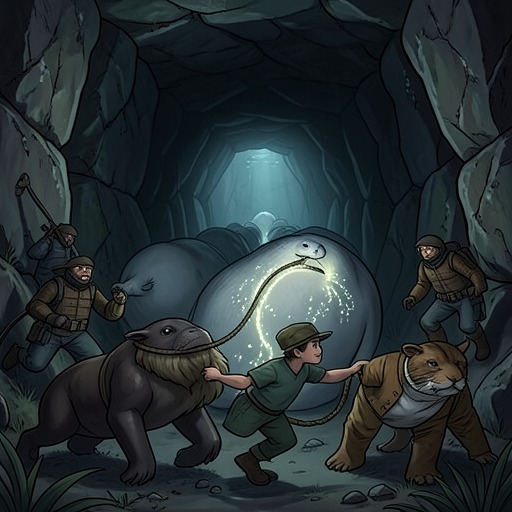
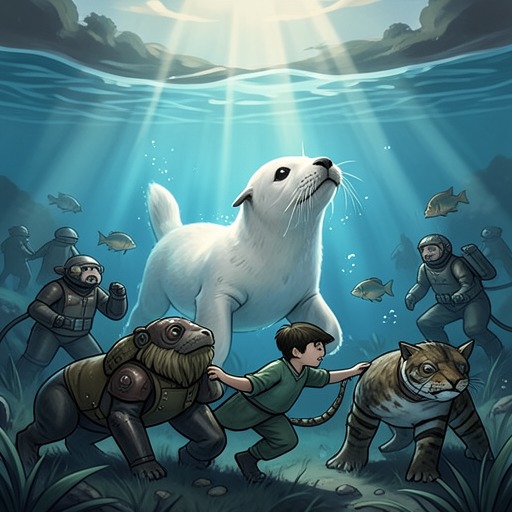
The crucial movement occurs at night. The Sea Cow herd suddenly sinks through the shining water and begins to swim at a speed that astonishes Kotick, who had not imagined that Sea Cow could swim so powerfully. The animals head toward a coastal cliff that falls into deep water, then plunge into a dark opening at its base twenty fathoms beneath the surface. Kotick follows them through the long underwater tunnel, enduring the difficult dive and longing for fresh air before reaching its far end.
When he surfaces, gasping and puffing, Kotick recognizes that the difficult passage has justified itself. The Sea Cows have led him to a coast of exceptionally suitable beaches: miles of smooth-worn rock for seal nurseries, hard sand sloping inland for play, rollers in which seals can dance, long grass for rolling, and dunes to climb. Most importantly, the water tells Kotick that no men have ever reached the place. The tunnel is not merely a concealed entrance; it is the route by which a vulnerable community can pass beneath the physical barriers that protect the shore.
The Hidden Rookery
Kotick immediately checks whether the new country can sustain seals by assuring himself that the fishing is good. He then surveys the coastline and counts low sandy islands partly concealed by rolling fog. Offshore, bars, shoals, and rocks extend in a line that would prevent a ship from coming within six miles of the beach. Between the islands and the mainland lies deep water reaching the perpendicular cliffs, while the mouth of the tunnel remains hidden somewhere below them.
The landscape answers every danger that defeated Kotick elsewhere. Unlike Novastoshnah, it offers not only excellent breeding ground but also natural defenses against ships, landing parties, and renewed human exploitation. Kotick judges that men could not descend the cliffs even if they reached them, while the offshore shoals would smash a ship to pieces. His conclusion is that if any place in the sea is safe, this is it. The discovery thus changes safety from a hope into a geographically demonstrable possibility.
Kotick nevertheless does not leave at once. Although he is eager to return to Novastoshnah and to the seal he has left behind, he thoroughly explores the new country so that he can answer every question about it. He dives to confirm the tunnel's entrance and races through it southward. The passage is so concealed that only a Sea Cow or a seal would have imagined its existence, and even Kotick, after emerging, can scarcely believe that he has traveled beneath the cliffs.
Consequences and Significance
The discovery gives material form to Kotick's rebellion against the older seals' fatalism. Sea Catch and Matkah define the slaughter as something an individual seal cannot stop; Kotick instead treats habitat as a problem that can be investigated, compared, and solved. His achievement depends on solitary endurance, long-distance travel, attention to ecological signs, and the ability to recognize that the Sea Cow's strange behavior conceals practical wisdom.
The tunnel also turns space into protection. Human violence dominates accessible beaches, while the hidden rookery lies behind cliffs, shoals, deep water, fog, and an underwater route known only to creatures capable of using it. Kotick's discovery therefore joins exploration to collective survival: he is not seeking a private escape but a place he can report, defend, and eventually offer to the wider seal community. The value shift is from threatened extinction to credible refuge, and the submerged tunnel is the precise hinge on which that change turns.