Kotick witnesses the seal slaughter
The Jungle BookKotick witnesses the seal slaughter at Novastoshnah and becomes the story’s decisive witness against a violence that the other seals accept only because they have not seen it. His first encounter with the killing grounds changes the meaning of the beach: the nursery is no longer merely a place of seasonal abundance, but part of a human system that drives, selects, clubs, and skins seals for commercial use. Because Kotick sees what his companions do not, horror becomes knowledge, and knowledge becomes a mission to find a refuge beyond human reach.
Setting and Human Enterprise
The event occurs at Novastoshnah, or North East Point, on Saint Paul Island in the Bering Sea, a summer gathering place where hundreds of thousands of seals arrive. Sea Catch, a huge fifteen-year-old gray fur seal, returns there each spring and fights for a place near the water, while the young seals play on the beach and treat the sea as their entire world. Against this expansive natural setting, the killing grounds reveal a sharply organized human enterprise.
Kerick Booterin, chief of the seal-hunters, and his son Patalamon come from the nearby village to select a drove of young seals. The men drive the seals much as sheep are driven, intending to turn their skins into seal-skin jackets. Their work is seasonal and quantified: the men expect to skin two hundred seals that day, though because it is the beginning of the season they decide that one hundred will be enough. The scale of the practice makes it ordinary to the workers even as it remains invisible to the animals who stay among the nurseries.
The Drive to the Killing Grounds
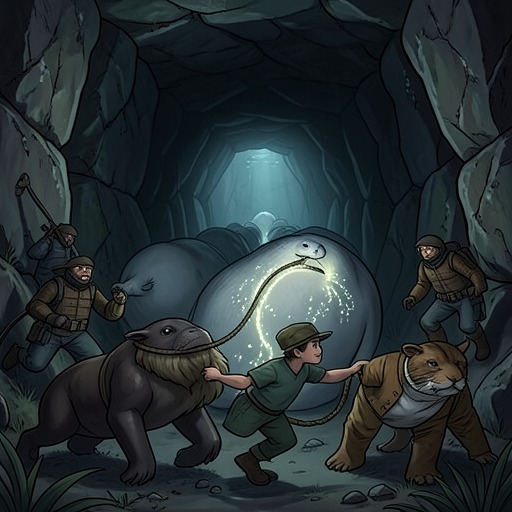
Patalamon rattles a pair of seal shoulder bones before a herd of holluschickie, and the sound makes them stop. Once he moves closer, the seals begin to follow, while Kerick heads them inland. The herd does not attempt to return to its companions, and the hundreds of thousands left on the beach continue playing as though nothing has happened. Kotick alone asks questions, but none of the other seals can explain more than the fact that men drive seals in this manner for six weeks or two months each year.
Kotick follows because he has never learned to treat the unexplained as normal. Patalamon is astonished that the white seal comes after the herd alone, while Kerick interprets him as an omen, calling him the ghost of Zaharrof, a seal-hunter lost in a gale. The men’s superstition does not interrupt their labor. It merely gives Kotick a strange status while the ordinary seals remain exposed to the same danger.
The half-mile journey takes an hour. Kerick deliberately keeps the herd slow so that the seals do not become heated; otherwise their fur would come off in patches when they were skinned. The procession passes Sea Lion’s Neck and Webster House before reaching the Salt House, beyond the sight of the beach. Kerick consults a heavy pewter watch and lets the drove cool for thirty minutes. The pause exposes the methodical character of the violence: killing is not a frenzy but a timed procedure designed to preserve the value of the skins.
Kotick’s Witnessing
Ten or twelve men arrive carrying iron-bound clubs three or four feet long. Kerick identifies seals that have been bitten by their companions or have grown too hot, and the men kick those animals aside in heavy boots made from walrus-throat skin. Then, at Kerick’s command, they club the seals on the head as quickly as possible. The selection process treats injury and temperature as practical criteria, while the clubs convert living bodies into manageable material.
The slaughter becomes fully intelligible to Kotick when the men rip the skins from his friends, from nose to hind flippers, and throw them into a pile. Only ten minutes earlier he had followed the herd with curiosity; afterward he can no longer recognize the seals he knew. The change is not simply emotional. His perception of the entire beach is reorganized by what he has seen: the familiar bodies of companions have been made unrecognizable by a process whose purpose is to produce usable skins.
Kotick turns and races back toward the sea, his new mustache bristling with horror. At Sea Lion’s Neck he throws himself into the cool water and gasps miserably. When a sea lion asks what is wrong, Kotick answers that he is lonely and that the holluschickie are being killed on all the beaches. His statement is immediately contradicted by the sea lion, who hears the continuing noise of the nurseries and dismisses the scene as merely old Kerick carrying out work he has performed for thirty years.
Isolation and Consequences
Kotick returns to Novastoshnah expecting sympathy, but the other seals tell him that men have always driven the holluschickie and that the practice is simply part of the day’s work. They advise him not to visit the killing grounds if he dislikes ugly sights. None of them has seen the slaughter, and that difference becomes the boundary between Kotick and his companions. Their acceptance is based not on approval grounded in knowledge, but on distance from the scene.
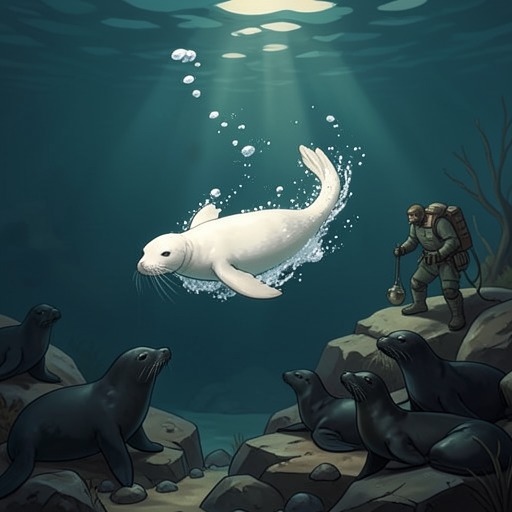
Kotick’s white coat intensifies his isolation. He is already visibly unlike the other seals, and his experience gives that difference an ethical dimension: he is the one who has seen what the community refuses to see. Sea Catch advises him to grow into a large seal, establish a nursery, and wait until he is strong enough to fight for himself. Even Matkah tells him that he cannot stop the killing and should return to play in the sea. Their counsel would preserve his place within the existing order, but it cannot erase the knowledge he has acquired.
That autumn Kotick leaves the beach as soon as he can. He sets out alone to find Sea Cow, if Sea Cow exists, and to locate a quiet island with firm beaches where seals can live beyond the reach of men. He explores the Pacific from north to south, sometimes swimming as much as three hundred miles in a day and a night. The search is the direct consequence of his witnessing: what began as an attempt to understand the men’s unexplained driving becomes a quest for a new home.
Narrative and Ethical Significance
The event gains force through its unequal distribution of knowledge. The seals on the beach hear the same general noise as before, but only Kotick has crossed the boundary between the nursery and the killing grounds. His testimony is therefore both personal and communal: he speaks for bodies that cannot return to explain what happened, while the surviving seals use the continuation of ordinary life as evidence that nothing extraordinary has occurred.
The slaughter also contrasts animal custom with human commodification. Sea Catch’s fights for breeding space are violent, but they are limited by the Rules of the Beach: he does not pursue a beaten seal. The seal-hunters, by contrast, organize violence around quantity, timing, transport, temperature, tools, and skins. The narrative does not present the killing as an isolated outburst; it presents a repeated system whose routine appearance helps conceal its victims.
Kotick’s witness turns seeing into responsibility. The other seals can remain inside inherited habit because they have not looked closely. Kotick cannot. His horror isolates him, but it also supplies the purpose that drives the remainder of his journey: to discover a rookery where the seal people will not have to depend on human restraint for survival. The event’s decisive significance lies in this conversion of perception into action. Once Kotick has recognized the killing grounds, the old beach can no longer be accepted as safe merely because it is familiar.